
Table of Contents
Key Takeaways
- The Market: Healthcare organizations need technology partners that can solve complex challenges around AI adoption, interoperability, security, and digital transformation.
- The Options: Each company brings different strengths. AVIZVA focuses on healthcare-specific engineering, Accenture on enterprise transformation, Cognizant on payer technology, GE HealthCare on clinical solutions, and others on modernization, AI, and infrastructure.
- The Decision: The right healthcare IT company depends on your goals, whether you need custom healthcare solutions, system modernization, better data connectivity, or enterprise-scale technology support.
- The Best Fit: The ideal partner depends on your organization’s priorities, technical requirements, healthcare expertise needs, and long-term transformation goals. Evaluate providers based on their domain experience, interoperability capabilities, security approach, scalability, and ability to support your specific use cases.
The United States represents the largest market for digital healthcare transformation in North America, accounting for over 60% of the regional market share. This dominance is driven by a dense network of healthcare providers and insurers, coupled with the widespread adoption of advanced technologies.
However, despite this momentum, healthcare enterprises in the US continue to encounter significant challenges in integrating digital solutions into their business operations. Data security and consumer privacy become critical concerns amid a growing wave of cyberattacks targeting the sector. Additionally, limited interoperability between systems continues to hinder effective data sharing and coordinated care delivery.
To successfully navigate these obstacles and drive digital transformation, healthcare enterprises must partner with the right healthcare IT service providers. This guide compares top healthcare IT companies in the USA that are positioned to help businesses innovate and improve operational efficiency.
Top Healthcare IT Companies Compared: Features, Expertise & Best Use Cases
| Company | Category | Key Expertise | Best Use Cases |
| AVIZVA | Healthcare Technology & Digital Engineering | AI, interoperability, portals, microservices, custom healthcare engineering | Healthcare enterprises (Payers, TPAs, PBMs) and IT teams seeking rapid development, high-quality, secure solutions, and healthcare-aware AI implementations |
| Accenture | Healthcare Consulting & Digital Transformation | Cloud transformation, AI and data, digital health, technology consulting | Large healthcare enterprises planning enterprise-wide digital transformation and cloud modernization |
| UST | Healthcare Technology & Engineering Services | Interoperability, EHR services, cybersecurity, AI, digital engagement | Healthcare organizations modernizing EHR environments, improving interoperability, or strengthening digital engagement |
| GE HealthCare | Medical Technology & Digital Healthcare Solutions | Digital healthcare, AI-enabled operations, enterprise imaging | Health systems and providers seeking connected clinical technologies, imaging solutions, and data-driven operational improvements |
| Cognizant | Healthcare IT Services & Payer Technology | Payer core administration, interoperability, reimbursement, member and provider experiences | Health plans modernizing core administration, claims, payer-provider data exchange, and digital experiences |
| Infosys | Healthcare IT Consulting & Digital Services | AI and automation, cloud, data modernization, payer and provider transformation | Healthcare enterprises modernizing legacy platforms and introducing cloud, AI, automation, and data capabilities |
| IBM | Enterprise AI, Hybrid Cloud & Technology | Enterprise AI, hybrid cloud, automation, data, cybersecurity | Healthcare enterprises requiring enterprise-scale AI, infrastructure modernization, hybrid cloud, and security capabilities |
Top 7 Healthcare IT Services Companies In 2027
Let us explore the top 7 healthcare software development companies in the USA.
1. AVIZVA
Category: Healthcare Technology & Digital Engineering
AVIZVA is a healthcare technology company that enables Payers, TPAs & PBMs to simplify, accelerate, and optimize care delivery. Established in 2011 and with 15 years of deep healthcare expertise, the company helps enterprises realize their business vision by offering them quality engineering that can improve their speed to market, along with a rich suite of proprietary products helping them solve common healthcare challenges.
With a proven track record of long-standing client partnerships and 150+ bespoke product deliveries, its engineering excellence spans designing and developing self-service experience products, managing data integration across external parties and internal systems, building innovative, industry-first products such as an in-flight drug pricing arbitrage engine, and much more.
Areas of Expertise
- Artificial Intelligence: The company’s AI capabilities empower enterprises to kickstart their AI journey or expand their existing capabilities with highly compliant and healthcare-aware implementations. From managing routine consumer queries with Generative AI, analyzing complex health records using Document AI, to delivering personalized health recommendations through Predictive AI, its AI experts seamlessly integrate cutting-edge intelligence and automation into healthcare ecosystems, improving operational efficiency and enhancing healthcare outcomes.
- Interoperability: Built on next-generation architecture, the company’s interoperability solutions efficiently handle all types of healthcare data – including claims, eligibility, benefits, accumulators, and prior authorizations- across diverse healthcare data formats such as HL7, CCDA, FHIR, EDI X12, IHE, DICOM, NCPDP, ICD-10, and QRDA. These solutions provide enterprises with real-time visibility and control over data as it moves across systems, all while keeping up the highest standards of data security and compliance.
- Portals: From web to native solutions, the organization specializes in building portals that centralize information and actions, bringing everything to users’ fingertips. Powered by robust, future-proof technology and designed with best-in-class industry standards, its portal solutions are engineered for personalization and scalability. In addition to supporting secure and seamless third-party integrations, the portal solutions ensure the highest levels of compliance.
- Microservices: The healthcare software development team brings a rich experience in developing high-performance data microservices tailored to the unique needs of healthcare enterprises. This accelerates API development while ensuring quality and consistency. Their pre-built API templates cover essential healthcare data needs, including Claims, Member & Eligibility, Provider Network, Billing & Payments, and Regulatory Compliance APIs, saving months of effort.

The AVIZVA Difference
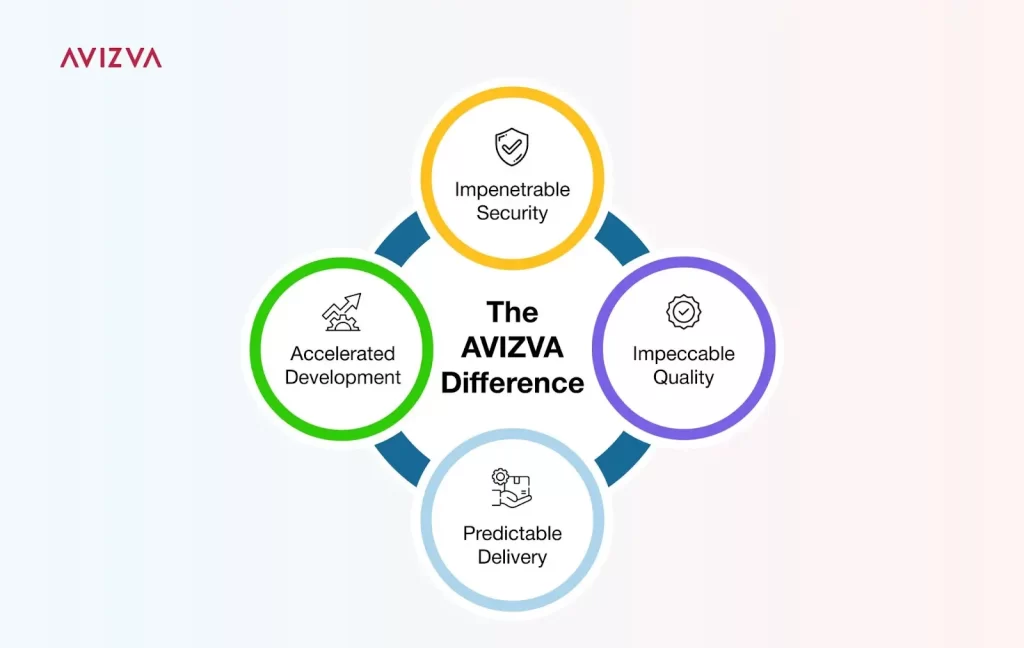
- Accelerated Development: Pre-packaged, proprietary Software Development Kits (SDKs) for User Experience, Microservices, and Integration applications help streamline development while maintaining consistency and quality. These frameworks enable teams to reduce development effort and bring healthcare solutions to market faster.
- Security & Compliance: Security controls should be embedded across the design, development, and deployment lifecycle. Strong healthcare applications incorporate access controls, encryption, compliance requirements, audit capabilities, and continuous monitoring to protect sensitive data and provide visibility into system activity.
- Quality Engineering: Quality practices should be integrated throughout the development process to improve reliability, automation, and compliance. AI-powered frameworks can help identify bottlenecks, optimize testing workflows, and maintain software performance as healthcare systems scale.
- Predictable Delivery: Large-scale healthcare implementations require clear visibility into progress, dependencies, and delivery timelines. Automated planning and reporting frameworks help teams track execution, manage risks, and support scalable deployments with greater predictability.

2. Accenture
Category: Healthcare Consulting and Digital Transformation
Accenture is a global technology and consulting company that helps healthcare organizations modernize operations, technology, and digital experiences. Its healthcare capabilities span payers, providers, and public health organizations, combining cloud, data, AI, and consulting expertise to support large-scale digital transformation.
Areas of Expertise
- Healthcare AI and Data: Accenture helps healthcare organizations apply AI, generative AI, analytics, and data technologies to improve decision-making, automate processes, and make healthcare data more useful across operations.
- Cloud Transformation: Accenture supports healthcare organizations in modernizing legacy infrastructure and moving applications and workloads to cloud environments. For payers, these capabilities extend across areas such as claims, enrollment, provider operations, and member experiences.
- Digital Health Experiences: Accenture helps organizations create connected digital experiences by bringing together healthcare data, workflows, and digital channels for patients, members, and healthcare professionals.
3. UST
Category: Healthcare Technology and Engineering Services
UST provides digital technology and engineering services for healthcare organizations, including payers, providers, medtech companies, and other healthcare enterprises. Its healthcare capabilities cover interoperability, cloud transformation, cybersecurity, AI, EHR services, and digital engagement.
Areas of Expertise
- Healthcare Interoperability: UST helps healthcare organizations connect applications and exchange healthcare information across systems, supporting greater accessibility and use of data across healthcare workflows.
- EHR Services: UST provides EHR implementation, optimization, integration, interoperability, analytics, training, and go-live support to help healthcare organizations improve their clinical technology environments.
- Healthcare Cybersecurity: UST combines cybersecurity services with healthcare-specific requirements to help organizations protect sensitive information, manage threats, and strengthen compliance.
- Digital Engagement: UST uses digital technologies, AI, and behavioral science to help healthcare organizations deliver more personalized and connected consumer experiences.
4. GE HealthCare
Category: Medical Technology and Digital Healthcare Solutions
GE HealthCare is a healthcare technology company with capabilities spanning medical devices, diagnostics, AI, and digital healthcare solutions. Its digital portfolio helps healthcare providers connect clinical and operational information, optimize workflows, and use data more effectively across healthcare environments.
Areas of Expertise
- Digital Healthcare Solutions: GE HealthCare provides software and digital solutions that connect healthcare data and use analytics to support clinical and operational decision-making.
- AI-Enabled Operations: Its Command Center technology uses AI-enabled applications to help health systems manage patient flow, capacity, staffing, and other operational processes.
- Enterprise Imaging: GE HealthCare provides enterprise imaging technologies designed to connect imaging information and workflows across departments and healthcare organizations.
5. Cognizant
Category: Healthcare IT Services and Payer Technology
Cognizant provides healthcare IT services and technology solutions across payer and provider organizations. Its healthcare portfolio includes core administration, interoperability, digital experiences, AI, data modernization, and healthcare operations, with its TriZetto portfolio providing specialized technology for health plans.
Areas of Expertise
- Payer Core Administration: Cognizant’s TriZetto portfolio includes healthcare administration platforms such as Facets and QNXT that support health plans across core administrative processes.
- Healthcare Interoperability: Cognizant provides FHIR-based capabilities designed to improve information exchange between payer platforms, provider systems, and EHR environments.
- Provider Reimbursement: Its TriZetto portfolio includes capabilities for claims pricing, contract modeling, payment bundling, and other provider reimbursement processes.
- Member and Provider Experiences: Cognizant helps health plans build digital experiences that give members and providers better access to healthcare information and services.
6. Infosys
Category: Healthcare IT Consulting and Digital Services
Infosys provides technology consulting and digital services for healthcare payers, providers, and health technology organizations. Its healthcare capabilities combine cloud, AI, automation, data, interoperability, and platform modernization to help enterprises update existing systems and improve healthcare operations.
Areas of Expertise
- Payer Transformation: Infosys works with health plans on technology and operational transformation across different areas of the payer value chain.
- AI and Automation: Infosys applies AI, generative AI, and automation to healthcare processes to reduce manual work, improve productivity, and support more intelligent workflows.
- Cloud and Data Modernization: Infosys helps healthcare organizations modernize legacy technology and establish cloud and data environments that can support changing business requirements.
- Provider Technology Services: Its healthcare capabilities include EHR-related services and clinical technology transformation for healthcare providers.
7. IBM
Category: Enterprise AI, Hybrid Cloud, and Technology
IBM provides enterprise technology that healthcare organizations can use to modernize infrastructure, manage data, strengthen cybersecurity, and introduce AI across business operations. Unlike a dedicated healthcare software vendor, IBM’s current relevance to healthcare primarily comes from its broader enterprise AI, hybrid cloud, automation, and security technologies.
Areas of Expertise
- Artificial Intelligence: IBM’s Watson portfolio provides enterprise AI capabilities for building, deploying, and governing AI applications and models, which healthcare organizations can apply to appropriate enterprise use cases.
- Hybrid Cloud: IBM’s hybrid cloud technologies help enterprises connect applications, infrastructure, and data across cloud and on-premises environments.
- Data and Automation: IBM provides data management and automation technologies that can help organizations integrate information, automate workflows, and modernize complex enterprise processes.
- Cybersecurity: IBM provides enterprise security technologies and services designed to help organizations protect applications, identities, infrastructure, and sensitive data.
How to Select the Right Healthcare Technology Company
Choosing among healthcare technology companies requires more than comparing service lists or development costs. The right partner should understand the operational, regulatory, and technical realities of healthcare and be able to support the organization as its technology needs grow.
A few factors deserve closer attention:
- Healthcare Domain Expertise: Look for a company with proven experience in healthcare software, workflows, and regulatory requirements. A partner that understands healthcare operations is better equipped to design solutions around real business and user needs.
- Security and Compliance: Healthcare technology solutions must protect sensitive data and support requirements such as HIPAA. Evaluate the provider’s approach to encryption, access controls, security testing, audits, and ongoing compliance rather than treating security as an afterthought.
- Interoperability and Integration Capabilities: Healthcare systems rarely operate independently. The provider should be able to connect new solutions with EHRs, existing applications, and other healthcare platforms while supporting standards such as HL7 and FHIR where required.
- Proven Delivery Experience: Review case studies, previous healthcare implementations, client references, and the functionality of solutions the company has already delivered. This helps validate whether its capabilities match the complexity and scale of your requirements.
- Scalability and Long-Term Support: A healthcare platform should be able to support growing data volumes, users, integrations, and new capabilities without requiring constant redevelopment. It is equally important to understand what monitoring, maintenance, security updates, and enhancements are available after deployment.
- Transparent Development and Delivery: Evaluate how the company manages development, communication, timelines, and project visibility. A clearly defined delivery process makes it easier for healthcare enterprises to track progress, manage dependencies, and reduce implementation risk.
Cost should still be considered, but it should be evaluated alongside implementation quality, integration requirements, customization, ownership, maintenance, and ongoing support. The lowest upfront quote may not represent the best long-term value if the solution later requires extensive rework or additional integrations.
For healthcare enterprises, the strongest healthcare IT solutions providers are therefore those that combine technical capabilities with healthcare expertise, security, interoperability, scalability, and predictable delivery.
Conclusion
Healthcare enterprises embarking on their digital transformation journey should partner with a technology company that provides solutions ensuring accelerated development, impenetrable security, impeccable quality, and predictable delivery.
Accelerated development improves time to market, while impenetrable security ensures robust protection for sensitive healthcare data. Impeccable quality guarantees high-performing solutions that optimize automation, ensure compliance, and maintain reliability. Predictable delivery ensures consistent, on-time results with scalable solutions that evolve alongside the organization’s needs.
If you’re seeking healthcare IT companies that excel in all these areas, AVIZVA is the ideal choice. With deep expertise in AI, interoperability, portals, and microservices, the company is uniquely positioned to drive innovation and enhance efficiency within the healthcare sector.
Take the next step in your healthcare digital transformation. Get in touch with AVIZVA today and discover how they can help you achieve your business goals.
FAQs
1. How do healthcare IT companies support digital transformation?
Healthcare IT solutions companies support digital transformation by enhancing operational efficiency, patient care, and administrative processes with technologies such as EHRs, AI-powered analytics, and cloud-based solutions.
2. Which healthcare IT company offers AI-powered solutions?
Many top healthcare IT companies provide AI-based solutions. AVIZVA offers AI-based tools that assist in data integration, predictive analytics, and clinical decision-making for better member outcomes.
3. Are there healthcare IT companies that specialize in insurance?
Yes, a few healthcare IT companies specialize in insurance, including AVIZVA, which offers AI-powered platforms for claims management, risk evaluation, and compliance with standards including HIPAA.
4. How do top firms like AVIZVA improve care delivery?
Top firms like AVIZVA improve care delivery by integrating AI, data interoperability, and scalable microservices into healthcare operations, enabling providers access to real-time patient data, optimizing workflows, and crafting more personalized and efficient care.
5. How does AVIZVA compare to other healthcare IT companies in the USA?
AVIZVA stands apart in focusing on advanced AI-powered solutions, data integration, and solid interoperability that allow healthcare enterprises to accelerate their digital transformation, optimize their operations, and gain more efficient customer care, more specialized than many other competitors.
6. How do healthcare technology solutions improve patient engagement?
Healthcare technology solutions improve patient engagement by making care more accessible, connected, and personalized. Tools such as patient portals, telehealth, automated reminders, wearables, and secure messaging help patients communicate with providers, manage appointments, monitor their health, and participate more actively in their care.
7. Who should partner with healthcare IT solutions providers?
Healthcare providers, payers, and organizations planning digital health initiatives should consider partnering with healthcare IT solutions providers. The right partner can help organizations modernize systems, develop custom solutions, strengthen security and compliance, integrate healthcare technologies, and support ongoing maintenance.
8. What makes a reliable healthcare software vendor?
A reliable healthcare software vendor combines healthcare expertise with strong technical, security, integration, and support capabilities. Organizations should evaluate vendors based on their industry experience, proven implementations, ability to meet healthcare requirements, integration capabilities, scalability, and long-term support.