
Table of Contents
Key Takeaways
- The Problem: Healthcare insurers often struggle with fragmented data, manual workflows, delayed decisions, rising fraud risks, and inconsistent member engagement.
- The Shift: Forward-looking insurers are using predictive analytics and AI to move from reactive operations to proactive, data-driven decision-making.
- The Fix: Predictive analytics helps insurers improve claims management, risk assessment, fraud detection, compliance, underwriting, and personalized member engagement through real-time insights.
- Keep reading to: Learn how predictive analytics in healthcare insurance helps enterprises reduce costs, improve operational efficiency, strengthen compliance, and deliver better member experiences.
The U.S. healthcare insurance landscape is evolving at an unprecedented pace. Yet many insurers find themselves unequipped to keep up. Without the right tools and technology, they are caught in a persistent cycle of fragmentation and inefficiency.
Core business functions like claims processing, plan administration, fraud detection, and consumer service continue to operate in isolated systems. This siloed infrastructure delays access to critical data, obstructs comprehensive visibility, and makes real-time decision-making nearly impossible. As a result, fraud often goes undetected until after the damage is done, operational costs rise unnecessarily, and enterprises struggle to maintain regulatory compliance.
The root of this challenge lies in the inability to integrate systems and analyze data in real time. In today’s high-stakes environment, that gap is more than a technical inconvenience, it’s a strategic risk.
This is where modern predictive analytics in healthcare changes the game. By consolidating and analyzing enterprise data in real time, predictive tools:
- Flag fraud as it happens.
- Deliver early warning signals for emerging risks.
- Enable seamless, automated claims processing.
- Bring accuracy and foresight into every decision.
With an integrated, real-time view of all enterprise data, insurers can shift from reactive problem-solving to proactive foresight – lowering costs, increasing efficiency, improving compliance, and enhancing consumer experiences.
With an integrated, real-time view of all enterprise data, insurers can shift from reactive problem-solving to proactive foresight – lowering costs, increasing efficiency, improving compliance, and enhancing consumer experiences.
This blog explores the top challenges predictive analytics in healthcare insurance solves and how data forecasting is reshaping risk and cost management.
What Makes Predictive Analytics in Healthcare a Game-Changer?
Predictive analytics empowers healthcare insurers to anticipate challenges before they arise. Acting as an intelligent assistant, it leverages historical claims data and current trends to identify early warning signs,whether it’s rising costs, potential fraud, or emerging risks and enables timely intervention to prevent escalation.
Beyond risk detection, the role of predictive analytics in healthcare is to accelerate claims processing, enhance fraud prevention, and help maintain cost control. By shifting from reactive decision-making to proactive forecasting, insurers can stay ahead in a rapidly evolving industry and deliver better outcomes and operational efficiency.
Data : The Foundation Of Effective Predictive Models
Behind every accurate prediction lies comprehensive, high-quality data. The effectiveness of any predictive analytics initiative depends on the depth, diversity, and reliability of the data used.
For healthcare insurers, this means integrating information from multiple sources to form a complete, actionable picture:
- Claims Data: Reveals treatment patterns, utilization trends, and billing anomalies.
- Member Demographics and Medical History: Supports accurate risk assessment and personalized care strategies.
- Provider Performance and Network Data: Evaluates service quality and operational efficiency across the network.
- External Factors: Includes regulatory changes, economic conditions, and market dynamics that influence healthcare delivery and costs.
When these data sources are unified and analyzed, they unlock meaningful insights that support smarter decisions and drive measurable impact.
What Hidden Bottlenecks Are Hurting Health Insurers Today?
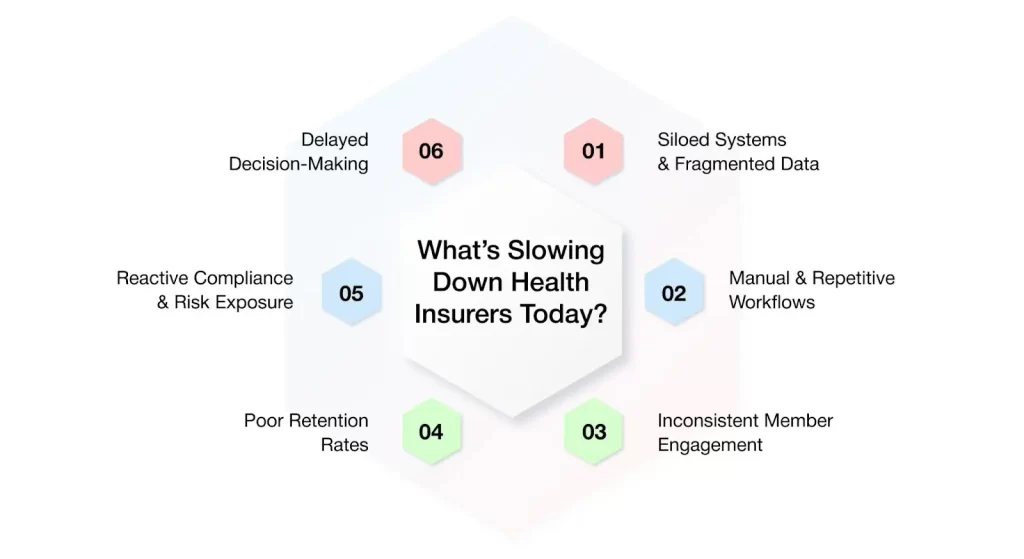
Healthcare insurers today face mounting challenges such as rising operational costs, increasing business complexity, and growing member expectations. It’s not a lack of effort from teams that’s holding enterprises back; its outdated systems and manual processes that limit efficiency and responsiveness.
The good news is that predictive analytics is reshaping the healthcare insurance landscape. By leveraging data-driven insights, insurers can streamline operations, reduce inefficiencies, and shift their focus on what truly matters delivering better care, enhancing service quality, and staying competitive in a rapidly evolving market.
1. Siloed Systems And Fragmented Data
One of the most persistent challenges faced by healthcare insurers is the reliance on disconnected systems across the enterprise. Functions such as claims, underwriting, customer service, and compliance often operate in isolation, with limited integration or data sharing. As a result, critical information becomes trapped in silos.
For example, a claims team may not have access to a member’s complete health history or relevant provider information, leading to time-consuming manual searches, greater potential for errors, and delayed decision-making.
Predictive analytics in healthcare helps insurers make better use of the data available across these systems by identifying patterns and forecasting outcomes. Rather than relying solely on historical information or manual assessments, it enables teams to anticipate member needs, and potential risks in advance.
2. Manual And Repetitive Workflows
Many insurers still rely heavily on manual workflows, particularly in high-volume processes like claims handling. These repetitive tasks drain time and resources and significantly increase the risk of human error.
Consider a claims processor handling hundreds of submissions a day. Without intelligent automation, it’s easy to overlook red flags like duplicate charges, unusual billing patterns, or policy misapplications.
Predictive analytics in healthcare using AI addresses this challenge by continuously analyzing historical and real-time data to surface irregularities and potential problems early. This enables faster, more accurate decisions, reduces errors, and allows teams to redirect their efforts toward tasks that add greater strategic value.
3. Inconsistent Member Engagement And Poor Retention Rates
Today’s members expect more than just plan coverage, they want personalized, timely, and relevant interactions that reflect their unique health needs. When communication feels generic or disconnected, members are less likely to engage with their plans or take advantage of the support available to them.
Consider a member managing a chronic health condition. Without proactive, personalized outreach, they may miss critical information or resources that could improve their outcomes.
Predictive analytics healthcare companies help solve this challenge by enabling insurers to better understand individual member behaviors, preferences, and health needs. By uncovering key insights and anticipating future needs, it allows insurers to deliver the right message at the right moment—whether it’s promoting preventive care, offering tailored health guidance, or providing ongoing support for complex conditions.
This level of personalization builds trust, increases engagement, and strengthens long-term member loyalty.
4. Reactive Compliance and Risk Exposure
Regulatory compliance is a non-negotiable part of healthcare insurance, but for many insurers, staying compliant remains a reactive, labor-intensive process. Teams often rely on spreadsheets, manual checklists, and siloed documentation to manage everything from privacy requirements to claims accuracy. This fragmented approach not only drains time and resources but also increases the risk of non-compliance, penalties, and reputational damage.
Predictive analytics transforms compliance from a reactive task into a proactive strategy. By providing real-time visibility into data and processes, it enables insurers to detect anomalies, monitor regulatory risks, and flag potential issues before they escalate. This improves audit readiness, strengthens internal controls, and ensures compliance efforts are embedded into daily operations, not managed in a last-minute rush.
5. Delayed Decision-Making
Many healthcare insurers still rely on retrospective reports to guide decision-making. However, by the time trends like rising claims costs or shifting market conditions become evident, the opportunity for impactful action may have already passed.
Predictive analytics in healthcare changes that. By identifying emerging patterns and potential risks early, predictive analytics in healthcare empowers insurers to make proactive, data-driven decisions. From adjusting plan designs and pricing to anticipating care needs or launching targeted wellness initiatives, predictive insights support more agile strategies driving better financial performance and stronger member satisfaction.
Reshaping Healthcare With Predictive Analytics and AI
AI-powered predictive analytics in healthcare is evolving rapidly,delivering greater speed, accuracy, and intelligence than ever before. It’s no longer limited to analyzing historical trends. Today, it enables insurers to gain real-time insights and anticipate what’s coming next.
By leveraging machine learning and live data streams, insurers can accelerate decision-making, automate routine processes, and deliver more personalized experiences to their members.
But what does that actually look like in day-to-day operations?
AI-powered predictive analytics is helping healthcare insurers work smarter by:
- Predicting high-risk members to enable early interventions and reduce claim costs
- Identifying members likely to churn or switch providers to improve member retention strategies
- Recommending next-best actions based on behavioral and health data insights
- Predicting inactive members likely to disenroll, and assistance in policy renewals
- Projecting premium adjustments using predictive modeling
Let’s explore each of these in greater depth.
1. Smarter Underwriting & Product Pricing
Underwriting is no longer a game of guesswork. With predictive analytics, insurers can tap into real-world data such as claims history, lifestyle patterns, and care utilization to gain a more accurate and clear understanding of individual health risks.
Here’s how predictive analytics transforms underwriting and pricing :
- More accurate risk scoring based on actual behaviors and benefit usage
- Personalized pricing that reflects individual risk, not just generalized averages
- Improved forecasting of reserves and potential losses, strengthening financial planning
This results in smarter, more equitable pricing models that are grounded in real behavior leading to healthier margins, fairer premiums, and more sustainable healthcare insurance products.
2. Proactive Claims Management
Claims management doesn’t have to be slow or reactive. Predictive analytics empowers insurers to get ahead of issues before they escalate, streamlining processes, reducing friction, and improving outcomes for both the insurer and the member.
Here’s how predictive analytics revamps claims management:
- Early identification of claims likely to be denied or appealed, enabling preemptive resolution
- Fraud detection by spotting suspicious patterns and red flags before they become serious issues
- Process optimization by identifying bottlenecks and inefficiencies to speed up claims handling
The result is faster approvals, fewer errors, and a smoother, more transparent experience for all healthcare insurance stakeholders.
3. Personalized Member Engagement
Today’s members expect more than just coverage, they want proactive, personalized support. Predictive analytics enables insurers to meet this expectation by using data-driven insights to guide meaningful interactions and improve health outcomes.
Here’s how predictive analytics elevates member engagement:
- Proactive nudges that encourage continued participation in wellness and preventive care programs
- Timely reminders for screenings, checkups, or prescription refills, delivered through preferred communication channels
- Targeted interventions by identifying high-risk members and connecting them to care teams before issues escalate
The result is outreach that feels personal, not generic, leading to stronger member relationships, higher satisfaction, and improved retention.
4. Intelligent Risk Stratification
Not all health risks are obvious at first glance. Predictive analytics gives insurers a comprehensive view of member health by analyzing data from care visits, prescriptions, and past claims helping identify those at risk before costly events occur.
Here’s how predictive analytics enhances risk stratification:
- Real-time risk scoring based on integrated clinical, behavioral, and utilization data
- Proactive intervention by care teams to manage conditions before they escalate
- Avoidance of high-cost events like emergency room visits and hospital admissions
This shift from reactive care to proactive prevention leads to better health outcomes for members and significantly reduced costs for insurers. It’s not just about treating illness it’s about anticipating risks and staying one step ahead to improve long-term health outcomes.
5. Optimized Utilization & Network Performance
Inefficient use of provider services can drive up costs and reduce the quality of care. Predictive analytics empowers insurers to assess how their networks are performing and make informed decisions to optimize utilization across the board.
Here’s how predictive analytics improves utilization and network management:
- Identify under- or over-utilized providers to balance care delivery and reduce waste
- Spot inefficiencies in service usage to streamline operations and improve member access
- Detect coverage gaps across geographic regions or specialties to enhance network adequacy
The result is a more efficient, better-aligned provider network, ensuring members receive the right care, in the right place, at the right time, while keeping costs under control.
6. Streamlined Compliance Management
Healthcare regulations are complex, constantly evolving, and non-negotiable. Staying compliant without slowing down operations is a major challenge, but predictive analytics can help insurers stay ahead of the curve.
Here’s how predictive analytics strengthens regulatory and compliance readiness:
- Automated rule enforcement to ensure adherence to CMS, HIPAA, and other regulatory standards
- Real-time error detection that flags missing or incorrect data before claims are submitted
- Comprehensive audit trails that support internal reviews and external audits with ease
The result is a more resilient and responsive compliance process that reduces risk, minimizes manual effort, and ensures smoother day-to-day operations.
AVIZVA: The AI Engine Behind Smarter Health Insurance
In today’s healthcare insurance landscape, insurers, TPAs, and PBMs struggle with fragmented data, reactive decision-making, and overwhelming manual dependence in areas where prediction should be driving the workflow.
Claims leakages, rising risk profiles, member churn, and compliance pressures persist largely because traditional systems only respond to events, they don’t anticipate them. This is exactly where predictive analytics becomes a game-changer, and where AVIZVA emerges as the most powerful enabler.
AVIZVA’s healthcare offerings are grouped into two key categories: Engineering Services and its Proprietary Product Suite, VIZCare.
A flagship product in this suite is VIZCare AI – a private, enterprise-ready AI platform built to meet the unique needs of healthcare enterprises. By offering a robust suite of prebuilt conversational AI applications, VIZCare AI empowers every consumer and stakeholder within the health plan ecosystem including members, providers, employers, brokers, and even admin and operations teams to engage effortlessly and efficiently.
Designed to deliver personalized, context-aware interactions, these AI-driven solutions streamline inquiries, automate routine workflows, and provide real-time support, reducing operational burden while boosting satisfaction and productivity.
Here’s how VIZCare AI turns predictive analytics into real-world impact:
1. Context-Aware, Terminology-Savvy Intelligence:
Because VIZCare AI understands the semantics and relationships between entities like claims, benefits, policies, and provider networks, it predicts risk hotspots, identifies anomalies, and surfaces the most relevant data for faster decisions.
By using its context-aware intelligence, insurers get the opportunity to convert predictive signals like possible claim denials, fraudulent activities on account of patterns, or risky behaviour of a member into an instant, guided response.
2. Agentic Architecture that Operationalizes Predictions:
Powered by the Presentation Context Protocol (PCP), VIZCare AI agents autonomously execute workflows based on predictive insights.
Whether it’s routing high-risk claims to special review, generating pre-emptive member outreach, or triggering internal compliance checks, these agents handle end-to-end actions with precision. This means predictions don’t remain insights on dashboards; they actively drive workflows.
3. Precision, Governance, and Access Control:
Predictive analytics rely heavily on the quality of data used, and thus, they need to be very careful in handling the data.
VIZCare AI makes sure of this through stringent RBAC + ABAC access control, contextual validation, and versioned datasets that guarantee accuracy across all operations. Insurers get high-integrity data pipelines that enable reliable, auditable, and HIPAA-compliant predictive modelling.
4. Secure, Isolated, Enterprise-Grade AI:
VIZCare AI is a product designed for healthcare corporations that are very particular about their data security.
In compliance with HIPAA, SOC 2, and GDPR, with an on-premises or private cloud deployment and complete data isolation, the platform guarantees that predictive intelligence and automated decision-making are conducted in a fully controlled environment. No data leaves your ecosystem, making every prediction both powerful and compliant.
Conclusion
Disjointed data systems continue to be a major challenge for healthcare insurers. When information related to claims, member history, fraud alerts, and compliance resides in isolated platforms, it’s nearly impossible to gain a clear, real-time view of enterprise operations. As a result, decisions are delayed, risks go undetected, and resources are strained.
Predictive analytics in healthcare changes that paradigm. By centralizing and analyzing data through AI, insurers can uncover insights faster, act on risks earlier, and engage members more effectively. The result is not just improved performance but a more agile, future-ready enterprise.
That’s exactly what AVIZVA’s VIZCare AI delivers.
This intelligent platform unifies your data, automates routine tasks, and gives your teams real-time insights they can act on immediately. From accelerating claims and streamlining renewals to supporting compliance and enhancing member engagement, VIZCare AI helps you reduce costs while improving outcomes. Wondering how it fits into your workflows?
FAQs
1. How can predictive analytics improve decision-making and operational efficiency in healthcare?
Predictive analytics empowers healthcare organizations to move from reactive to proactive decision-making. By analyzing historical and real-time data, it helps:
- Identify risks early – Flagging patients likely to develop chronic conditions or face readmissions.
- Optimize resources – Forecasting demand for staff, beds, and equipment to reduce bottlenecks.
- Prevent fraud and errors – Detecting unusual patterns in claims for faster resolution.
- Support clinical decisions – Offering data-driven treatment recommendations for better outcomes.
- Boost engagement – Predicting member behavior to improve adherence and satisfaction.
The result is smarter decisions, reduced costs, and streamlined operations, ultimately enabling healthcare enterprises to deliver more efficient, effective, and patient-centric care.
2. What challenges do healthcare organizations face when implementing predictive analytics into their operations?
While predictive analytics holds immense promise, healthcare organizations often face hurdles such as:
- Data silos & integration issues – Fragmented systems make it difficult to unify and analyze data.
- Data quality concerns – Inaccurate, incomplete, or inconsistent data can skew predictions.
- Privacy & compliance – Strict regulations like HIPAA require careful governance of sensitive data.
- Cultural resistance – Clinicians and staff may hesitate to trust AI-driven insights over traditional methods.
- Cost & scalability – Advanced infrastructure, skilled talent, and ongoing model maintenance demand significant investment.
Overcoming these challenges requires a thoughtful approach, —combining strong data governance, interoperable systems, and a culture that embraces AI-driven decision-making.
3. How does predictive analytics help healthcare organizations identify trends and forecast patient needs?
Predictive analytics helps healthcare organizations spot patterns in historical and real-time data, enabling them to forecast patient needs, anticipate demand, personalize care, and allocate resources more efficiently.
4. How can predictive analytics reduce healthcare costs while improving patient outcomes?
Predictive analytics reduces costs by preventing avoidable hospitalizations, optimizing resource utilization, and minimizing inefficiencies, while simultaneously improving outcomes through early risk detection, personalized treatment plans, and proactive care management.
5. What are the limitations of predictive analytics in healthcare, and how can they be mitigated?
Predictive analytics is powerful but not foolproof. Challenges such as data quality issues, privacy concerns, algorithm bias, and integration complexities with existing systems often arise. These can be addressed through strong data governance, use of diverse and representative datasets, strict compliance with regulations like HIPAA, transparent AI practices, and phased integration supported by clinician training and feedback.
6. How does predictive analytics improve healthcare insurance operations?
Predictive analytics allows insurance companies to foresee claims trends, spot irregularities at the earliest stage, and facilitate changes in decision-making processes in various departments such as underwriting, claims, fraud detection, and member engagement. The technology is a powerful tool that lessens the number of manual checks, increases the precision, and, most importantly, enables prompt and efficient operations.
7. How does predictive analytics support risk assessment in healthcare insurance?
It analyzes historical claim behaviour, demographic trends, utilization patterns, and cost drivers to predict emerging risks. This enables insurers to segment risk more precisely, price plans accurately, and intervene proactively to reduce avoidable costs.
8. What technologies are commonly used for predictive analytics in healthcare insurance?
Insurers are generally dependent on various technologies such as machine learning models, sophisticated data processing platforms, natural language understanding, rules engines, and enterprise-grade AI tools that are merged with secure data pipelines to achieve their goals. These technologies, when combined, serve to provide precise predictions, automated insights, and support for decisions in real-time.