
Table of Contents
Key Takeaways
- The Shift: Healthcare enterprises are moving from disconnected applications toward unified software ecosystems built on AI, interoperability, and automation.
- The AI Evolution: Agentic AI is advancing from decision support to workflow execution across complex healthcare operations.
- The Integration Need: FHIR-based APIs and modern architectures are becoming essential for scalable healthcare data exchange.
- The Modernization Path: Modular platforms allow enterprises to upgrade legacy environments without full system replacement.
- The Enterprise Goal: Connected intelligence will define how healthcare market leaders improve operations, decisions, and digital experiences.
A healthcare organization can invest in advanced analytics, digital platforms, automation, and AI, yet still struggle to make faster, more informed decisions when these capabilities operate in silos.
This disconnect is becoming one of the defining challenges of healthcare technology as organizations move toward more connected, data-driven operations.
Over the years, technology investments have often been made to address specific business needs. One system manages claims, another supports member engagement, another maintains provider information, while others deliver analytics and operational insights. Each solution can improve individual processes, but the greater enterprise value lies in how effectively these systems connect data, workflows, and decisions across the organization.
As healthcare operations grow more complex, organizations need enterprise healthcare software that goes beyond managing information or automating isolated tasks. They need connected, intelligent platforms that can unify data, streamline workflows, strengthen interoperability and security, and enable better experiences across the healthcare ecosystem.
The next phase of healthcare technology will be shaped by this shift: from standalone solutions to connected enterprise capabilities.
Here are seven healthcare enterprise software trends that will influence how healthcare market leaders build, optimize, and operate their technology ecosystems in 2027.
1. Agentic AI Moves from Assistance to Action
Artificial intelligence has already transformed how healthcare entities analyze data, automate tasks, and assist consumers. The next evolution is moving beyond AI that recommends or assists toward AI that can execute defined workflows.
Among the AI trends in healthcare enterprise software, this shift may carry the most direct operational impact, as organizations look to move AI from insight generation to operational execution.
Traditional AI applications often rely on people to interpret outputs, make decisions, and initiate the next step. Agentic AI introduces a more autonomous model. These systems can understand context, reason across multiple steps, interact with connected applications, and execute defined tasks within established rules and guardrails.
For healthcare enterprises, this creates opportunities to embed AI directly into operational workflows, from coordinating processes and routing information to initiating actions across connected systems. Rather than functioning as a standalone assistant, AI can become an active layer within enterprise operations, helping payors and providers move from insights to actions, and from assistance to execution.
From AI Copilots to AI Agents
Many healthcare systems have started their AI journey with copilots and assistants that support tasks such as:
- Answering member questions
- Summarizing documents and case information
- Assisting customer service teams
- Extracting relevant information from healthcare records
These applications can improve productivity, but they typically still depend on people to determine what happens next. The next step is connecting AI to the systems, rules, and workflows required to act on those insights.
For example, an AI agent supporting prior authorization could:
- Review submitted information
- Identify missing documentation
- Check applicable rules and requirements
- Route the request to the appropriate workflow
- Notify relevant stakeholders about next steps
The same model can extend to claims operations, eligibility verification, provider services, and other administrative processes.
The opportunity goes beyond reducing manual effort. By embedding AI into enterprise workflows, healthcare networks can create processes that respond faster, coordinate actions across systems, and operate more consistently – all while keeping execution within defined controls and human oversight.
AI Governance Becomes Essential
As AI takes on a greater role in operational workflows, healthcare enterprises will need governance frameworks that evolve alongside it.
AI-powered healthcare enterprise platforms will need capabilities such as:
- Human oversight for high-impact decisions
- Clear audit trails
- Controlled access to data and systems
- Model monitoring and performance controls
- Security and compliance policies
- Explainable and traceable outputs
Healthcare organizations cannot treat AI as a standalone capability. As AI becomes embedded deeper into enterprise operations, it must operate within the same standards of security, governance, accountability, and control expected of other systems handling sensitive healthcare information.
The internal team that makes meaningful progress with AI in 2027 will not simply be those deploying more AI tools. They will be those that connect AI to the right enterprise data and workflows while maintaining the governance, transparency, and human oversight needed to use it responsibly.
2. FHIR-First Interoperability Becomes Enterprise Infrastructure
Healthcare data has never been the problem. The challenge has been making it accessible, consistent, and usable across the systems that depend on it.
As healthcare entities future-proof their technology environments, interoperability is becoming a foundational requirement for enterprise software, not simply an integration capability.
Regulatory momentum is accelerating this shift. The CMS Interoperability and Prior Authorization Final Rule (CMS-0057-F) introduced new API requirements to improve the exchange of healthcare information across stakeholders, with major provisions taking effect in 2027.
As a result, FHIR-First Interoperability is moving beyond the scope of an IT improvement project. It is becoming an enterprise capability that enables connected workflows, scalable integrations, and more effective use of healthcare data.
APIs Become a Business Requirement
Healthcare enterprises increasingly need applications and platforms that can exchange information reliably across the following:
- Member applications
- Provider networks and directories
- Prior authorization systems
- Internal administrative platforms
FHIR-based APIs provide a standardized foundation for this exchange, reducing reliance on point-to-point integrations and custom interfaces.
Instead of building a new connection every time another system enters the technology ecosystem, providers can establish reusable, API-driven integration layers that make data available across applications and workflows.
This creates an interoperability foundation that can support not only today’s integration requirements, but also new applications, partners, regulatory mandates, and emerging technologies as the enterprise evolves.
Moving Beyond Point-To-Point Integrations
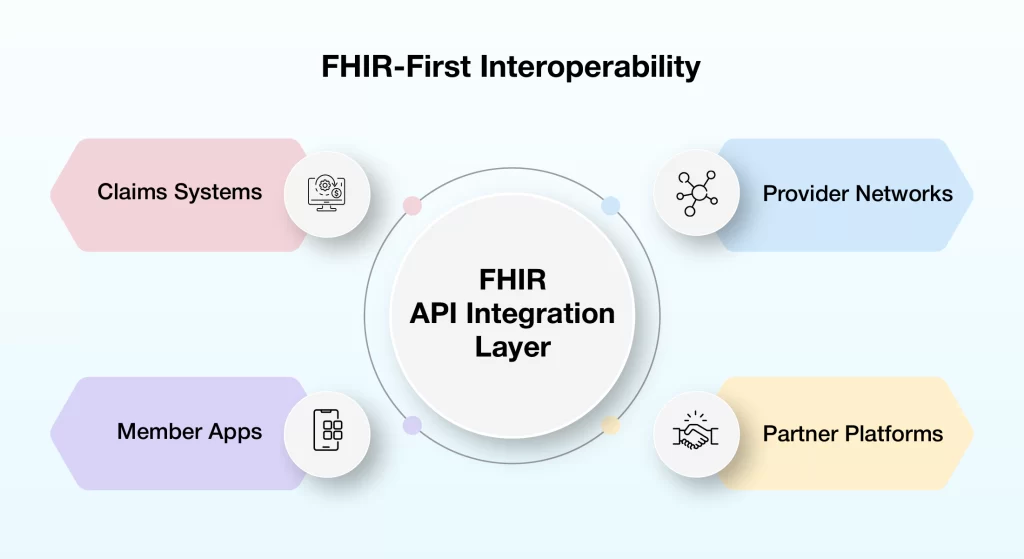
Many healthcare systems still operate on complex, point-to-point integrations built over years of technology expansion. As new applications, partners, and digital experiences are added, these connections can become increasingly difficult to maintain, scale, and adapt.
Modern healthcare technology strategies are shifting toward more scalable integration architectures built around:
- API-driven architectures
- Reusable data services
- Microservices
- Standardized data models
- Enterprise integration platforms
This approach enables payers to evolve incrementally, connect and enhance existing systems without requiring an entire replacement of the technology landscape.
The goal is no longer simply to move data between systems. It is to build a connected, reusable foundation that makes enterprise data more accessible and actionable – powering automation, analytics, AI, and more personalized member and provider experiences.
In this model, interoperability becomes more than an integration capability. It becomes an enterprise foundation for continuous modernization.
3. Healthcare Automation Evolves Into Intelligent Workflow Orchestration
Healthcare automation is entering a new phase. The focus is shifting from automating individual tasks to orchestrating complete workflows across departments, systems, and stakeholders.
Earlier automation efforts largely targeted repetitive, time-consuming activities. While these initiatives improved efficiency, many complex healthcare processes still required employees to manually move information between disconnected applications, validate data, coordinate next steps, and track outcomes.
The next generation of healthcare technology is moving beyond task automation toward intelligent workflow orchestration: connecting the systems, data, and processes involved in an end-to-end operation.
Prior Authorization Leads The Shift
Prior authorization is one of the clearest examples of why healthcare workflows need to evolve.
The process can span multiple stakeholders and systems, requiring clinical information, supporting documentation, rules-based decisions, approvals, and ongoing status updates.
Modern automation can connect these activities through the following:
- Data validation
- Documentation review
- Rules-based processing
- Status tracking
- Communication workflows
Rather than requiring employees to manage each step across separate systems, intelligent automation can coordinate the workflow from initiation through resolution, while routing exceptions and decisions that require human expertise.
Automation Expands Across Enterprise Operations
The same model can extend across a wide range of healthcare workflows, including:
- Claims processing
- Enrollment management
- Eligibility verification
- Provider data operations
- Billing workflows
- Payment reconciliation
The objective is not to eliminate human involvement. It is to reduce the manual coordination surrounding healthcare operations, allowing teams to spend more time on decisions, exceptions, and activities that require domain expertise.
As healthcare insurance carriers advance their technology environments, the opportunity lies in moving beyond isolated automation tools toward connected, intelligent workflows that improve operational speed, accuracy, and visibility.
By 2027, the organizations making the most of automation will be those that treat it not simply as a way to automate tasks, but as a foundation for orchestrating how work moves across the enterprise.
4. Cost Intelligence and Payment Integrity Gain Priority
Healthcare payers are under growing pressure to manage rising costs while maintaining quality and improving outcomes. As a result, enterprises are raising their expectations of what healthcare software should deliver.
Traditional reporting can explain what happened in the past. However, payers and TPAs now need technology that can identify emerging cost patterns, surface financial and operational risks, and help teams determine where action is needed.
This is driving greater focus on cost intelligence and payment integrity: using data, analytics, and automation to move from retrospective reporting toward more proactive cost and operational management.
According to PwC’s Behind the Numbers: Medical Cost Trend report, healthcare costs are expected to continue rising in 2027, driven by factors including increased utilization, high-cost therapies, provider cost pressures, and workforce challenges. These pressures are making traditional approaches to cost management increasingly difficult to sustain.
The role of enterprise software is therefore evolving – from simply reporting financial and operational data to helping payers understand cost drivers, identify risk, and act earlier.
Analytics Becomes More Predictive
Healthcare enterprises have access to vast amounts of data across claims, system adoption, provider networks, member interactions, and financial operations. The challenge is turning this fragmented information into timely, actionable intelligence.
Modern analytics capabilities can help health insurers identify the following:
- High-cost service usage patterns
- Payment anomalies and inconsistencies
- Claims and financial risks
- Provider performance trends
- Operational bottlenecks
- Opportunities for process improvement
Instead of relying solely on periodic reports to identify emerging issues, organizations can use more timely insights to detect patterns earlier, investigate potential risks, and respond before they translate into greater financial or operational impact.
Payment Integrity Moves Beyond Detection
Payment integrity is another area where intelligent software can create measurable value. By analyzing claims data, identifying unusual patterns, applying business and clinical rules, and supporting review workflows, organizations can strengthen payment accuracy while reducing unnecessary manual effort.
The opportunity extends beyond identifying individual errors. Connecting payment data with broader claims, provider, care volume, and operational intelligence can help organizations understand why discrepancies occur and where systemic improvements can be made.
From Reporting To Action
The next generation of healthcare analytics will not be defined by the number of dashboards an organization has. It will be defined by how effectively data helps teams identify what matters, understand why it matters, and determine what to do next.
As cost pressures continue to increase, healthcare enterprises will increasingly look for software that turns complex operational and financial data into intelligence that supports faster, more informed decisions.
5. Cybersecurity And AI Governance Become Core Capabilities
As healthcare organizations connect more systems, exchange more sensitive information, and embed AI into enterprise workflows, security and governance can no longer be treated as separate layers added after software is built.
They are becoming foundational capabilities of modern healthcare technology.
Healthcare has long operated under stringent data protection requirements. But increasingly connected digital ecosystems introduce additional considerations: from expanding API connectivity and third-party access to cloud environments, distributed data, and AI-enabled workflows.
Regulatory expectations are evolving alongside these changes. In December 2024, the U.S. Department of Health and Human Services (HHS) proposed updates to the HIPAA Security Rule aimed at strengthening cybersecurity protections for electronic protected health information. The proposal includes measures such as stronger risk analysis, encryption, multi-factor authentication, network segmentation, incident response planning, and regular compliance reviews. The current Security Rule remains in effect while the proposed rule-making proceeds.
Security Moves Into the Architecture
Modern healthcare platforms need security practices embedded throughout the software lifecycle: not treated as a final checkpoint before deployment.
Key capabilities include:
- Identity and access management
- Data encryption
- API and application security
- Role-based permissions
- Continuous monitoring and threat detection
- Audit trails and activity logging
- Data governance and policy controls
Together, these capabilities help organizations maintain greater visibility into who can access information, how data moves across systems, and how sensitive workflows are being executed.
AI Brings A New Layer of Governance
As AI becomes embedded in healthcare applications and operational workflows, governance needs to extend beyond traditional data security.
Organizations increasingly need clear controls around:
- Which data AI systems can access
- How sensitive information is used by AI applications
- How AI-generated outputs are reviewed
- When human oversight or approval is required
- How AI-driven decisions and recommendations are documented
- How models and their performance are monitored over time
The objective is not simply to secure AI systems. It is to create accountable AI workflows where organizations can understand how AI is being used, maintain appropriate oversight, and manage evolving risks.
Governance Becomes Part of the Technology Stack
The convergence of cybersecurity, data governance, and AI is changing how healthcare organizations evaluate enterprise healthcare technology.
Security will increasingly be assessed not only by whether a platform protects data, but by whether it provides the controls, visibility, and governance needed to operate securely at scale.
By 2027, cybersecurity and AI governance will increasingly be built into the architecture of healthcare platforms rather than treated as standalone capabilities. Organizations will look for technology that enables innovation while providing the safeguards and oversight needed to manage increasingly connected, data-intensive, and AI-enabled operations.
6. Modular and AI-Ready Architecture Replaces Legacy Complexity
Many healthcare enterprises are not starting their technology transformation from scratch. They are working with decades of investments across core platforms, custom applications, databases, and integrations.
Replacing these systems entirely is rarely practical, and often unnecessary.
As a result, modular architecture is emerging as a key healthcare enterprise software trend for 2027, enabling organizations to upgrade incrementally while preserving the systems and capabilities their operations depend on.
Modernization Without Full Rip-and-Replace
Rather than undertaking large-scale replacement projects, organizations are increasingly adopting architectures that allow individual capabilities to evolve without disrupting the broader technology ecosystem.
This can include:
- APIs
- Microservices
- Cloud infrastructure
- Reusable components
- Integration layers
- Event-driven architectures
For example, an organization can transform its member engagement experience without replacing its core claims platform. Similarly, it can introduce AI-powered automation into an existing workflow while continuing to rely on established operational systems underneath.
This approach allows enterprises to reduce transformation risk, limit disruption, and create a more flexible path to modernization.
Building the Foundation for AI
The shift toward modular architecture is also closely tied to AI adoption.
However, AI initiatives depend on more than models and algorithms. They require the following:
- Accessible, trusted data
- Connected applications
- Scalable infrastructure
- Real-time data flows
- Well-defined integration points
When data and workflows remain trapped across disconnected legacy systems, organizations can struggle to move AI initiatives beyond isolated pilots. Even promising AI capabilities can be difficult to operationalize when the underlying systems cannot reliably provide the data, context, and workflow access they require.
A modular architecture creates a more adaptable foundation, allowing new technologies and capabilities to be introduced without continually rebuilding the systems underneath them.
From Transformation Projects to Continuous Modernization
The future of healthcare technology will not be defined by a single large-scale transformation. It will increasingly depend on an architecture that allows organizations to re-engineer continuously, integrate new capabilities, and adopt emerging technologies without disrupting core operations.
For healthcare enterprises, becoming AI-ready therefore starts well before deploying an AI solution. It starts with building a technology foundation that is modular, connected, scalable, and designed to evolve.
7. Digital Healthcare Experiences Become Connected and Intelligent
Healthcare consumers no longer interact with organizations through a single channel. Members, providers, employers, and brokers move across websites, mobile applications, contact centers, messaging platforms, portals, and other digital services, often within the same journey.
The challenge is no longer simply providing digital access. It is connecting these touchpoints so that information, context, and workflows move with the user.
This is making omnichannel healthcare engagement an increasingly important healthcare enterprise software trend for 2027.
Traditional portals often place the burden on users to find information, understand complex processes, move across multiple screens, and complete tasks themselves. The next generation of digital experiences will increasingly use connected data, automation, and AI to make these journeys more intuitive and outcome-oriented.
From Self-Service to Resolution
Healthcare digital experiences are moving beyond basic self-service toward proactive, personalized, and intelligent engagement.
Instead of requiring users to do the following:
- Search for benefit information
- Check authorization or claim status
- Contact support for routine questions
- Switch between systems to complete a task
Connected experience platforms can provide the following:
- Personalized and context-aware information
- Guided workflows
- Intelligent recommendations
- Automated assistance
- Real-time status updates
- Faster issue resolution
Conversational AI, mobile applications, digital portals, and contact-center technologies are increasingly becoming connected components of a broader experience ecosystem rather than isolated channels.
Connecting the Experience Behind the Screen
A connected digital experience depends on more than the interface users see. It requires the underlying systems to share data, context, and workflow states.
For example, a member checking an authorization status should not have to repeat information already available elsewhere in the enterprise. A provider interacting with a payer organization should be able to move from information discovery to task completion without working through disconnected processes.
This requires digital experiences to be supported by connected data, integrated workflows, and intelligent automation.
For healthcare enterprises, the goal is therefore not to create more digital channels. It is to make every channel part of a cohesive, connected journey that helps users accomplish what they came to do.
As healthcare organizations continue to digitize, the differentiator will increasingly be how effectively technology turns fragmented interactions into simpler, more personalized, and more actionable experiences.
A Quick Look at the Top Healthcare Enterprise Software Trends
| Healthcare Enterprise Software Trend | What Is Changing | Why It Matters in 2027 |
| Agentic AI | AI is moving from assistance toward autonomous workflow execution. | Can reduce dependency on manual intervention for repeatable processes while requiring stronger governance for complex decisions. |
| FHIR-First Interoperability | Healthcare data exchange is shifting toward API-based standards. | Can simplify ecosystem connectivity as organizations add more applications, partners, and data exchange requirements. |
| Workflow Automation | Automation is expanding from individual tasks to end-to-end process orchestration. | Moves organizations away from isolated automation efforts toward coordinated workflows across multiple systems. |
| Cost Intelligence | Analytics is moving from historical reporting toward predictive insights. | Allows organizations to identify cost drivers earlier instead of relying only on retrospective analysis. |
| Security & AI Governance | Security controls and AI policies are becoming embedded into enterprise platforms. | Becomes critical as organizations manage larger data flows, third-party access, and AI-driven decisions. |
| AI-Ready Architecture | Enterprises are adopting modular architectures built on APIs, microservices, and cloud infrastructure. | Provides a gradual modernization path without requiring complete replacement of existing technology environments. |
| Connected Digital Experiences | Digital channels are converging into unified, personalized experiences. | Shifts engagement from separate touchpoints toward connected journeys across members, providers, employers, and internal teams. |
How AVIZVA Helps Healthcare Enterprises Prepare for 2027
The healthcare technology trends shaping 2027 point to a common requirement: healthcare organizations need technology ecosystems that can connect data, workflows, intelligence, and digital experiences.
Preparing for this future is not about adopting every new technology. It is about building the right foundations to evolve systems continuously, integrate emerging capabilities, and respond to changing business and regulatory demands.
AVIZVA helps healthcare enterprises build and upgrade these foundations through healthcare-focused engineering expertise spanning AI-powered automation, end-to-end data interoperability, intuitive and user-centric digital experiences, and scalable microservices architectures.
AI-Powered Automation
AI can help healthcare organizations improve operational efficiency, automate repetitive processes, and create more responsive digital experiences.
AVIZVA brings healthcare context to AI solutions, helping organizations apply intelligent capabilities to the industry’s unique workflows, operational requirements, and business challenges.
Security and privacy remain integral to these implementations, with appropriate safeguards designed to protect sensitive healthcare information and support compliance with applicable HIPAA requirements for protected health information (PHI).
End-To-End Interoperability
Connected healthcare operations depend on reliable data exchange across applications, platforms, partners, and ecosystems.
AVIZVA delivers interoperability solutions that connect critical healthcare data, including claims, eligibility, benefits, accumulators, and prior authorization information, across diverse healthcare standards and formats such as HL7, C-CDA, FHIR, EDI X12, IHE, DICOM, NCPDP, ICD-10, and QRDA.
AVIZVA’s interoperability expertise helps organizations establish real-time visibility and greater control over how data moves across the enterprise, enabling more connected workflows and reducing the friction created by fragmented systems.
Security and privacy are embedded throughout these solutions, with appropriate safeguards to protect sensitive healthcare information and support compliance with applicable HIPAA requirements for protected health information (PHI).
Intuitive Digital Experiences
As consumer expectations evolve, healthcare organizations need digital experiences that are more connected, personalized, and intuitive.
AVIZVA helps healthcare organizations build digital portals that bring information, services, and actions together in a unified experience. Built on modern, scalable architectures and aligned with industry standards, the portal solutions are designed to support personalization, third-party integration, and evolving business needs.
AVIZVA’s portal capabilities enable secure integration with third-party systems and services while maintaining rigorous standards for compliance and data protection. By adhering to HIPAA requirements and safeguarding PHI, the team helps organizations deliver digital experiences that are simple for users and trusted by the enterprise.
Scalable Microservices Architecture
Modernization does not always require replacing existing systems. Modular architectures enable enterprises to enhance critical capabilities while continuing to operate existing platforms.
AVIZVA builds high-performance healthcare data microservices that accelerate API development while maintaining security, consistency, and scalability. The pre-built API templates cover key domains including Claims, Member & Eligibility, Provider Network, Billing & Payments, and Regulatory Compliance, reducing development effort and time to market.
AVIZVA’s specialized framework further streamlines development with reusable components and standardized patterns, helping enterprises advance infrastructure incrementally and scale with agility.
Conclusion: The Future of Healthcare Enterprise Software Is Connected Intelligence
The defining shift in healthcare technology in 2027 will not be driven by a single technology. AI, interoperability, automation, analytics, security, and modern architecture are converging to create more connected and intelligent tech ecosystems.
Organizations preparing for the next phase of healthcare transformation will need more than individual digital solutions. They will need technology ecosystems that can connect data, automate processes, support better decisions, and deliver simpler experiences.
The opportunity is to move from disconnected technology investments toward a connected enterprise model.
That connected foundation is what will set emerging healthcare enterprise software apart from the point solutions that came before it.
FAQs
1. What are the biggest healthcare enterprise software trends in 2027?
The biggest healthcare enterprise software trends in 2027 include agentic AI, FHIR-based interoperability, intelligent workflow automation, predictive analytics, built-in cybersecurity, modular architecture, and connected digital healthcare experiences. These trends reflect the growing need for scalable platforms that can support operational efficiency and better stakeholder experiences.
2. How is AI transforming healthcare enterprise software?
AI is transforming healthcare enterprise software by moving beyond simple automation and enabling intelligent workflows. AI-powered platforms can support tasks such as claims processing, member services, prior authorization, analytics, and administrative operations while maintaining governance, security, and human oversight.
3. How is cloud computing changing healthcare enterprise software?
Cloud computing is enabling healthcare organizations to build more flexible, scalable, and modular technology environments. Cloud-based architectures support faster innovation, easier integration, improved data accessibility, and the infrastructure required for AI-driven healthcare applications.
4. How can healthcare organizations choose the right enterprise software?
Healthcare organizations should evaluate enterprise software based on interoperability, scalability, security, workflow support, AI readiness, and the ability to integrate with existing systems. The right platform should solve current operational challenges while supporting future modernization needs.