
Table of Contents
Key Takeaways
- Strategic Imperative: Real-time, AI-driven support is now critical for health insurers to enhance member experience, reduce costs, and stay competitive.
- The Challenge: Legacy systems and reactive workflows create delays, errors, and fragmented experiences for members and agents.
- The Solution: VIZCare AI offers an integrated platform that streamlines claims, customer support, predictive analytics, and risk assessment, enabling proactive, personalized engagement.
- Core Benefits: Unified member view with predictive insights, AI-powered multi-channel assistance, and automated, compliant claims processing.
Health insurance today isn’t what it used to be. With rising costs, immense data troves, and customers expecting quick, personalized service, insurers are under pressure like never before. Traditional systems just can’t keep up with the speed and complexity of modern healthcare demands.
That’s where Artificial Intelligence comes in.
Artificial intelligence in health insurance is no longer a futuristic concept, it’s already helping health insurance companies work smarter and faster. Whether it’s streamlining claims, answering member queries in real time, or spotting fraud before it happens, AI is quietly reshaping how the industry operates. In fact, around 75% of insurers are already using AI for customer experience in insurance support, and 50% are applying it to claims management.
In this blog, we’ll explore AI use cases in health insurance, where it’s being used, the challenges that come with it, and a few success stories along the way. If you’re in the business of health insurance or simply curious about how tech is improving care delivery, this is a read for you.
How is AI Used in Health Insurance?
The world of health insurance is undergoing a dramatic shift and artificial intelligence (AI) is at the heart of this transformation. From streamlining operations to delivering personalized support, AI is redefining how insurers serve members, brokers, and providers alike.
Let’s explore how AI and machine learning are transforming health insurance operations, enabling smarter decisions, faster service delivery, and more personalized member experiences.
- Transforming Contact Centers with Real-Time AI Assistance
Health insurance contact centers face immense pressure. Agents must juggle complex member queries—often under tight deadlines leading to prolonged call times and inconsistent service.
AI is changing the game by offering agents real-time, intelligent support:
- Unified Access to Member & Provider Information: AI integrates data across systems to give agents a complete, contextual view of members, employers, and providers reducing time spent switching screens or searching.
- AI-Enhanced Call Summaries & Documentation: During live calls, AI captures notes, creates summaries, and generates transcripts streamlining compliance and letting agents stay focused on helping members.
- Automated Follow-Ups & Intelligent Routing: AI systems auto-generate tasks based on call outcomes and route them to the appropriate team reducing manual effort and enhancing responsiveness.
This is a clear example of how AI is reshaping the health insurance experience that enables faster service, reducing operational errors, and delivering personalized support tailored to each member’s needs.
- Accelerating Sales with AI-Driven Automation
Health insurers need to move fast especially when it comes to quotes, contracts, and renewals. But manual processes often slow things down and introduce errors.
Artificial intelligence improves these areas by automating and streamlining important steps in the sales process.
- Instant Generation Of Quotes, Proposals and Contracts : AI uses templates and rule engines to quickly produce accurate, tailored documents saving time and reducing compliance risk.
- Streamlined Approvals with Smart Workflows: Automated decision-making ensures quick reviews, reducing bottlenecks and enabling faster deal closures.
- Predictive Renewal Insights : AI analyzes historical data to flag renewal opportunities and recommend optimal plan options – empowering brokers and employers to act proactively.
- Smarter Underwriting and Risk Assessment for Fair Pricing
Underwriting and risk assessment are important steps in health insurance, but often require a lot of time and resources. These processes can lead to delays and make it harder to offer policies that match individual needs. Traditional methods depend on limited data and manual reviews. This creates inefficiencies, uneven risk evaluations, and pricing that may not be fair.
Artificial intelligence provides a strong solution by using a wide range of data, including clinical records and social factors, to build detailed and accurate risk profiles.
- Data-Driven Risk Profiling: AI evaluates vast, diverse data sets from clinical records to social determinants to deliver nuanced, predictive risk insights.
- Automation of Routine Tasks: From data ingestion to initial scoring, AI automates much of the underwriting workflow improving speed without sacrificing accuracy.
These applications highlight some of the most powerful healthcare payer analytics use cases, where data-driven insights fuel fairer pricing and faster decision-making.
- Enhancing Customer Support with AI-Powered Assistants
In the dynamic world of healthcare insurance, call centers are often overwhelmed flooded with high volumes of inquiries and complex member questions. Traditional IVR systems and rudimentary chatbots struggle to keep pace, frequently falling short of delivering the quick, personalized assistance that today’s members expect. The result? Frustration, long wait times, and a deteriorating member experience.
Enter AI-powered virtual assistants transformative tools that bring always-on, intelligent self-service across channels. These digital assistants are redefining how insurers engage with their members, offering faster resolutions and more satisfying interactions.
- Simplifying Plan Details with Conversational Guidance : AI assistants make it easier for members to navigate the complexities of their health plans. By offering clear, conversational explanations of benefits, coverage, and policy rules, they reduce the need for live-agent intervention freeing up human support for higher-priority issues while improving overall satisfaction.
- Providing Instant, Transparent Claim Updates : No more guessing games or long wait times. AI-powered tools deliver real-time claim status updates, complete with simple, easy-to-understand explanations. This boosts transparency, builds trust, and empowers members with timely information all without the need for a support call.
5. Predictive Analytics: Proactively Managing Risk and Enabling Preventive Care
In the pursuit of better outcomes and cost-effective care, timing is everything. Yet, traditional risk management approaches often rely heavily on retrospective data limiting their ability to anticipate health challenges before they escalate. The result? Missed opportunities for early intervention and rising avoidable costs.
AI-powered predictive analytics is changing that paradigm. By analyzing vast and diverse datasets including clinical histories, lifestyle patterns, behavioral signals, and social determinants of health these advanced models empower insurers to move from reactive care to proactive engagement.
- Early Identification of High-Risk Members: Predictive systems flag individuals who may be at risk of developing chronic conditions or experiencing acute medical events. With these insights, care managers and health coaches can intervene earlier targeting support where it’s most likely to drive impact.
- Personalized, Preventive Care Pathways: Leveraging predictive data, health plans can design and deliver care programs tailored to individual risk profiles. From nudging members toward preventive screenings to enrolling them in disease management programs, the experience becomes timely, relevant, and personal boosting engagement and improving long-term outcomes.
These innovations are key examples of healthcare analytics use cases, enabling insurers to personalize preventive care and intervene earlier to reduce avoidable costs.
6. Health Insurance Claims Automation: Cutting Delays, Errors & Operational Waste
Claims processing has long been a bottleneck for health insurers mired in manual reviews, multi-step approvals, and data entry tasks. These inefficiencies not only delay reimbursements but also frustrate members and inflate administrative costs.
Enter intelligent claims automation a game-changer in transforming how payors handle high-volume workflows.
- Consistent Compliance, Every Time: AI-powered systems automatically apply up-to-date regulatory rules and policy parameters to each claim. This ensures consistent and accurate adjudication, reducing human error and reinforcing compliance without the need for constant manual oversight.
- Early Detection of Fraud and Irregularities: With machine learning models continuously scanning for anomalies, insurers can flag suspicious activity early before it results in costly overpayments or abuse. Whether it’s duplicate billing, inflated procedures, or identity mismatches, these smart systems enhance operational integrity while protecting margins.
By digitizing and automating core claims workflows, insurers can streamline operations, accelerate resolutions, and improve member satisfaction all while tightening compliance and fraud protection.
Top Challenges in Adopting AI and How to Overcome Them
Artificial intelligence in health insurance promises transformative value; from automating routine administrative tasks to enabling personalized care journeys, improving operational efficiency, and enhancing the overall member experience.
But adoption is rarely smooth. As insurers scale AI initiatives, they must navigate a series of strategic, operational, and ethical hurdles. Tackling these challenges head-on is essential to unlock sustainable impact and maintain stakeholder trust.
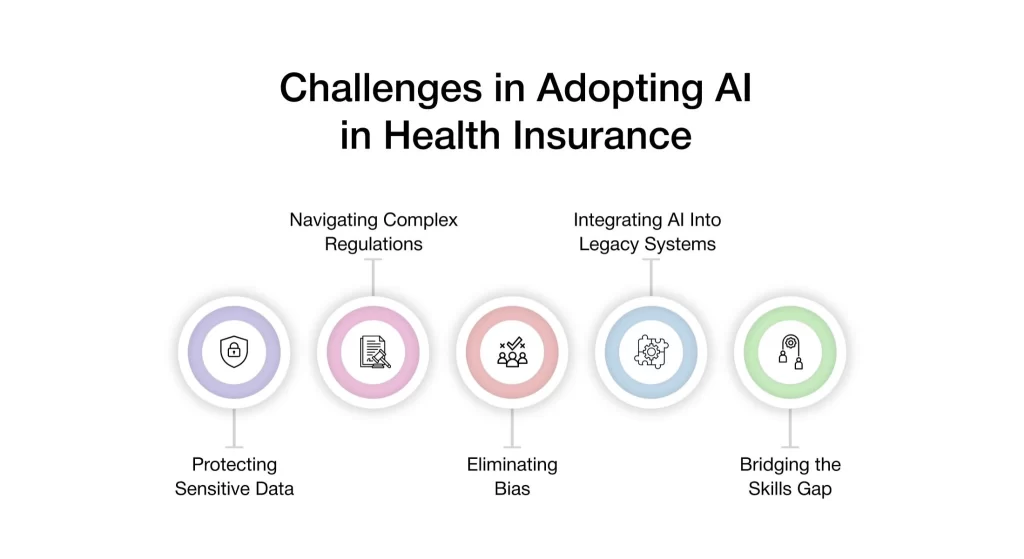
1. Data Silos and Poor Data Quality
AI systems thrive on clean, connected, and comprehensive data. But many insurers still operate in fragmented environments where member, claims, and provider data live in separate systems.
How to Overcome:
Invest in data integration frameworks and APIs that unify disparate systems. Data governance initiatives focused on standardization, quality control, and lineage tracking should be prioritized from the start.
2. Compliance and Privacy Concerns
AI needs access to sensitive personal health information (PHI). That raises red flags around HIPAA compliance, consent management, and auditability.
How to Overcome:
Deploy privacy-first architectures. Choose AI solutions with built-in HIPAA safeguards, role-based access controls, and transparent audit trails. Emphasize ethical AI practices that align with regulatory expectations and member trust.
3. Resistance to Change Among Internal Teams
Frontline teams may view AI as disruptive or even as a threat to job security. Without buy-in, adoption stalls and ROI suffers.
How to Overcome:
Position AI as an intelligent companion, not a replacement. Provide clear communication on how AI enhances roles rather than replaces them. Invest in change management programs and upskilling to empower teams, not displace them.
4. Lack of Explainability in AI Decisions
Black-box models that deliver decisions without context can erode confidence especially when used in clinical or claims-related decisions.
How to Overcome:
Favor explainable AI (XAI) frameworks that offer transparent reasoning behind every outcome. This builds trust with both internal teams and regulators.
5. Unclear ROI and Use Case Prioritization
Insurers often struggle to measure AI’s impact or determine where to begin. Without clarity, pilot programs fizzle out or fail to scale.
How to Overcome:
Start with high-impact, low-complexity use cases like claims triage, member inquiry automation, or fraud detection. Tie each initiative to clear KPIs (cost savings, time-to-resolution, member satisfaction) to demonstrate value early.
VIZCare AI: Powering the Next Era of Intelligent Health Insurance
Tackling the biggest service, claims, and operations challenges requires more than standard automation, it demands an AI platform built for healthcare. VIZCare AI is exactly that: a healthcare-native, enterprise-ready AI platform equipped with “ready-to-deploy agents and freedom to build your own applications”.
What VIZCare AI Brings to the Table
- Infused with Deep Healthcare Insurance Intelligence: Pre-trained on payer operations and carrier ecosystems, the solution is “context-aware, terminology-savvy” and deeply embedded across members, providers, claims, benefits, and prior authorizations.
- Agentic Architecture with Full Functional Coverage: Not just reactive responses, VIZCare AI’s architecture enables autonomous workflows, orchestration across channels, and scalable actions via its Presentation Context Protocol (PCP).
- Private, Secure & Compliant by Design: Built for healthcare confidentiality, the platform ensures data isolation, supports HIPAA, SOC 2 & GDPR compliance, and keeps training and deployment within approved boundaries.
- Guaranteed Data Accuracy with Granular Access Control: With RBAC and ABAC models built in, the platform delivers the right data to the right person every time with auditability, precision, and regulatory readiness.
- Ready-to-Deploy Applications Across Stakeholders: From members and brokers to providers, employers, and operations teams like, VIZCare AI offers conversational agents built for every stakeholder in the healthcare insurance ecosystem.
Behind VIZCare AI stands AVIZVA’s engineering expertise. Our team helps you architect, integrate, and scale AI-powered workflows whether you’re starting with pre-built agents or building custom applications. From data ingestion and system integration to business-rule configuration and secure deployment, AVIZVA ensures your AI journey is fast, compliant, and aligned with your enterprise goals.
Conclusion
Artificial intelligence in health insurance is changing how insurers think about service, speed, and scale. Instead of relying on slow, manual systems, insurers now use artificial intelligence health insurance solutions to make faster decisions, reduce repetitive tasks, and deliver better service across every channel.
VIZCare AI takes this further by helping insurers unlock value hidden in their everyday operations. It simplifies complex processes, connects teams, and gives smart insights when they are needed most.
AVIZVA stands out for building tools that are easy to adopt and built to last. Ready to lead smarter? Power your next move with us. Get in touch to know more!
FAQs
1. What are the main barriers preventing the widespread adoption of AI in the health insurance sector?
Many health insurers struggle with fragmented data, outdated systems, and concerns around privacy and compliance. On top of that, some teams resist change, unsure how artificial intelligence health insurance solutions will impact their roles. These hurdles make it tough to scale AI smoothly across the organization.
2. How does AI address fraud detection in health insurance claims?
AI flags suspicious patterns like duplicate claims, inflated charges, or identity mismatches by scanning massive volumes of data in real time. This allows insurers to catch fraud early and protect both margins and member trust. In artificial intelligence health insurance workflows, this means faster, smarter fraud prevention without slowing down legitimate claims.
3. What are the challenges in integrating AI with existing health insurance systems?
Legacy systems often lack the flexibility needed for modern AI tools, making integration slow and complex. Data silos and inconsistent formats also make it harder for artificial intelligence health insurance platforms to work effectively. Overcoming this requires strong APIs, clean data, and cross-team alignment.
4. How can AI improve personalized health insurance plans for customers?
AI analyzes member behavior, health history, and preferences to recommend plans that truly fit individual needs. This helps insurers offer more tailored coverage, better benefits, and proactive support. Artificial intelligence health insurance tools make personalization easier and more scalable than ever.
5. What are AI use cases in health insurance?
Some AI use cases in health insurance are contact centers providing real-time support, faster claims processing, predictive analytics for early risk detection, AI-assisted virtual assistant member engagement, intelligent underwriting, and risk assessment. These innovations are enabling insurers to deliver faster, more personalized, and cost-effective healthcare coverage.
6. How are insurance companies using AI to improve operations?
In the insurance field, AI is used to automate repetitive workflows, expedite the quote-to-contract process, enhance compliance in claim handling, and so forth. It increases accuracy and cuts administrative waste from fraud detection, predictive renewals, and intelligent work routing, thereby streamlining the entire insurance life cycle.
7. What are healthcare payer analytics use cases?
Some essential use cases for healthcare payer analytics include data-driven risk profiling, predictive modeling for preventive care, and identifying high-risk members for early intervention. By analyzing a variety of datasets, such as clinical, behavioral, and social data, AI supports payers in designing personalized care programs that proactively engage individuals so as to avoid unnecessary costs.
8. How can AI improve customer communications for insurers?
With the help of AI, insurers can also improve customer communications using smart virtual assistants and on-the-spot conversational support. These programs guide members through plan details and benefits, provide immediate updates on claims, and prevent long wait times, a surge in escalations, and higher satisfaction across every touchpoint.