
Table of Contents
Key Takeaways
- Core Challenge: Healthcare interoperability challenges persist across payer organizations due to disconnected systems, leading to delays in operations, data inconsistencies, compliance risks, and fragmented member experiences.
- Industry Shift: Healthcare organizations are moving from siloed, point-to-point integrations to real-time, automated data orchestration that enables seamless and auditable information flow across the ecosystem.
- The Solution: Interoperability platforms with built-in data orchestration, real-time visibility, and AI-driven intelligence help unify systems, reduce manual effort, and improve operational decision-making.
- Business Outcome: Early investment in interoperability infrastructure helps healthcare insurers improve efficiency, stay compliant with evolving regulations, and remain competitive in a rapidly changing market.
In healthcare insurance enterprises, millions of transactions are exchanged daily across a complex network of stakeholder systems. Yet critical updates, such as a member’s eligibility change, often fail to propagate in real time across dependent platforms. As a result, by the time a claim reaches adjudication, the enrollment system and the claims engine may still be operating on inconsistent versions of the same member record : creating delays, inaccuracies, and operational inefficiencies.
Managing critical data at enterprise scale remains one of the industry’s most persistent challenges. Healthcare insurance organizations operate within vast, highly interconnected data ecosystems where seamless coordination and real-time information exchange are essential to maintaining operational continuity and ensuring accurate outcomes.
The need for interoperability solutions in healthcare has therefore become a foundational requirement for modern payer organizations rather than a technical enhancement.
The National Institutes of Health (NIH) further underscores the importance of interoperability, emphasizing the need for healthcare organizations to adopt systems that can securely and seamlessly exchange health-related information across both internal and external stakeholders.
As healthcare enterprises continue to modernize their digital infrastructure, interoperability has evolved from a technical enhancement into a strategic business imperative. This blog explores the most effective healthcare interoperability solutions for modern insurance organizations and outlines how enterprises can build scalable, connected ecosystems that support long-term operational resilience and growth.
VIZCare Connect : A Highly Trusted Healthcare Interoperability Solution
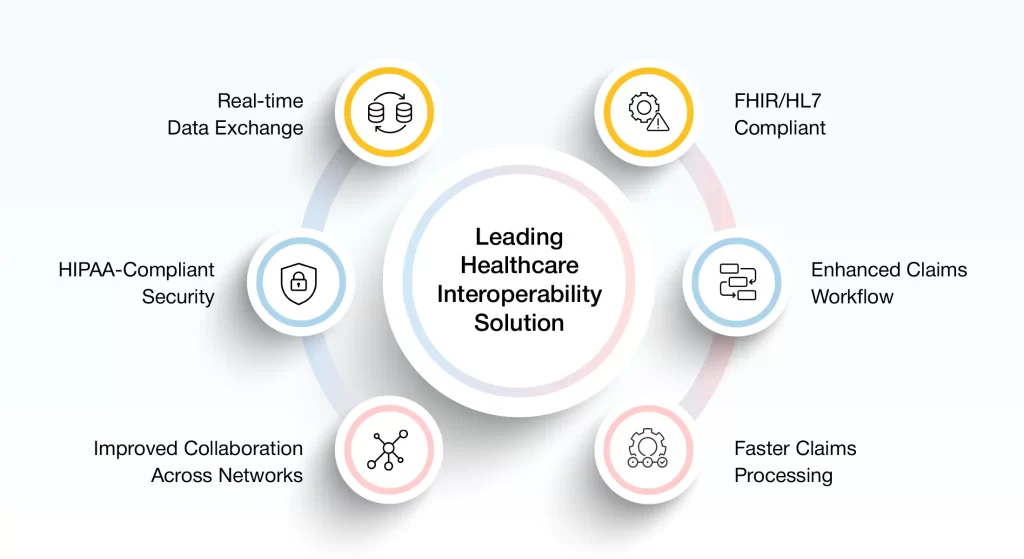
Interoperability platforms are not all built alike. Payer organizations require far more specialized capabilities than what generic integration platforms provide. Beyond simple data exchange, they need platforms designed for complex insurance workflows, regulatory demands, and the nuanced data relationships that define payer operations.
VIZCare Connect is a future-looking interoperability platform offered by AVIZVA that is designed to address the end-to-end data integration and interoperability needs of healthcare enterprises.
Here is a closer look at what sets VIZCare Connect apart from other healthcare interoperability solutions :
Real-time Data Orchestration & Synchronization
VIZCare Connect supports a wide range of integration protocols and formats, automates complex data flows, and leverages
built-in AI to dynamically configure sources, map fields, and optimize transformations.
- The platform synchronizes data across internal systems and external stakeholders such as clearing houses, providers, PBMs, payers, and regulatory bodies. It eliminates data silos and ensures accurate, up-to-date information across all touchpoints.
- The platform supports multiple integration protocols and formats to accommodate diverse system requirements, including file-based EDI (Electronic Data Interchange), direct database interfaces, modern micro-services architecture with JSON structures and asynchronous event-based integration patterns for real-time updates and consistency
- The platform includes a workflow-driven, configurable data orchestration engine, eliminating manual intervention and ensuring timely, accurate data movement across all systems. It facilitates seamless data transformation, enrichment, and validation before reaching target systems.
- The platform’s native rules engine enables dynamic data transformation, allowing seamless conversion from one format to another based on business logic and integration requirements.
A Robust Suite Of 300+ Healthcare APIs
VIZCare Connect is designed to accelerate an enterprise’s internal product development and unlock enterprise-grade innovation at scale. Its robust suite of healthcare APIs is purpose-built to support lookup, read, search, add, and update functions across all key healthcare data types.
- The APIs incorporate business rules, data interdependencies, and healthcare-specific logic, ensuring accurate, context-aware transactions. The platform supports transaction integrity across payer, provider, and regulatory ecosystems.
- The platform includes all HL7 FHIR APIs, enabling CMS interoperability and compliance with federal regulations. It ensures secure, structured data exchange across healthcare networks, payers, and regulatory bodies.
- The platform has a modern, scalable, and secure API layer that acts as a business catalyst, driving seamless integrations, intelligent workflows, and powerful application-led use cases across a healthcare enterprise. It also positions the platform among leading healthcare interoperability solution providers in the USA by enabling seamless, payer-grade integrations across complex healthcare ecosystems.
Preloaded & Continuously Updated Healthcare Industry Data
VIZCare Connect provides an enriched, ready-to-use dataset that complements enterprise data, enabling enhanced analytics, decision-making, and AI-driven insights.
- The platform automatically validates and enhances incoming transactions with healthcare interoperability standards such as HL7 and FHIR reference data.
- The platform reduces the effort needed to ingest and process foundational healthcare data.
- The platform keeps datasets updated at the frequency recommended by authoritative sources, ensuring accuracy and reliability.
360° Data Views For Business & Operational Intelligence
VIZCare Connect delivers end-to-end visibility across all systems and touch points, providing real-time insights and analytics to drive scalable, accurate, and efficient healthcare operations.
- The platform monitors the flow of transactions as they happen. It instantly identifies bottlenecks, tracks dependencies, and detects issues before they escalate – enhancing operational decision-making and ensuring regulatory compliance.
- The platform allows easy access to interconnected views of key healthcare data types – members, providers, plans, claims, prior authorizations, and groups. It enables visibility into each entity’s full lifecycle, including historical transactions like coverage changes, claim adjudications, and authorizations, all in one place, strengthening healthcare data interoperability across the enterprise.
- The platform enables identification and correction of data inconsistencies directly within the unified view. It automatically propagates updates across all linked systems, ensuring clean, consistent, and trustworthy enterprise data.
- The platform intelligently correlates data from across disparate systems to deliver 360-degree insights. This empowers teams to perform reporting, auditing, and monitoring with confidence and clarity.
Core Features of VIZCare Connect
| Feature | How It Works for Health Insurers |
| Real-Time Data Exchange | Eligibility updates, claim status changes, and authorization decisions propagate instantly across all connected payer, provider, and clearinghouse systems eliminating the batch delays. |
| FHIR/HL7 Compliance | All CMS-mandated FHIR APIs are included out of the box, along with HL7 support, which implies new regulatory interoperability requirements are met without custom development or system rework. |
| Secure Integrations | Data moves through encrypted, HIPAA-compliant channels with API-level access controls, so sensitive member records reach only the systems and users authorized to receive them. |
| Claims Workflow Enhancement | When a claim is submitted, VIZCare Connect automatically validates it against reference data, routes it through the appropriate adjudication workflow, and surfaces any errors before they cause a denial, reducing manual touches and rework cycles. |
| 300+ Healthcare APIs | Every payer transaction from enrollment submission to commission retrieval is available through a purpose-built API that carries healthcare-specific business logic, not just a data pipe. |
| Automated Reconciliation | When member records, eligibility files, or payment data diverge across systems, VIZCare Connect detects the inconsistency and propagates the correction automatically. |
Why Insurers Need Reliable Healthcare Interoperability Solution Providers in USA
Even one day without effective interoperability can be enough to trigger widespread disruptions and operational delays across a payer enterprise. Member eligibility data may fall out of sync with the provider’s EHR. Claims can be denied due to outdated coverage information. Prior authorizations may be approved in one system while remaining invisible to the billing platform. In turn, teams are forced to resolve these gaps manually, slowing down resolution times and creating downstream delays for other pending requests.
This is not a hypothetical scenario. Many health insurers still operate with fragmented systems and incompatible vendor formats that introduce translation gaps at every handoff. These are not minor inefficiencies, they compound across workflows, and the cost accumulates every day.
This is precisely why interoperability solutions for health insurance companies have shifted from a long-term roadmap consideration to an immediate operational priority. When systems are designed to share data by default, the entire operation becomes more accurate, more efficient, and more resilient.
Key Benefits Of Healthcare Interoperability
Accurate Data Access
When a provider updates a member’s diagnosis or a member reports a life event, every dependent system must reflect that change immediately. Critical functions such as claims adjudication, benefits management, and billing cannot operate on outdated information. This is where interoperable healthcare systems become essential. By enabling real-time data exchange across platforms, they ensure that the right information is consistently available to the right system at the right time.
Improved Operational Efficiency
Every manual step in a payer’s data workflow introduces both cost and the potential for error. Tasks such as re-keying eligibility data, reconciling mismatched claim records, and manually validating provider credentials are significantly reduced through a modern interoperability platform. By streamlining data exchange across systems, organizations reduce operational overhead, minimize errors, and achieve measurable, sustained efficiency gains. This is also a key factor considered when evaluating top healthcare interoperability vendors for payers.
Scalable And Flexible Infrastructure
As organizations add new product lines, expand into new markets, or onboard large employer groups, data volumes and transaction loads grow in parallel. Healthcare interoperability solutions built on open standards and modular APIs are designed to scale with this growth, ensuring that infrastructure supports expansion rather than constraining it.
What Insurers Should Look For In Interoperability Solutions
Evaluating leading healthcare interoperability vendors for payers is not just a technology choice – it is a high-stakes operational decision that demands careful consideration. The right platform has to fit into your existing environment, meet regulatory requirements, and perform reliably at scale without creating new points of failure.
Here are the criteria that matter most, and why each one connects directly to the realities of running a payer operation:
Meets Healthcare Compliance Standards
Any platform under consideration should fully support healthcare interoperability standards such as HL7 and FHIR. Without this, even routine transactions can break down. For example, when a provider submits an eligibility request in HL7 format to a system that only supports proprietary formats, it creates a translation gap that delays responses, disrupts member encounters, and triggers manual follow-ups that strain both payer and provider teams. Compliance must be built into the platform’s core architecture, not added as an afterthought.
Ensures Secure Data Exchange
Healthcare data is among the most sensitive information organizations manage, making security a non-negotiable requirement for any interoperability platform. The platform should support HIPAA-compliant data exchange through encryption in transit and at rest, API-level authentication, role-based access controls, detailed audit logging, and the ability to meet standards such as SOC 2 compliance.
Without these safeguards, even a single compromised credential can expose sensitive member information, including claims history, diagnoses, and payment data. Security cannot be treated as an add-on feature. It must be embedded into the platform’s architecture from the ground up.
Supports Scalable Integration
Payer environments are constantly evolving, with new provider networks, employer groups, PBM relationships, and third-party systems being added over time. An interoperability platform must be able to scale alongside these growing operational demands without requiring extensive custom development for every new integration. Without this flexibility, integration layers quickly become operational bottlenecks that slow implementation timelines and increase maintenance overhead.
For example, when a payer onboards a large employer group mid-year, the platform should be able to absorb increased data volumes and establish new connections without disrupting existing workflows. The right solution integrates seamlessly with legacy systems, modern EHR platforms, and external partner networks while adapting to the payer’s environment, rather than forcing the environment to adapt to the platform.
Enables Real-Time Data Analytics
Speed and visibility are critical in payer operations, where delays in data synchronization can directly impact claims processing, consumer experiences, and financial accuracy. An interoperability platform should provide real-time data synchronization and analytics capabilities that allow teams to access, monitor, and act on information as it moves across systems. Without real-time visibility, issues such as coverage mismatches or eligibility discrepancies may only surface during delayed batch reconciliations, increasing the risk of payment errors, denied claims, and operational rework.
For example, a platform with real-time analytics can identify a coverage mismatch at the point of adjudication before an incorrect payment is processed. The right solution not only accelerates data exchange but also provides actionable insights that help payer teams respond proactively, reduce downstream disruptions, and maintain operational efficiency.
Conclusion
For U.S. health insurers, the operational and financial cost of disconnected systems is no longer a sustainable trade-off. Delayed claims, compliance gaps, manual reconciliation, and fragmented consumer data are not unavoidable industry challenges, they are the consequences of infrastructure that was never designed for intelligent, real-time information exchange.
As a result, interoperability solutions in healthcare have evolved from a long-term roadmap initiative into an immediate operational priority. Payers that continue to delay investment are not simply postponing modernization, they are increasing operational complexity and compounding costs with every passing quarter.
The organizations that move ahead faster will be those that recognize interoperability not as a technical enhancement, but as a strategic foundation for enterprise efficiency, regulatory readiness, and improved consumer experiences. The ability to enable faster processing, maintain consistent data accuracy, and support seamless coordination across systems is becoming a defining competitive advantage. This is also driving increased focus on evaluating best healthcare interoperability companies in USA as part of long-term modernization strategies.
VIZCare Connect was purpose-built to address these challenges. With real-time data orchestration, more than 300 healthcare-specific APIs, preloaded industry datasets, and 360 degree enterprise data visibility, the platform enables health insurers to streamline operations and elevate end-to-end consumer experiences.
FAQs
1. What are the main benefits of implementing healthcare interoperability solutions?
Interoperability solutions in healthcare have been highly beneficial to insurance companies, and they include:
- More Accurate Data Access: Real-time access to member and claims data helps insurers make informed decisions without outdated or incomplete data.
- Enhanced Risk Management: Insurers use combined data to analyze risk more efficiently, and as a result, underwriting and pricing decisions are made more efficiently.
- Better Care Organization: Insurers will have a better chance to collaborate with healthcare providers because timely, accurate data will help achieve better results for members.
- Lower Operation Costs: Automation of data exchange will reduce manual operations and overhead, leading to lower operational costs.
2. Which interoperability standards should healthcare solution providers support?
Healthcare solution providers must support the following healthcare interoperability standards to ensure seamless, secure, and efficient data exchange:
- HL7 (Health Level Seven): This standard enables the interoperability of clinical and administrative healthcare data, ensuring that systems can communicate effectively.
- FHIR (Fast Healthcare Interoperability Resources): FHIR enables the real-time access of healthcare data via modern web technologies, ensuring that information can be exchanged quickly and securely.
These standards are essential for seamless communication between healthcare systems, ensuring interoperability across platforms and improving data accuracy.
3. How do healthcare interoperability solutions help insurance companies?
Interoperability applications in healthcare have the following substantive advantages to insurance companies:
- Real-Time Data Access: This allows insurance companies to access accurate, up-to-date data, which also sharpens decision-making.
- Automated Data Transfer: These solutions will accelerate claims adjudication and payment by automating data transfer.
- Improved Risk Management: The use of multiple data sources can enable insurers to gain a clearer understanding of risks and price more optimally.
- Increased Operational Efficiency: Automation of manual processes through seamless data integration improves workflows, reduces errors, and lowers operational costs.