
Table of Contents
Key Takeaways
- The Problem: Reactive service models in healthcare insurance are breaking under rising member expectations, high contact center load, and outdated rule-based support tools.
- The Shift: Conversational AI assistants paired with predictive analytics can move insurers from reactive support to proactive, context-aware engagement that prevents issues before they escalate.
- The Fix: Deploy production-ready, healthcare-trained AI agents that use real-time data, predictive signals, and governed workflows to guide members, reduce service friction, and improve outcomes at scale.
- Keep reading to see how conversational AI and predictive analytics are shaping the future of proactive healthcare insurance.
It’s a Tuesday morning, and the world looks a little different.
Sarah, a health insurance member, wakes up to a proactive message from her conversational AI assistant. It isn’t a generic notification or reminder , it’s personalized guidance based on real-time insights.
With Sarah’s consent, the AI continuously analyzes data from her wearable device alongside her medical history, claims data, and recent clinical records. It detects a pattern of abnormal heart rhythms and identifies an elevated risk that warrants immediate clinical attention. Rather than waiting for symptoms to worsen, the assistant recommends the next best course of action and helps schedule the earliest available virtual consultation with an in-network physician.
This represents the future of healthcare insurance , one where predictive intelligence replaces reactive service, and meaningful interventions happen before problems escalate.
For most insurers today, however, that future remains out of reach. Member engagement typically begins only after confusion, delays, or service issues arise. Questions about claims, benefits, prior authorizations, and coverage continue to drive high call volumes, overwhelming service teams and creating an interaction void where members lack timely, personalized touchpoints that help members before issues become more complex.
Closing this gap requires more than automation. It demands the convergence of predictive analytics and conversational AI, enabling insurers to anticipate member needs, initiate proactive engagement, and deliver personalized support at the moments that matter most.
In this blog, we’ll explore how predictive analytics and conversational AI assistants are reshaping healthcare insurance, helping payers move from reactive service models to proactive, intelligent member engagement through a healthcare member engagement platform.
Why Reactive Service Models Will Not Scale Beyond 2030
The traditional “Payer” model is approaching its operational limits. Built around responding to member inquiries after issues arise, reactive support is becoming increasingly difficult to sustain amid rising expectations, growing complexity, and mounting cost pressures.
1. Member Expectations Continue To Rise
Today’s healthcare members expect more than accurate answers, they expect immediate, personalized and seamless experience.
Members increasingly expect:
- Instant access to information
- Plain-language explanations of benefits & claims
- Consistent experiences across digital and human-assisted channels
When these expectations aren’t met, even accurate responses can feel frustrating.
2. Contact Centers Are Under Growing Pressure
As healthcare becomes more complex, contact centers are handling higher volumes of inquiries while operating under increasing resource constraints.
Common challenges include :
- Rising call volumes for routine queries like claims, coverage or benefits
- Longer handle times caused by fragmented systems and disconnected data
- Repeated contacts because issues aren’t fully resolved the first time
As demand grows faster than operational capacity, service costs rise while member satisfaction declines.
3. Rule-Based Chatbots Are No Longer Enough
Early automation helped deflect basic questions, but it breaks down quickly in healthcare insurance.
Traditional chatbots and static FAQs fail because they:
- Depend on predefined rules and scripted responses
- Lose context across multi-step conversations
- Cannot adapt to changing eligibility, benefit or policy information
They answer the question that was asked, but often fail to understand the member’s broader intent or situation. As a result, they can increase member effort rather than reduce it.
4. The Cost-to-Serve Continues to Climb
Despite ongoing investments in digital channels and automation, many insurers continue to see rising service costs.
Contributing factors include :
- High volumes of avoidable service interactions
- Agents spending valuable time on routine inquiries
- Escalations that occur only after member frustration has grown
Reactive service models address problems after friction has already occurred. Future-ready insurers will instead focus on anticipating member needs, resolving issues earlier, and preventing unnecessary interactions before they happen.
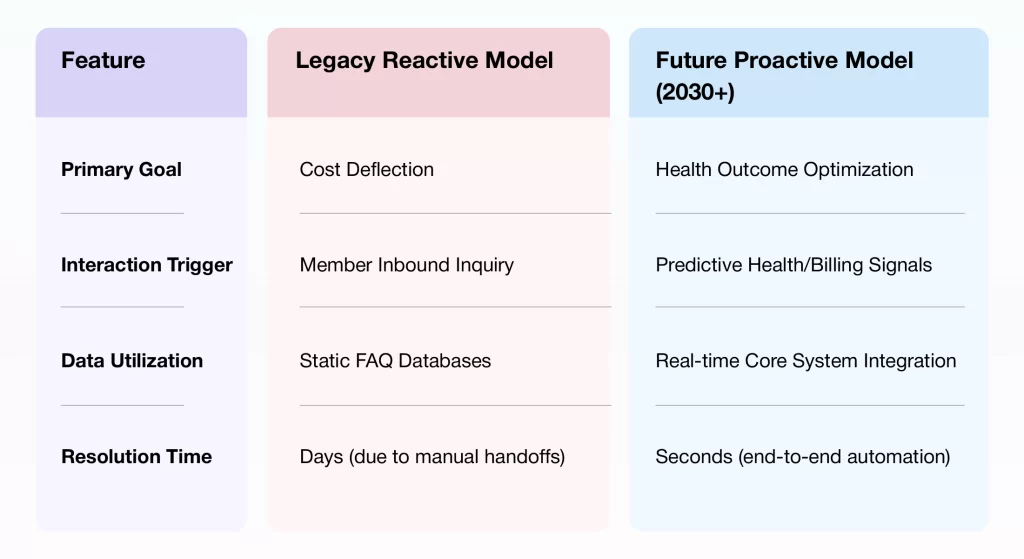
The Service Evolution: 2024 vs. 2030+
Conversational AI Assistants: The Key to Proactive Engagement
Historically, insurers have engaged members primarily when a problem occurred, whether it was a claim denial, billing question, coverage issue, or service request. This reactive approach creates long periods of inactivity between meaningful interactions, leaving opportunities for timely guidance and intervention untapped.
Conversational AI assistants are changing this paradigm by shifting engagement from reactive support to proactive, intelligence-driven interactions.
From Reactive Conversations to Predictive Interventions
By shifting from request management to proactive intervention, conversational AI assistants enable insurers to close the “Interaction Void” and deliver more timely, effective member support.
Modern conversational AI assistants leverage real-time data, predictive analytics, and automation to identify signals that may require member engagement. Rather than waiting for members to reach out, they use insights from claims, eligibility, enrollment, benefits, and utilization data to deliver timely, relevant support.
This enables insurers to:
- Engage with context, not keywords
By combining conversational AI with real-time member data, assistants understand the member’s context and not just the question being asked, rather allowing them to deliver personalized guidance and recommend the next best action. - Resolve issues before they escalate
Routine inquiries, claim delays, missing documentation, and other predictable scenarios can be identified and addressed early, reducing inbound call volumes, repeat contacts, and unnecessary escalations. - Deliver continuous member engagement
Instead of interacting only when problems arise, insurers can provide timely reminders, proactive updates, personalized recommendations, and ongoing guidance throughout the member journey.
Proactive Engagement: Anticipating the Member Journey
Conversational AI has evolved beyond answering member questions on demand. Today, it is becoming a proactive engagement layer that uses predictive insights to identify opportunities for timely intervention and initiate meaningful interactions before issues escalate.
Rather than waiting for a claim dispute, coverage question, or service request, AI assistants help insurers engage members at the right moment, i.e., when proactive support can improve outcomes and reduce operational effort.
- Early alerts before issues escalate
By analyzing real-time operational and member signals, AI assistants can identify potential issues such as claim delays, missing documentation, upcoming coverage changes, or care gaps, and proactively notify members before they need to seek support. - Smarter, Context-aware conversations
Modern AI assistants understand the member’s history, preferences, and recent interactions, enabling more personalized conversations without requiring members to repeat information or navigate multiple channels. - Strike right balance between AI and human expertise
Routine inquiries are resolved quickly through AI, while complex or sensitive cases are seamlessly escalated to human agents with full conversation context and interaction history. This enables faster resolutions, reduces member effort, and allows service teams to focus on situations where empathy and human judgment create the greatest value
Real-World Application: Solving Issues Before the Call
The most effective healthcare conversational AI platforms address the three biggest drivers of inbound volume: claims, billing, and coverage.
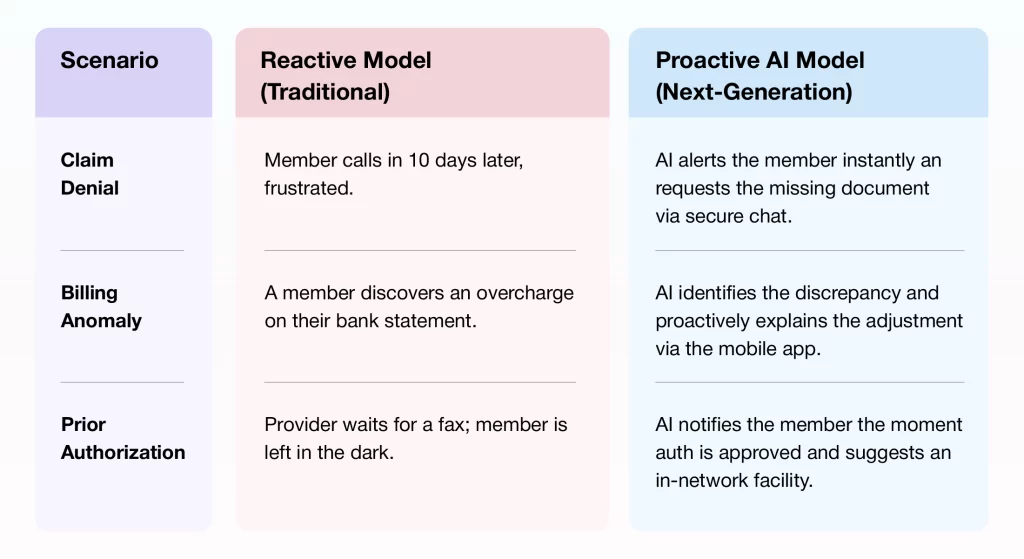
Example: The Proactive Member Interaction Cycle
Consider a member approaching their annual renewal. Instead of receiving a lengthy renewal packet and having to decipher it on their own, the member receives a personalized email to review their upcoming plan changes with the help of an AI agent.
The AI generates a clear, easy-to-understand summary of the renewal documents, highlighting what’s changing, what’s staying the same, and any actions the member may need to take. It explains updates to premiums, deductibles, benefits, and coverage in plain language, answers follow-up questions conversationally, and guides the member through the renewal process.
Rather than asking members to navigate complex insurance documents independently, the AI delivers timely, contextual guidance that makes renewals simpler, faster, and more transparent and improves the member experience while reducing confusion and support inquiries.
Predictive Analytics: Driving Smart, Data-Backed Decisions in Healthcare Insurance
Predictive analytics provides the intelligence that powers proactive healthcare insurance operations. By analyzing historical claims, enrollment, utilization, behavioral, and real-time operational data, predictive models identify patterns, estimate future risks, and recommend the next best actions.
Conversational AI serves as the engagement layer, interacting with members through natural language and guiding them through insurance-related tasks. Predictive analytics provides the insights behind those interactions, determining when to engage, what information to surface, and which actions are most likely to improve member outcomes.
Together, predictive and prescriptive analytics with conversational AI enable insurers to move beyond reactive service models. Instead of simply responding to member inquiries, they can anticipate potential issues, deliver timely and personalized guidance, and recommend the next best action before problems escalate.
This convergence transforms member engagement from transactional support into intelligent, proactive experiences that improve operational efficiency, strengthen member satisfaction, and support better healthcare outcomes.
Understanding Predictive Analytics in Healthcare Insurance
Predictive analytics in healthcare uses historical and real-time and behavioral data to identify patterns, estimate future risks and support more informed decision making across healthcare insurance operations.
Common applications include predicting:
- Claims that may require additional review or are at risk of delays
- Members who may miss preventive care or recommended follow-ups
- Coverage gaps or renewal risks based on plan and utilization patterns
- Members at risk of high-cost healthcare utilization or adverse health outcomes
How Predictive Analytics Transforms Operations
Integrating predictive intelligence with conversational AI does more than enhance the member experience, it enables healthcare insurers to make smarter decisions, automate routine workflows, and operate more proactively across the enterprise
- Smarter Claims Management : Predictive models help identify claims that may require additional review or intervention, allowing low-risk claims to move through processing more efficiently while directing claims teams to cases that need closer attention.
- Proactive Member Engagement : By analyzing claims, utilization, enrollment, and behavioral data, predictive analytics helps identify members who may be at elevated risk of care gaps, rising healthcare needs, or increased utilization. Conversational AI can then proactively deliver personalized guidance, reminders, and next-best actions to improve engagement and outcomes.
- Smarter Resource Planning : Predictive insights help forecast periods of increased service demand such as open enrollment, renewal cycles, or seasonal spikes in inquiries. This enables insurers to optimize staffing, automate routine interactions, and maintain service levels during peak demand.
Real-World Example: Proactive Financial Guidance
Consider a member whose recent claims history indicates consistently high out-of-pocket healthcare costs under their current plan.
Using predictive analytics, the insurer identifies that the member may benefit from reviewing their coverage during the next eligible enrollment period. Instead of waiting for the member to question rising medical expenses, the conversational AI assistant proactively reaches out with a personalized message:
“Based on your recent healthcare utilization, you may benefit from reviewing your current coverage options during your next eligible enrollment period. We’ve prepared a personalized comparison of plans that may better align with your healthcare needs and estimated annual costs. Would you like to explore your options?”
The assistant then presents a clear, side-by-side comparison of available plans, highlighting estimated premiums, deductibles, out-of-pocket costs, and key benefits based on the member’s historical utilization patterns. Members remain in control of the decision, while receiving timely, data-driven guidance that helps them make more informed coverage choices.
The Benefits of Integrating Conversational AI and Predictive Analytics
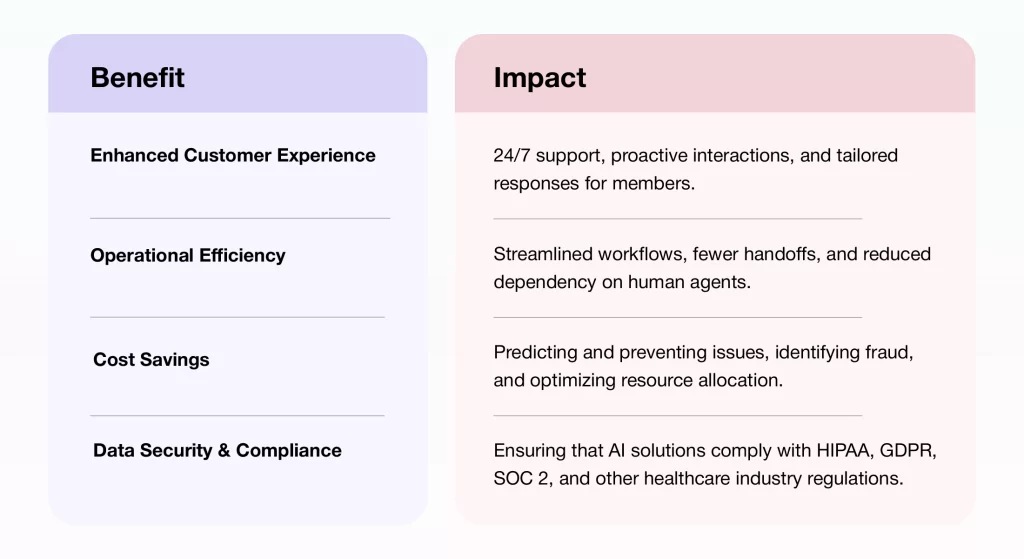
When conversational AI is combined with predictive analytics, healthcare insurers can move beyond reactive support to deliver proactive, data-driven member engagement. While conversational AI enables natural, personalized interactions, predictive analytics provides the intelligence to anticipate member needs, identify potential risks, and recommend the next best actions before issues escalate.
Together, these technologies empower insurers to deliver more timely, relevant, and context-aware experiences while improving operational efficiency and decision-making across the enterprise.
The value of this convergence extends across four critical pillars of the healthcare insurance ecosystem:
AVIZVA’s Approach: Proactive, Scalable, and AI-Powered Healthcare Insurance Solutions
AVIZVA approaches conversational AI as a core insurance capability, not a surface-level chatbot layer. The focus is on enabling healthcare insurers to operationalize predictive intelligence through production-ready AI agents that work across real insurance workflows.
At the center of this approach is VIZCare AI, a healthcare insurance–ready conversational AI platform designed to scale proactive engagement across members, brokers, employers, and providers.
Introducing VIZCare AI: Decision-Grade Intelligence
VIZCare AI is not an experimental pilot; it is a production-ready suite of healthcare conversational AI agents designed to turn every interaction into a moment of trust. By integrating directly with core insurance systems, VIZCare AI delivers context-aware responses that resolve intents rather than just deflecting calls.
Ready-to-Deploy AI Agents
Our conversational AI for healthcare strategy utilizes specialized agents tailored to every stakeholder in the insurance lifecycle. These agents don’t just respond, they understand intent, retain context, and take action.
- Member Agents: These provide plain-language explanations of benefits, claims guidance, and enrollment support to eliminate member friction.
- Broker Agents: Empower brokers to compare plans, manage commissions, and streamline onboarding through conversational commands.
- Employer Agents: Through simple conversations, group enrollments, and invoices can be easily managed by employers; thus, the need for complex forms is eliminated.
- Service & Operations Agents: These agents offer the internal workforce direct-in-time assistance, recognition of the business purpose, and automated after-call summaries.
- Provider-Facing Agents: Making eligibility checks and prior authorization requests more efficient, thus decreasing the administrative burden for provider groups.
Each agent is designed to operate within approved policy, regulatory, and data-access boundaries ensuring consistency and control at scale.
What Makes VIZCare AI Different From Generic Conversational Tools
Most conversational tools stop at answering questions. VIZCare AI is designed to resolve intent within insurance workflows. It enables:
- Context-aware conversations across all channels.
- Real-time access to claims, eligibility, coverage, and billing systems.
- Predictive triggers that initiate proactive outreach.
- Seamless escalation to service teams with full interaction context.
This allows insurers to move from isolated conversations to continuous, outcome-driven engagement.
Designed for Scale, Governance, and Trust
Healthcare insurance demands more than conversational accuracy, it demands control. VIZCare AI is built with:
- HIPAA-aligned security and data handling.
- Role-based access and response governance.
- Rule-aware responses grounded in policy logic.
- Private deployment options with full data ownership.
By combining predictive intelligence, insurance-trained AI agents, and enterprise-grade governance, VIZCare AI helps healthcare insurers close the interaction void turning everyday conversations into proactive, trusted experiences across the insurance lifecycle.
Wrapping Up
Healthcare insurance is entering an era where waiting to respond is no longer enough.
The insurers that lead the next phase of healthcare transformation will be those that act today. Those that make it beyond 2030 will be those that embed intelligence right into the everyday conversations – not an add-on, but as a core operating model.
By integrating conversational AI assistants with predictive analytics, you can finally close the “Interaction Void.” This combination is the secret to improving member engagement, cutting costs through the better running of operations, and most importantly, getting quality health outcomes for every member.
Are you ready to transition from reactive service to predictive engagement? Request a demo and see how AVIZVA helps healthcare insurers turn conversations into outcomes.
FAQs
1. How will conversational AI assistants evolve in the future of healthcare insurance?
In the coming years, these assistants will further evolve into self-sufficient insurance navigators, proactively managing the lifecycle of each member. They will be powered by technologies such as:
- Invisible user interfaces (“the end of apps”)
Multiple insurers, providers, and healthcare apps will be replaced by a single conversational AI agent acting as the primary interaction layer. - Multimodal communication capabilities
AI assistants will integrate voice, text, and augmented reality (AR) to provide a picture, interactive explanations rather than just words. - Agentic AI with autonomous decision-making
AI will watch, devise and implement by itself handling the tasks such as pre-authorizations, and eligibility checks fully. - Proactive care and insurance navigation
Leveraging wearable data, records, and policy context, AI will be able to identify the needs and take the necessary steps without waiting for instructions. - Human-in-the-loop governance frameworks
Humans will be responsible for control and exceptions, while AI will perform the insurance journeys that are both routine and complex independently.
2. How does predictive analytics work with conversational AI in proactive healthcare insurance?
Predictive analytics enables the early identification of risk and service triggers, while conversational AI enables their translation into well-timed and policy-aware interactions. Together, they help insurers guide members proactively rather than respond after issues surface.
3. Are there privacy or data security concerns with conversational AI assistants?
While security is a primary consideration in insurance, conversational AI assistants built on enterprise-grade foundations treat privacy as a non-negotiable architectural requirement rather than a secondary concern. By utilizing HIPAA and SOC2-compliant frameworks, solutions like VIZCare AI ensure all interactions occur within secure payer boundaries.
This is achieved through private deployments in which sensitive member data remains under the insurer’s control and is never used to train external models or exposed to third-party risks.
4. How do conversational AI assistants handle complex or sensitive healthcare insurance interactions?
Conversational AI assistants deliver efficient handling of complex and sensitive insurance interactions by leveraging a mix of real-time intelligence, contextual memory, and guided escalation:
- Real-time complexity detection: Continuously assesses intent, sentiment, urgency, and policy sensitivity to identify when an interaction becomes complex.
- Context retention across journeys: Maintains conversation context across turns and channels, eliminating the need for members to repeat information.
- Dynamic intent understanding: Interprets situational insurance needs such as coverage, eligibility, or exceptions based on conversation flow, not keywords.
- Seamless human handoff: Transfers complex or sensitive interactions to human agents with full conversation history and context intact.