

Table of Contents
The healthcare landscape is undergoing a digital transformation, and Conversational AI is at the forefront of driving this change.
Currently valued at USD 10.80 billion in 2023 and projected to reach USD 80.50 billion by 2032, Conversational AI in healthcare is experiencing explosive growth, with a remarkable CAGR of 25.02%. However, this growth isn’t just reflected in the numbers but also in the fundamental ways in which the future-ready technology is reshaping healthcare delivery.
While traditional AI has long been used to automate routine tasks such as scheduling appointments and processing claims, healthcare enterprises still face ongoing business challenges with respect to operational inefficiencies.
This is where Conversational AI steps in—not simply as a chatbot but as a strategic tool that empowers enterprises to engage in intelligent, real-time, natural language interactions by going beyond simple task automation.
In this blog, we will explore how Conversational AI is unlocking new opportunities for healthcare enterprises.
Conversational AI in Healthcare
Imagine a technology so intuitive that it not only understands your needs but also responds in real-time. This is the promise of Conversational AI. Far from being just a passing trend, it serves as a smart, interactive interface where AI seamlessly engages in meaningful, human-like conversations—whether through text or voice—at scale.
At its core, Conversational AI blends Natural Language Processing (NLP) with advanced Machine Learning to build systems that go far beyond providing basic automated responses. These systems understand context, recognize intent, and engage in thoughtful dialogue.
More than just simulating conversation, they continuously learn and evolve, making each interaction smarter, faster, and more impactful than the last.
In the health insurance sector, Conversational AI unlocks transformative possibilities that enhance both operational efficiency and the overall consumer experience :
- Providing real-time responses to queries from members, providers, brokers, employers, and internal teams
- Automating complex, manual processes with precision
- Offering 24/7 assistance that combines empathy with accuracy
What sets Conversational AI apart is its ability to grow and adapt continuously. With every interaction, it gets sharper, more precise, and more effective. This continuous learning empowers healthcare enterprises to streamline operations, reduce friction, and elevate every consumer experience.
Conversational AI VS Traditional AI in Healthcare
While traditional AI has been instrumental in automating healthcare operations and processing vast amounts of data, it often lacks the human-centered nuance that healthcare demands. Conversational bridges this gap with a smarter, more intuitive approach.
Let’s understand the differences between the two technologies in greater depth :
| Aspect | Traditional AI in Healthcare | Conversational AI in Healthcare |
| Understanding and responsiveness | Rule-based, predefined responses; struggles with complex queries | Understands the healthcare context and consumer intent; engages in human-like conversations |
| Learning and adaptation | Static; requires manual updates to improve performance | Continuously learns from interactions; provides personalized and accurate responses |
| Integration and customization | Limited adaptability to different healthcare systems; manual integration required | Seamless integration with EHRs, customer portals, and healthcare workflows |
| Data handling and security | May lack advanced security and compliance measures | HIPAA-compliant; follows strict data privacy regulations for secure handling |
| Consumer benefits | Provides basic information; limited consumer engagement | Enhances consumer interactions with real-time, accurate, and empathetic responses |
| Team benefits | Automates routine administrative tasks like appointment scheduling | Reduces administrative burden; assists in decision-making with AI-driven insights |
| Health system benefits | Limited efficiency gains; minor impact on consumer experience | Improves operational efficiency; enhances consumer outcomes, and reduces healthcare costs |
- Conversational AI For Members
Conversational AI empowers members with intelligent self-service capabilities, enabling them to navigate through plan benefits, understand coverage details, monitor claim status, estimate costs, and schedule appointments—all with great ease and speed.
Additionally, the AI companion guides members through care plans, sends medication reminders, tracks vital signs, and encourages healthy habits—creating an ongoing cycle of personalized, proactive care.
- Conversational AI For Providers
Conversational AI reduces the administrative burden on providers by supporting critical tasks like eligibility checks, prior authorizations, documentation and claim analysis. This allows providers to redirect their time and energy towards patient care.
- Conversational AI For Internal Teams
Conversational AI boosts the productivity of internal teams by assisting them with complex queries, compliance checks, policy lookups, and other repetitive operational tasks. This helps the internal teams work smarter and faster.
- Conversational AI For Brokers & Employers
Conversational AI enables brokers and employers to simplify the quoting process, efficiently manage employee benefits, access enrollment insights, and handle renewals – all through an intuitive, conversational interface.
How Conversational AI is Reshaping Healthcare Insurance Operations
Conversational AI in healthcare insurance is not just enhancing member interactions – it’s also optimizing internal processes. AVIZVA’s solutions leverage AI-powered assistants and virtual service platforms to address inefficiencies across policy management, claims processing, and member support.
Increased Engagement with Virtual Triage Assistants:
AI chatbots help insurance providers offer quick, accurate responses to member queries—whether it’s policy coverage, claim status, or benefits explanation. By reducing wait times and automating routine inquiries, insurers can free up human agents to focus on complex member cases.
AI Integration into Workflows:
Integrating conversational AI into workflows enables seamless data exchange with Electronic Health Records (EHR), appointment scheduling, and member care systems. This empowers insurance teams to process claims faster, track compliance more effectively, and deliver highly personalized member experiences at scale.
Key Applications of Conversational AI in Healthcare
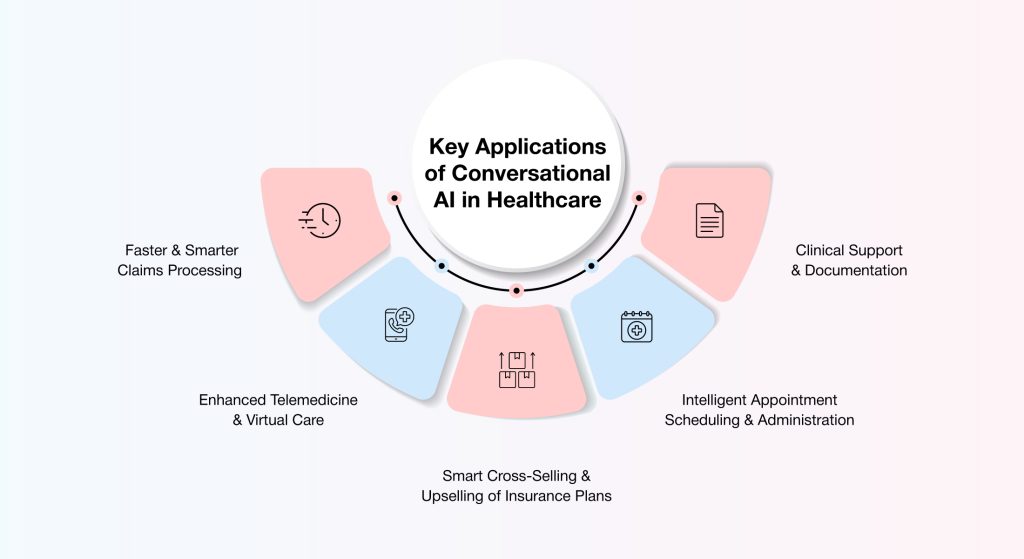
Conversational AI is rapidly transforming the healthcare industry, bringing innovation at every stage of the care journey while elevating operational efficiency. Here’s how forward-thinking enterprises are putting it to work.
- Faster & Smarter Claims Processing
Conversational AI is transforming the traditionally slow and manual claims process. According to a McKinsey study, AI-powered claims automation can reduce manual workloads by 30–50% while increasing approval accuracy and speed.
Virtual assistants trained on claims support can guide users through submissions, resolve plan-related queries, and provide real-time status updates. With conversational AI, the experience becomes more intuitive and personalized—significantly reducing errors and expediting claim resolution.
- Intelligent Appointment Scheduling & Administration
Conversational AI is redefining routine administrative tasks such as appointment scheduling, consumer onboarding, and insurance verification. It not only automates these workflows but also delivers a personalized experience by adapting to individual needs in real-time.
Beyond scheduling, AI chatbots in healthcare can handle rescheduling, send proactive reminders, and manage timely follow-ups—significantly easing the administrative burden on healthcare teams while enhancing operational efficiency, service quality, and overall consumer satisfaction.
- Enhanced Telemedicine & Virtual Care
AI health assistants elevate telemedicine by simplifying remote consultations and improving clinical readiness. These virtual health assistants can triage symptoms, retrieve relevant patient history, and assist in scheduling virtual visits.
By providing pre-assessment data and automating routine steps, Conversational AI helps providers make more informed decisions, saving time, improving patient flow, and enhancing the overall virtual care experience for both providers and patients.
- Clinical Support & Documentation
AI medical assistants intelligently capture and summarise patient symptoms, medical history, and real-time consultation data – enabling providers with a clear, consolidated view of the patient’s conditions. This leads to faster, more informed decision-making and supports highly personalized care recommendations.
Additionally, an AI virtual assistant in healthcare automates the documentation of key consultation details, reducing manual data entry efforts, minimizing errors, and ensuring accurate, up-to-date records for future visits. This allows providers to spend less time on administrative tasks and more time focused on patient care.
- Smart Cross-Selling & Upselling of Insurance Plans
Conversational AI empowers payers to identify and act on cross-sell and upsell opportunities by analyzing consumer data and real-time conversation context. A healthcare AI assistant can proactively recommend relevant add-ons or complementary plans tailored to individual needs.
For example, after a consumer purchases a health plan, the AI assistant might suggest dental or vision coverage based on their profile—seamlessly driving value at the right moment while enhancing the consumer experience.
Conversational AI has undeniably made significant strides in healthcare, driving efficiency and enhancing consumer experiences. However, like any emerging technology, it presents its own set of challenges that healthcare enterprises must address as they adopt and integrate Conversational AI into their ecosystem.
Accuracy & Misinformation Risks
For conversational AI to be truly effective in healthcare, it must provide highly accurate and reliable information. Even minor inaccuracies in medical advice can have severe consequences, including misdiagnosis, improper treatment recommendations, or legal liabilities. The following are the critical accuracy challenges faced by healthcare enterprises when integrating conversational AI :
- Understanding Complex Medical Conditions: AI models may struggle to fully grasp the intricacies and nuances of complex medical conditions, which could lead to gaps in care or misinterpretation of symptoms.
- Risk of False Predictions: There is a risk that AI systems may generate false but seemingly plausible responses, leading to potentially incorrect advice or guidance.
Thus, continuous oversight by healthcare enterprises is necessary to ensure the AI’s recommendations and outputs remain accurate, reliable, and safe.
Ethical & Data Privacy Considerations
Healthcare data is among the most sensitive types of personal information. Thus, healthcare enterprises must consider its protection as a top priority. Any AI-driven solution working on this data must comply with strict regulatory requirements such as HIPAA in the U.S. and GDPR in Europe. Critical data security concerns faced by a healthcare enterprise in this regard include :
- Consumer Confidentiality : Conversational AI must ensure that personal health information remains secure and inaccessible to unauthorized parties.
- Cybersecurity Threats : AI systems can be vulnerable to data breaches or cyberattacks, potentially exposing protected health information (PHI).
- Bias in AI Responses : If trained on non-diverse or incomplete datasets, AI models may produce biased or skewed responses—leading to unequal care recommendations and overlooking the needs of certain populations.
Integration Challenges
Many healthcare enterprises rely on legacy infrastructure, making integration of modern AI systems complex and resource-intensive. Following are the integration challenges they may face :
- Interoperability Issues : Older electronic health record (EHR) systems often lack compatibility with AI platforms, creating barriers to seamless data exchange.
- Data Fragmentation: AI must process both structured and unstructured data from disparate systems, requiring sophisticated data integration capabilities.
- Resistance to Change : Enterprises may hesitate to adopt AI tools due to unfamiliarity, reliability concerns, or fear of workflow disruption.
Steps to Adopt Conversational AI in Your Organization : Action Plan Checklist
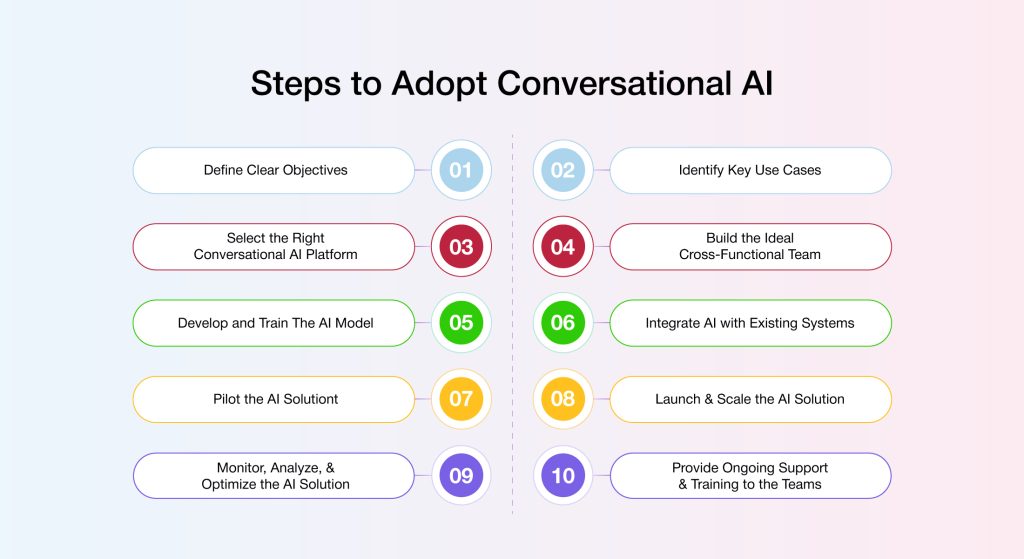
Step 1 : Define Clear Objectives
Before implementing Conversational AI, healthcare enterprises should clearly identify what they aim to achieve—whether it’s enhancing consumer engagement, streamlining administrative tasks, or improving overall operational efficiency.
These objectives should align with the broader strategic goals of the organization, such as reducing costs, increasing productivity, or delivering a more seamless consumer experience.
Step 2 : Identify Key Use Cases
The next step is to identify specific areas where Conversational AI can deliver meaningful impact—such as automating responses to FAQs, managing support tickets, facilitating appointment scheduling, or supporting virtual care.
These use cases should then be evaluated and prioritized based on their potential value to the organization and the complexity of implementation. Focusing on high-impact, low-complexity use cases can help drive early success and build momentum.
Step 3 : Select The Right Conversational AI Platform
Enterprises must then evaluate AI platforms that align with their enterprise’s specific needs, budget, and long-term vision.
Key considerations should include scalability, ease of integration with existing systems, data security and compliance, and the platform’s natural language processing (NLP) capabilities.
They should choose a solution that seamlessly integrates into their current technology ecosystem and can grow with their enterprise’s evolving needs.
Step 4 : Build The Ideal Cross-Functional Team
The next step must be to assemble a dedicated, cross-functional team that includes stakeholders from IT, customer support, marketing, operations, and data analytics.
Healthcare enterprises must ensure that their team members either possess or are trained in the necessary skills to successfully manage and support the deployment of Conversational AI solutions.
The roles and responsibilities of everyone must be clearly defined to ensure accountability and alignment during every phase of implementation.
Step 5 : Develop & Train The AI Model
Enterprises must then design the conversational workflows based on the identified use cases. They should train their AI model using relevant data, such as common customer queries and internal FAQs, to ensure it responds effectively.
Furthermore, they must regularly refine and improve the model as new data and feedback are gathered to optimize its performance and accuracy over time.
Step 6 : Integrate AI With Existing Systems
After training the AI model, healthcare enterprises must ensure that Conversational AI integrates smoothly with their existing systems, such as CRM platform, Helpdesk tools, or any other relevant platforms.
They should test the integration thoroughly to ensure seamless data flow between systems and the AI solution.
They must also conduct comprehensive testing before going live to identify and address any potential issues, ensuring a smooth rollout.
Step 7: Pilot The AI Solution
Healthcare enterprises should then test their AI model with a small group of internal users or a select segment of customers.
They should gather feedback on its performance, user engagement, and areas for improvement.
Based on the feedback, enterprises must make adjustments to the system and fine-tune it to ensure better results
Step 8 : Launch & Scale The AI Solution
Once the solution has been refined and is performing well, healthcare enterprises must expand their deployment to a wider audience or additional channels.
They should monitor it’s performance closely as user volume increases and be prepared to scale the system quickly to accommodate growing demands.
Additionally, enterprises must ensure that the infrastructure of the AI solution can handle increased data and user interactions without compromising performance.
Step 9 : Monitor, Analyze & Optimize The AI Solution
Healthcare enterprises should track AI interactions and performance regularly.
They should use analytics to assess how well the AI solution is meeting their enterprise goals, such as consumer satisfaction, response times, and overall engagement.
Enterprise must continuously update and optimize the AI model to improve its accuracy and responsiveness, ensuring it remains effective and valuable over time.
Step 10 : Provide Ongoing Support & Training To The Teams
Healthcare enterprises must offer continuous training to internal teams so they can effectively manage, troubleshoot, and interact with the AI system.
They must establish a clear support framework for addressing AI-related issues or escalations.
Furthermore, they should encourage feedback from users and stakeholders to fuel iterative improvements and keep the system aligned with business goals.
AVIZVA : Advanced Conversational AI Partner in Healthcare
The healthcare industry is evolving unprecedentedly, and Conversational AI is playing a pivotal role in driving this change.
AVIZVA is a health-tech company offering intelligent Conversational AI solutions tailored for healthcare enterprises, PBMs, and TPAs. These solutions empower enterprises to enhance consumer interactions, automate administrative tasks, and boost team productivity, delivering measurable outcomes across the care continuum.
Key features of AVIZVA’s Conversational AI solutions include :
- End-to-end compliance with HIPAA and PHI standards, ensuring the highest levels of data security and privacy across every touchpoint.
- Personalized self-service experiences for all healthcare consumers —including members, providers, brokers, and employers—through intelligent AI-driven interactions.
- AI-powered assistance and automation for internal teams, helping them reduce manual workload and enable faster, more accurate service delivery.
- Seamless integration with existing platforms and systems, ensuring smooth adoption without disrupting current workflows or operations.
- Built-in healthcare intelligence allows the solutions to address the unique challenges and complexities of the industry with precision.
- End-to-end compliance with HIPAA and PHI standards, ensuring the highest levels of data security and privacy across every touchpoint.

Conclusion
In today’s healthcare industry, consumers are more informed and empowered than ever. They expect real-time health updates, easy access to plan details, and interactions that feel personalized and meaningful.
While traditional AI is effective at automating processes and improving operational efficiency, it often falls short in delivering the empathetic, human-like experience that today’s healthcare consumers value the most.
When someone is feeling unwell or anxious, the last thing they want is to interact with a cold, robotic system. What they truly need is to feel heard, understood, and cared for. This is where Conversational AI makes a meaningful difference. By enabling intelligent, real-time interactions that mimic natural conversation, it brings warmth, empathy, and reassurance into every digital touchpoint.
AVIZVA is a leading health-tech company specializing in AI-powered solutions tailored for Health Plans, TPAs, and PBMs. Backed by over 14 years of healthcare expertise, AVIZVA helps enterprises harness the power of Conversational AI to elevate consumer experiences, streamline operations, and enhance workforce productivity.
Want to explore how conversational AI can elevate your healthcare operations? Let’s talk—schedule a call with us today
FAQs
1. How does AVIZVA implement AI assistants in healthcare?
AVIZVA brings AI to life in healthcare through VIZCare AI, an advanced platform built to autonomously manage claims, member inquiries, and provider support—while ensuring every interaction feels intelligent, compliant, and human.
The platform leverages context-aware, healthcare-trained intelligence built on real-world datasets across members, providers, claims, benefits, and authorizations. This domain depth allows VIZCare AI assistants to not only understand medical and operational terminology but also take informed actions such as checking eligibility, submitting claims, or managing workflows with its agentic architecture powered by the Presentation Context Protocol (PCP).
Built for enterprise-grade security and compliance (HIPAA, SOC 2, GDPR), VIZCare AI supports on-premise deployment with complete data isolation and granular access controls (RBAC + ABAC), ensuring safe, role-based visibility.
With ready-to-deploy agents for members, providers, brokers, and service teams and the flexibility to build custom applications via modular APIs – AVIZVA empowers healthcare organizations to automate complex operations while preserving accuracy, compliance, and a truly conversational user experience.
2. What technologies power conversational AI in healthcare?
Healthcare conversational AI utilizes a combination of NLP, ML, and Deep Learning algorithms to enable AIs to understand, process, and answer another user in real time. The set of technologies enables the AI tool to comprehend complicated queries in the medical domain and provide context-aware answers.
3. How can AI improve claims processing and member engagement?
Claims processing AI handles mundane tasks and reduces human errors, thereby improving the workflow approval time. Conversing with members takes place in real-time through intelligent chatbots and virtual assistants, making communications smooth and fast.
4. What is conversational AI in healthcare?
Conversational AI in healthcare uses technologies like chatbots and virtual assistants to enable natural, human-like interactions with their consumers and stakeholders. It helps answer benefit or policy questions, guide care navigation, streamline administrative tasks like claims, authorizations, and provide 24/7 support. By combining real-time responses with personalization, conversational AI improves access, reduces workload for support teams, and enhances the overall healthcare experience.
5. How does conversational AI help in healthcare?
Conversational AI enables human-like interactions through chatbots and virtual assistants, helping patients, members, and providers access information quickly and easily. It streamlines tasks like appointment scheduling,explanation of documents, claims support, and eligibility checks, while offering 24/7 assistance. By reducing wait times, improving engagement, and automating repetitive processes, conversational AI enhances consumer experiences, boosts efficiency, and lowers operational costs.
6. Is conversational AI in healthcare secure and compliant?
The data remains secure by AVIZVA through strong encryption and role access controls, ensuring compliance with HIPAA and other regulations. Hence, this manner of multi-level security assuredly stands between sensitive healthcare data and unauthorized parties while simultaneously maintaining compliance with privacy laws.