
Table of Contents
Key Takeaways
- The Problem: Healthcare payers and TPAs still run critical workflows across disconnected systems, causing delays, errors, compliance risk, and poor member experiences.
- The Shift: Data orchestration software moves healthcare operations from brittle point-to-point integrations to real-time, automated, and auditable data flows across the ecosystem.
- The Fix: Use a healthcare-ready orchestration platform with built-in interoperability, operational visibility, and AI-driven intelligence to connect systems, reduce manual work, and improve decisions.
- Keep reading to see how data orchestration software helps healthcare enterprises simplify integration, speed up claims, strengthen compliance, and support smarter operations.
Healthcare organizations across the United States process billions of transactions every year. Claims submissions, eligibility checks, prior authorizations, enrollment updates, provider verifications, and payment workflows move continuously across an increasingly complex ecosystem of payers, TPAs, PBMs, providers, and regulatory systems.
The challenge is not the lack of data; it is the inability of fragmented systems to exchange, synchronize, and operationalize that data efficiently in real time.
Many healthcare enterprises still operate on disconnected legacy platforms, batch-based integrations, and manual reconciliation processes. When these systems fail to communicate effectively, the consequences escalate quickly:
- Claims processing delays
- Operational bottlenecks
- Inaccurate or duplicated data
- Compliance exposure
- Poor member and provider experiences
This is the operational gap that data orchestration software is designed to solve.
Modern healthcare data orchestration platforms help organizations move from isolated integrations to connected, intelligent ecosystems where data flows securely, workflows execute automatically, and operational decisions happen in real time.
In this blog, we explore:
- What data orchestration software actually does
- Why healthcare integration challenges continue to grow
- The limitations of traditional point-to-point integrations
- How orchestration improves interoperability, automation, and operational visibility
- And how platforms like VIZCare Connect and VIZCare AI help healthcare enterprises simplify integration complexity while enabling smarter, faster, and more scalable operations
This blog covers what data orchestration software actually does, the biggest challenges in healthcare data integration, and how AVIZVA’s VIZCare Connect and VIZCare AI help payers, TPAs, and PBMs build a smarter, more connected data ecosystem.
How Data Orchestration Software Actually Works
Data orchestration software automates the movement, transformation, synchronization, and coordination of data across multiple systems in real time. In healthcare, it acts as the operational backbone of a healthcare business, ensuring the right data reaches the right system, in the right format, at the right time, while maintaining workflow continuity across the enterprise.
Rather than relying on isolated point-to-point integrations, orchestration platforms coordinate end-to-end workflows across claims systems, enrollment platforms, provider networks, billing systems, utilization management tools, and external healthcare partners.
Practical Example:
Imagine a payer processing a member’s claim. Behind the scenes, multiple systems and validations must work together in sequence:
- Pull member eligibility from the enrollment system
- Validate procedure codes against CPT and ICD 10 code sets
- Check prior authorization status in the utilization management platform
- Route the claim to the appropriate adjudication engine
- Update the billing system and send a notification to the member
Without data orchestration software, these processes are often managed through disconnected integrations, manual interventions, or brittle workflows that are difficult to monitor and maintain.
With a healthcare orchestration platform in place, the entire workflow becomes automated, synchronized, traceable, and operationally visible in real time. Teams can monitor transactions from a centralized dashboard, identify integration failures instantly, automate exception handling, and maintain full auditability across every step of the workflow.
| Insight: Data orchestration is not just about connecting systems. It is about coordinating and automating the intelligent flow of data between them. |
Evaluate Healthcare Data Orchestration Capabilities
Enterprises should evaluate a healthcare data orchestration platform on four capabilities: integration depth, interoperability standards, scalability, and security. These four determine whether a platform can serve as the data foundation for enterprise operations or whether it becomes another silo to work around.
Integration depth:
The platform should support the full range of exchange patterns healthcare enterprises actually run, including file based EDI, direct database interfaces, microservices with JSON, and asynchronous event based integration. Equally important is what happens after connection: look for automated orchestration that transforms, enriches, and validates data in motion, with a built in rules engine applying business logic dynamically rather than through hardcoded mappings.
Interoperability standards:
HL7 FHIR compliance is the baseline, not a differentiator. Evaluate whether the platform enables CMS interoperability mandates out of the box, supports real time synchronization with external stakeholders such as clearinghouses, providers, PBMs, and regulatory bodies, and maintains current healthcare code sets including CPT, ICD 10, HCPCS, and NDC without manual upkeep.
Scalability:
Enterprise data volumes grow in both size and variability. The platform should sustain millions of transactions while preserving accuracy and consistency, and allow new data sources or workflows to be added without redesigning existing integrations.
Security and compliance:
HIPAA and SOC 2 compliance are table stakes. Beyond certifications, examine how the platform enforces access: record and attribute level authorization, full auditability, and transaction level visibility that lets teams monitor data flows live and detect discrepancies before they propagate.
A useful shorthand for enterprises: platforms that only move data solve yesterday’s problem. Platforms that orchestrate it, with visibility and intelligence built in, are the ones that hold up at enterprise scale.
| Ready to see what enterprise grade data orchestration looks like in practice? Explore Healthcare Solutions |
Challenges in Healthcare Data Integration: The Need for Data Orchestration
| Challenge | Impact on Operations | What Orchestration Solves |
| Data Silos | Delayed claims processing, fragmented workflows, and limited visibility across systems | Creates a unified, real-time data layer across payer, provider, and member touchpoints |
| Legacy System Fragmentation | Manual rework, disconnected workflows, and high processing error rates | Enables standards-based integration across legacy and modern healthcare systems |
| Compliance Gaps | Increased regulatory risk, inconsistent reporting, and difficult audit readiness | Automates compliance controls, transaction monitoring, and end-to-end audit logging |
| Lack Of Real-TimeData | Slow operational decisions, delayed service delivery, and poor care coordination | Supports real-time data synchronization and workflow orchestration across stakeholders |
| Manual Data Entry & Reconciliation | High administrative burden, duplicate work, and claims processing delays | Automates data transformation, validation, routing, and enrichment workflows |
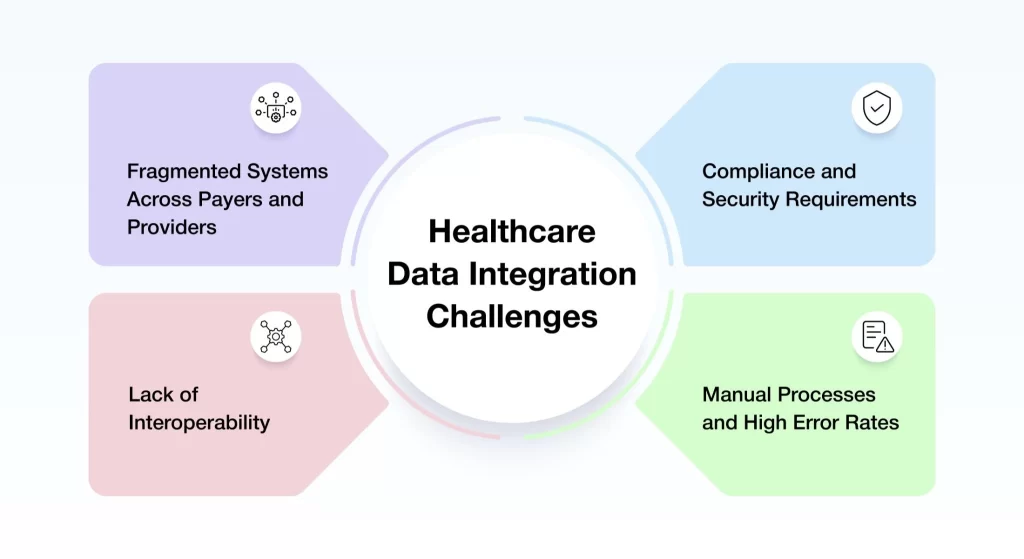
The need for health orchestration software becomes clear when looking at the operational complexity that healthcare enterprises manage every day. These are not isolated technical issues; they are systemic challenges rooted in decades of fragmented healthcare IT evolution.
1. Fragmented Systems Across Payers and Providers
Most US healthcare organizations have built their infrastructure over time by layering new technologies on top of legacy systems. . is a disconnected ecosystem of payer platforms, EHRs, PBM systems, clearinghouses, billing tools, and third-party applications that were never designed to work together seamlessly.
A single claims workflow may require data and actions across multiple systems, from eligibility verification and prior authorization checks to adjudication and payment processing. Without orchestration, these workflows become slow, manual, error-prone, and difficult for operations teams to monitor in real time.
| Stat: A survey by Healthcare IT News found that 60% of healthcare organizations cite data silos as a major barrier to efficient operations. |
2. Compliance and Security Requirements
Healthcare data in the US is governed by strict regulatory and interoperability standards, including HIPAA, FHIR, HL7, and a growing list of state-level compliance requirements. . Every transaction, data exchange, and workflow interaction must be secure, traceable, and audit-ready.
However, many healthcare organizations still rely on manual processes and fragmented integrations that make it difficult to maintain consistent governance and clean audit trails. As transaction volumes grow, ensuring compliance across disconnected systems becomes increasingly complex and operationally risky.
3. Lack of Interoperability
Claims data, eligibility records, clinical information, and provider data are often stored across incompatible formats and systems. As a result, critical healthcare workflows remain disconnected, delayed, and difficult to manage in real time.
Without a unified orchestration layer, systems struggle to exchange information accurately, consistently, and contextually across the healthcare network. This lack of interoperability creates operational inefficiencies, increases manual intervention, and limits visibility across payer and provider ecosystems.
| Tip: When evaluating healthcare data orchestration platforms, confirm that they natively support HL7, FHIR, and EDI formats. These are the foundations of interoperability in US healthcare. |
4. Manual Processes and High Error Rates
Manual data entry, spreadsheet-based workflows, and file-based data transfers continue to introduce significant inefficiencies across healthcare operations. Even a single incorrect member ID, eligibility detail, or procedure code can trigger a cascade of downstream issues, including a chain of claim denials, payment delays, compliance risk, and rework that costs hours to untangle.
These errors do not remain isolated. They ripple across claim systems, billing platforms, provider workflows, and member communications, creating friction for both operational teams and healthcare consumers. The financial impact is substantial. Industry analysis estimates that healthcare organizations lose nearly $342 billion annually, due to inefficient data management and fragmented communication systems. As healthcare becomes more complex, the operational cost of manual workflows continues to grow.
How AVIZVA’s VIZCare Connect Solves Healthcare Data Orchestration Setbacks
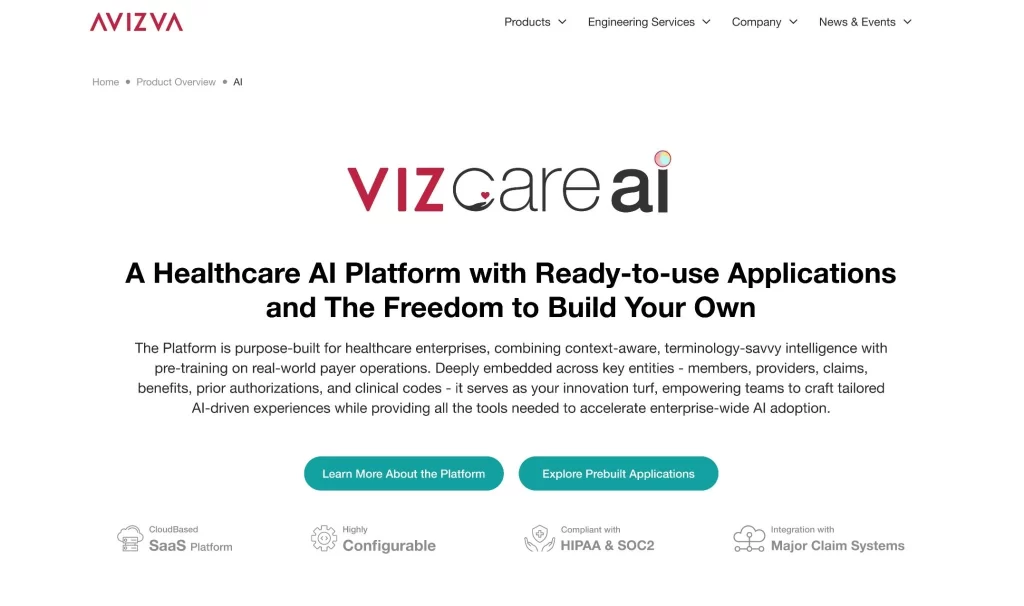
VIZCare Connect is purpose-built to address the end-to-end data integration and healthcare data interoperability needs of modern healthcare enterprises. Designed for payers, TPAs, PBMs, and healthcare organizations, the platform helps simplify complex integration environments through three foundational capabilities: real-time data exchange, an extensive healthcare API ecosystem, and continuously updated industry-ready healthcare data models. It operates across three core pillars: real-time data exchange, a suite of over 300 healthcare APIs, and preloaded and continuously updated industry data.
1. Real-Time Data Synchronization Across Your Entire Ecosystem
VIZCare Connect enables real-time data synchronization across internal systems and external stakeholders, including clearinghouses, providers, PBMs, employer groups, and regulatory networks. Instead of relying on delayed batch processing or manual reconciliation, systems remain continuously synchronized across the ecosystem.
The platform supports a wide range of healthcare integration standards and protocols, including EDI, FHIR, HL7, JSON, and event-driven asynchronous integration patterns. This flexibility allows healthcare enterprises to integrate with existing legacy and modern systems without large-scale infrastructure replacement.
VIZCare Connect also provides centralized operational visibility across every integration workflow. All data movements, transactions, and synchronization events are monitored through a unified operational dashboard that allows teams to:
- Track transaction flows in real time
- Detect bottlenecks and integration failures quickly
- Resolve workflow issues proactively
- Maintain complete auditability and compliance visibility
By combining interoperability, orchestration, and operational intelligence, VIZCare Connect helps healthcare organizations reduce manual effort, improve data accuracy, accelerate workflows, and build a more connected healthcare ecosystem.
2. 300 Plus Prebuilt Healthcare APIs
Instead of building integrations from scratch, VIZCare Connect provides a library of more than 300 production-ready healthcare APIs designed to accelerate interoperability and workflow automation across the ecosystem.
These APIs are more than simple connectors. They come embedded with healthcare-specific business logic, enabling organizations to streamline workflows, reduce implementation complexity, and accelerate operational execution without extensive custom development.
The API ecosystem supports core healthcare functions such as lookup, read, search, add, update, and workflow-triggered transactions.
Coverage Across Key Healthcare Domains :
The API library spans critical healthcare insurance operations such as :
- Group and Employer management, including hierarchy and plan structures, employer data, and product administration
- Plan and Benefits administration, including benefits configuration, plan documents, reporting, and eligibility structures
- Enrollment and Census operations, including member enrollment workflows, approvals, rejections, and census synchronization
- Member and Coverage management, including dependents, demographics, coverages & eligibility information
- Claims processing, including claim submission, adjudication workflows, and claim status management
- Prior Authorization management, including status Authorization requests, approvals, tracking, and workflow coordination
- Invoice and Payment operations including Billing workflows, invoice management, reconciliation, and bulk payment updates
- Provider and Network data management, including provider affiliations, directory synchronization, network participation, and credential-related information
By combining prebuilt APIs with healthcare-ready orchestration capabilities, VIZCare Connect helps organizations reduce integration timelines, simplify connectivity across systems, and create a scalable foundation for real-time healthcare operations.
| Point to Note: Prebuilt APIs reduce integration development time, letting your IT team focus on innovation rather than system plumbing. |
3. Preloaded and Continuously Updated Industry Data
VIZCare Connect comes equipped with preloaded healthcare industry data, eliminating the operational burden of sourcing, managing, and manually updating foundational reference datasets across healthcare systems.
The platform includes continuously updated data sets such as CMS NPPES provider and NPI records, CPT codes, ICD-10 code sets, HCPCS codes, NDC drug data, DRG classifications, & Network pricing and reimbursement information. These datasets are refreshed according to the update frequency recommended by authoritative healthcare and regulatory sources, helping ensure that workflows always operate using accurate, current, and standardized information.
By embedding trusted healthcare reference data directly into the platform, VIZCare Connect improves claims accuracy, reduces validation errors, accelerates workflow execution, and strengthens compliance across payer and provider operations.
4. Full Operational Visibility and Transparency
One of the most overlooked challenges in healthcare data management is operational visibility. When transactions fail, r integrations break, or data becomes inconsistent across systems, identification of the root cause can take hours or even days across fragmented environments.
VIZCare Connect addresses this challenge with end-to-end transaction visibility and operational transparency across the entire integration ecosystem. The platform provides:
- Real-time transaction tracking
- Advanced filtering and search capabilities
- Dynamic data exploration
- Automated error detection and resolution workflows
- Mass data correction and reconciliation tools
This enables operations teams to quickly diagnose, monitor, and resolve integration issues directly within the platform without relying on multiple disconnected systems or manual investigation processes.
The platform also strengthens compliance and audit readiness. Every transaction is fully logged with detailed processing history, workflow status, and integration traceability, making regulatory reporting more accurate while significantly simplifying audit processes across healthcare operations.
The Role of VIZCare AI in Smarter Healthcare Data Orchestration
While data orchestration software manages the movement, synchronization, and routing of healthcare data. VIZCare AI adds an additional layer of intelligence that transforms those workflows into proactive, decision-driven operations.
Rather than simply moving data between systems, VIZCare AI helps healthcare organizations interpret data contextually, automate operational decisions, and surface actionable insights in real time.
1. AI-Driven Automation for Better Decision Making
VIZCare AI is purpose-built for healthcare payer operations and trained on real-world healthcare workflows and not adapted from a generic AI model. It understands complex healthcare entities and processes, including:
- Members and coverage
- Providers and networks
- Claims and adjudication workflows
- Benefits and eligibility
- Prior authorizations and utilization management
This healthcare-specific intelligence enables VIZCare AI to automate operational decisions that traditionally require manual review and intervention. The platform can:
- Flag potential claim denials before processing
- Predict authorization outcomes
- Detect workflow anomalies and service risks
- Surface operational bottlenecks and service opportunities
- Assist teams with contextual recommendations and next-best actions
By embedding AI-driven intelligence into orchestration workflows, healthcare organizations can reduce operational complexity, improve consistency, accelerate decision-making, and lower the cognitive burden on service and operations teams.
| Stat: According to Accenture, 40% of all working hours in healthcare could be supported or augmented by language-based AI. |
2. Predictive Analytics to Anticipate Member Needs
VIZCare AI leverages predictive analytics to help healthcare organizations identify risks, engagement gaps, and service opportunities before they escalate into operational or member experience issues.
By analyzing historical member interactions, claims activity, coverage patterns, and operational data, the platform can surface actionable insights that enable payers to deliver more proactive and personalized engagement strategies.
These insights can help organizations:
- Identify members at risk of disengagement or care gaps
- Anticipate service needs and outreach opportunities
- Support proactive care management initiatives
- Personalize communication and benefit guidance
- Improve retention and long-term member engagement
This shifts healthcare operations from reactive service models to proactive engagement strategies, allowing organizations to intervene earlier, improve member experiences, and drive stronger health and operational outcomes over time.
3. Private, Secure, and Compliant by Design
VIZCare AI is deployed within your organization’s infrastructure, ensuring that sensitive healthcare data remains securely within your environment at all times. The platform is designed to support healthcare-grade security and compliance requirements, including HIPAA and SOC 2 standards.
To strengthen governance and data protection, VIZCare AI enforces access controls at both the record and attribute level using RBAC (Role-Based Access Control) and ABAC (Attribute-Based Access Control) models. This ensures that only authorized users can access specific data based on their role, permissions, and contextual policies, delivering secure access, complete traceability, and full audit readiness across healthcare operations.
4. Ready to Deploy AI Agents for Every Stakeholder
VIZCare AI comes with a set of prebuilt conversational AI agents for every stakeholder in your ecosystem. These are not generic chatbots. They are trained on healthcare insurance workflows with deep knowledge of plans, benefits, dependents, and claims logic built in.
- Service Agents: Real-time call assistance, automated post-call notes, and intelligent follow-up task creation
- Member Agents: 360-degree healthcare access, claim filing and appeals, benefit explanations in plain language
- Provider Agents: Eligibility checks, prior authorization tracking, claims guidance, and denial resolution
- Broker Agents: Quote generation and comparison, commission statement analysis, full book of business insights
- Employer Agents: Member onboarding, benefits administration, payment, and invoice clarity
- Operations Teams: AI-assisted management of broker, employer, and provider workflows across the enterprise
Key Benefits of Data Orchestration Software in Healthcare
Better Operational Efficiency and Decision-Making
When data moves automatically and intelligently across systems, operations teams spend less time manually reconciling records, re-entering information, or resolving preventable discrepancies. Instead of chasing fragmented data across platforms, teams can focus on exception handling, member support, and higher-value operational decisions.
For example, billing teams that previously spent hours cross-verifying claims and payment records can redirect that time toward resolving complex cases that require human expertise and judgment.
Greater Compliance and Security
Healthcare orchestration platforms help ensure that every transaction, whether it is a claims payment, eligibility update, or provider communication, flows through secure, authenticated, and fully traceable workflows.
By embedding compliance controls, encryption, audit logging, and standards-based interoperability directly into integration workflows, organizations can strengthen regulatory readiness while reducing operational risk across healthcare data exchanges.
Faster and More Accurate Claims Processing
Many claims require manual review because of missing documentation, mismatched codes, eligibility issues, or incomplete validation checks. These breakdowns create delays, increase administrative burden, and slow reimbursement cycles.
Data orchestration software automates validation against eligibility rules, code sets, benefit structures, and authorization requirements at the point of processing. Clean claims move directly into adjudication workflows, while exceptions are flagged with clear reasoning, improving both speed and accuracy across claims operations.
Improved Regulatory Adaptability
Healthcare regulations continue to evolve rapidly, from HIPAA updates and CMS interoperability mandates to state-level compliance requirements. Traditional integration environments often struggle to adapt without costly redevelopment.
Modern orchestration platforms built around HL7, FHIR, EDI, and API-driven architectures allow organizations to adjust workflows and data-sharing requirements through configuration rather than full system replacement. This enables healthcare enterprises to respond faster to regulatory changes while maintaining operational continuity.
Optimized Member Satisfaction and Experience
Members typically contact support because they lack clarity, experience delays, or cannot get timely resolutions. Orchestrated healthcare data helps eliminate these friction points by giving agents and digital platforms real-time visibility into member coverage, claims, benefits, and prior interactions from a unified operational view.
This leads to:
- Faster first-call resolutions
- Reduced repeat contacts
- Lower average handling times
- More personalized member interactions
When members receive timely, accurate, and contextual support, they are far more likely to remain satisfied and engaged with their health plan.
Better Coordination Across the Healthcare Ecosystem
Data orchestration ensures that the right information reaches the right stakeholder at the right time, whether it is a provider verifying eligibility before an appointment, a member reviewing an EOB, or a payer coordinating a prior authorization workflow.
By synchronizing data across systems in real time, healthcare organizations can create more connected, transparent, and efficient experiences across the payer-provider-member ecosystem.
How to Choose the Right Enterprise Data Orchestration Platform
With multiple vendors competing in this market, here is a practical checklist for US healthcare enterprises evaluating their options. Use this as a starting framework for your vendor conversations and RFP process.
Core Capabilities to look for :
- Native support for healthcare integration standards, including HL7, FHIR, EDI, and JSON
- HIPAA-compliant data handling with full transaction-level audit logging and traceability
- Real-time data synchronization across internal systems and external stakeholders
- Prebuilt APIs and connectors for core healthcare workflows & data entities
- Role-based access control(RBAC) and attribute-based access control(ABAC) with record-level granularity
- Built-in AI, analytics, or seamless integration support for intelligent automation and operational insights
- Scalable, cloud-ready architecture capable of supporting enterprise-grade transaction volumes
- End-to-end operational visibility across integrations, workflows, and exception handling
- Support for legacy system integration alongside modern API-driven architectures
- Configurable workflow orchestration and standards-based interoperability controls
Questions to Ask Your Vendor
- How does your platform manage data lineage, transaction tracking and error resolution across systems?
- Can the platform integrate with our existing legacy systems without requiring large-scale replacements?
- What is the typical implementation timeline for organizations of our size and operational complexity?
- How are ongoing healthcare code set updates managed for CPT, ICD-10, HCPCS, NDC, and other standards?
- What healthcare compliance certifications and security frameworks does your platform currently support?
- Is AI deployed within our infrastructure, or does sensitive healthcare data leave our environment?
- How does the platform support real-time interoperability across payers, providers, PBMs, and regulatory systems?
- What operational visibility and monitoring capabilities are available for integration workflows?
- How are scalability, failover, and performance managed during peak transaction periods?
- What governance controls exist for audit readiness, access management, and compliance reporting?
Conclusion
Healthcare enterprises that invest in modern data orchestration software are doing far more than solving integration challenges. They are building the operational foundation required for faster claims processing, better member experience, stronger interoperability, improved compliance, and scalable AI-driven operations.
As healthcare ecosystems become increasingly connected and data-intensive, organizations need platforms that can synchronize information in real time, automate workflows intelligently, and provide complete operational visibility across systems.
AVIZVA’s VIZCare Connect and VIZCare AI are purpose-built to address these evolving healthcare challenges. Together, they create a connected, intelligent, and compliant data ecosystem that helps payers, TPAs, and healthcare enterprises simplify operations, strengthen decision-making, and scale confidently in a rapidly changing healthcare environment.
The question is no longer whether your organization needs healthcare data orchestration software. The real question is how long they can afford to operate without it.
FAQs
1. How is data orchestration different from data integration?
Data integration is about creating a connection between two systems so they can share data. In a healthcare context, integration might connect your claims platform to a clearinghouse. But healthcare data orchestration governs what happens to that claims data the moment it enters the pipeline:
- Is the member’s eligibility current?
- Does the procedure code match the active benefit?
- Does the provider’s NPI validate against the latest CMS registry?
- If something fails, where does it route and who gets notified?
During integration, data moves from system A to B, whereas Data orchestration software makes sure it arrives correctly, complete, and actionable every time.
2. Why do healthcare enterprises need data orchestration software?
Running a payer operation on disconnected systems is not just inefficient; it is operationally risky. Most U.S. health insurers are managing claims, eligibility, authorizations, and member communications across platforms that were never designed to work together.
The result is predictable:
- Claims sit in manual review queues because eligibility could not be confirmed in real time
- Authorization decisions are delayed because the request data did not transfer cleanly between systems
- Member service teams give inconsistent answers because there are different versions of the same record
Healthcare data orchestration software eliminates these breakdowns by creating a single governed layer that moves, validates, and routes data across every system automatically.
3. What are the benefits of data orchestration software for payers and providers?
The benefits of data orchestration software look different depending on which side of the transaction you are on, but the common thread is the same: less waiting, fewer errors, and better outcomes.
For Payers:
- Claims move through adjudication faster because eligibility, benefits, and code validation happen automatically at the point of entry rather than in a manual review
- Risk and underwriting teams make decisions based on real-time, integrated data rather than batch exports that are already outdated
- Compliance posture improves because every data transaction is governed, encrypted, logged, and auditable by default
- Member service quality rises because agents have a complete, current view of every member record in one place
For Providers:
- Eligibility verification happens in real time before the member encounters, eliminating the surprise denials that damage provider-payer relationships
- Claims submission is cleaner because the orchestration layer flags missing or mismatched data before the claim is sent, reducing denial rates at the source
- Remittance data is accurate and timely, making reconciliation straightforward rather than a multi-day manual exercise
4. How long does it take to implement healthcare data orchestration software?
The implementation schedules will be determined by the number of systems you need to connect, the level of documentation of your existing IT infrastructure, and whether the platform you are going to adopt has ready-built connectors to the existing systems of your usage.
The following framework is realistic:
- When built on a platform such as VIZCare Connect, which comes with ready-to-use connectors to clearinghouses, PBMs, and provider networks, organizations with already well-documented infrastructure and shared system settings can anticipate initial workflows to be activated within weeks.
- Mid-complexity applications that might incorporate multiple legacy systems, custom data formats, and a number of integrations with other partners usually take two to four months to be fully operationally deployed.
- Enterprise-wide implementations that can handle large volumes of transactions, operate across multiple states, and have high levels of existing system dependencies need to be more comprehensively discovered and configured.
5. How does data orchestration improve healthcare interoperability?
Standards such as FHIR and HL7 are interoperability standards that specify the way healthcare data is organized and shared.
It is here that healthcare data orchestration software is applied in practice to enhance interoperability:
- A provider sends a request to eligibility in HL7 format through their EHR. It is delivered to the orchestration layer, where the format is validated and converted to the structure required by the core system of the payer, and a real-time eligibility response is delivered without any human intervention.
- When a CMS requirement is to have payers make member data available through standardized FHIR APIs, the orchestration layer also manages the conversion of internal data representations to FHIR-compliant ones automatically, without the underlying systems needing any changes.
- In cases where data differences can be observed between related systems, automated reconciliation will detect and fix data differences between all the related platforms at once, and not per system individually.
6. How do organizations evaluate healthcare data orchestration software?
The most reliable evaluation method is a live proof of concept, not a feature comparison. Most payers, TPAs, and PBMs follow a sequence like this:
- Pick a real integration scenario. Something with actual stakes, such as syncing eligibility data between a claim system and an external clearinghouse.
- Test the exchange patterns you actually run. EDI files, direct database interfaces, JSON microservices, event based integration. A platform that only handles one pattern well will force workarounds for the rest.
- Introduce a discrepancy on purpose. Feed it conflicting or incomplete data and watch what happens. Strong platforms detect and correct; weak ones silently propagate the error downstream.
- Check what you can see. If the platform cannot show you transactions moving in real time, your teams will be blind to bottlenecks until they escalate.
A platform that stays accurate and transparent through all four steps is worth shortlisting. One that only demos well is not.
7. What should healthcare organizations look for in a data orchestration platform?
Four capabilities separate enterprise ready platforms from everything else: integration depth, interoperability, scalability, and security.
Integration depth means more than connecting systems. The platform should orchestrate data in motion, transforming, enriching, and validating it automatically across every exchange pattern the enterprise uses. Interoperability starts at HL7 FHIR compliance and CMS readiness, but should also cover maintained code sets like CPT, ICD 10, and NDC so teams are not managing updates manually.
Scalability is proven under volume: millions of transactions with no loss of accuracy, and new sources added without redesigning what already works. And security goes beyond HIPAA and SOC 2 certificates to record and attribute level access control with full audit visibility.
The shorthand: platforms that only move data solve yesterday’s problem. Platforms that orchestrate it hold up at enterprise scale.
8. Where can I explore AVIZVA's healthcare data orchestration capabilities?
You can visit AVIZVA’s VIZCare Connect page to understand how healthcare enterprises can simplify data orchestration through real-time data synchronization, 300+ healthcare APIs, and interoperability support across HL7, FHIR, and other healthcare standards. The platform helps payers, TPAs, and PBMs connect fragmented systems, automate complex data workflows, improve operational visibility, and build a scalable foundation for secure healthcare data exchange.