
Table of Contents
Key Takeaways
- The Problem: Healthcare payers and TPAs struggle with fragmented systems, slow workflows, and reactive communication, leading to poor member experiences and low satisfaction.
- The Shift: Healthcare CX is now benchmarked against seamless digital experiences. Members expect real-time updates, personalization, and effortless self-service across channels.
- The Fix: AVIZVA’s VIZCare suite combines AI, connected data, and user-friendly portals to unify systems, automate workflows, and deliver consistent, personalized member interactions.
- What to Expect: Faster claims processing, reduced manual effort, real-time visibility, and higher member satisfaction driven by proactive, intelligent engagement.
Something fundamental has shifted in health insurance. Members are no longer evaluating their health plans against other insurers. They are comparing them to the best digital experiences they encounter every day, from seamless banking apps to real-time retail and on-demand service platforms.
That shift is redefining healthcare customer experience expectations. Accurate claims processing and responsive call centers are no longer enough. Today’s members expect health plans to understand their needs, deliver proactive support, and resolve issues without requiring repetitive explanations or fragmented interactions.
According to the Kaiser Family Foundation, satisfaction with health insurance is directly tied to how well insurers communicate and resolve issues. The HealthEdge Annual Consumer Study reinforces this, showing that rising consumer expectations are reshaping how health plans operate at a foundational level.
This blog explores what that shift means in practice, what is driving it, and how AVIZVA’s suite of VIZCare solutions helps health insurers, payers, TPAs, and PBMs build the kind of experience that keeps members coming back.
| Quick insight: Member retention in health insurance is heavily influenced by experience quality, not just plan pricing. A seamless interaction at the right moment can be more powerful than a competitive premium. |
The Growing Focus on Healthcare Customer Experience
1. The Rising Demand for a Better Member Experience
Today’s health plan member is no longer a passive beneficiary. They are informed, digitally empowered consumers who expect the same level of convenience, transparency, and responsiveness they receive from leading digital brands across industries
As expectations evolve, the healthcare customer experience has become a critical differentiator for insurers. Members no longer judge health plans solely on coverage or cost, they evaluate every interaction, from claims communication and benefits access to service responsiveness and digital usability.
Research from Kaiser Family Foundation consistently highlights dissatisfaction around claims communication, coverage clarity, and service complexity as major drivers of member frustration. At the same time, industry studies show that members who feel understood, informed, and supported are significantly more likely to remain loyal to their health plan and recommend it to others.
The expectations are clear and increasingly immediate:
- Real-time claim and coverage updates
- Simple, intuitive digital self-service experiences
- Personalized support across channels
- Faster issue resolution without repetitive interactions
Members no longer want to call support centers to fix what digital systems failed to resolve. They expect healthcare experiences that are connected, proactive, and effortless from the start.
| Insight: Healthcare consumer expectations are now shaped by the seamless digital experiences delivered by retail and banking brands. If your member portal is more confusing than an e-commerce checkout, that gap will cost you. |
2. Key Challenges Holding Healthcare CX Back
Most health insurers are not struggling because they lack the intent to improve member experience. They are struggling because the underlying systems and operational models were never designed around the member journey.
Fragmented data spread across multiple platforms prevents servicing teams from accessing a complete, unified view of the member. A member calling about a claim may interact with a representative who cannot see related coverage details, prior interactions, or recent updates. At the same time, disconnected workflows turn even simple requests, such as an address change or eligibility update, into slow, multi-system, manual processes.
Operational silos further intensify the problem. Different departments manage isolated parts of the member lifecycle, but no single system or team owns the end-to-end experience. The result is reactive communication, delayed resolutions, inconsistent experiences, and members repeatedly following up for answers
These are not isolated inefficiencies. They represent the operational reality for many mid-to-large payer organizations and remain a major reason why member satisfaction continues to lag despite significant investments in digital transformation
Common Challenges Impacting Healthcare CX
- Fragmented systems create inconsistent member data across channels and touchpoints
- Manual workflows slow down claims processing, prior authorizations, and enrollment updates
- Siloed teams prevent a connected, end-to-end view of the member journey
- Reactive communication forces members to repeatedly follow up for updates and resolutions
- Disconnected platforms create delays, duplicated effort, and inconsistent service experiences
- Limited real-time visibility reduces operational responsiveness and decision-making accuracy
- Legacy systems make it difficult to deliver seamless digital self-service experiences
- Lack of workflow orchestration increases administrative burden across teams
How Digital Transformation Is Reshaping Healthcare Member Experience
Leading healthcare organizations no longer view technology as a back-office support function. They see it as a core driver of healthcare customer engagement and member satisfaction. The organizations delivering the strongest member experiences are investing in connected digital platforms that make every interaction faster, more personalized, and easier to navigate.
AI and automation are playing a central role in this transformation. Intelligent systems can route requests automatically, identify service risks early, pre-fill forms, and guide members through complex workflows with minimal friction. At the same time, digital portals and mobile applications are giving members greater control over their healthcare experience, allowing them to access benefits, track claims, manage coverage, and receive updates in real time.
This shift is improving both operational efficiency and customer experience. By reducing dependency on manual support channels, healthcare organizations can lower inbound call volumes while delivering faster and more consistent service experiences.
Research from Deloitte also highlights that redesigning experiences around consumer expectations is one of the most effective ways healthcare organizations can improve customer interactions and long-term engagement.
What Technology Needs to Do to Bridge the Gap
Technology alone cannot fix a fragmented healthcare experience. Its real value lies in its ability to connect systems, workflows, and interactions into a seamless member journey. To improve healthcare customer experience, technology must unify data from disparate platforms, present it in a clear and actionable format, and enable both members and service teams to act quickly without operational friction.
Omnichannel communication is an essential feature to be considered. A member may begin an inquiry through a portal, continue it on a mobile app, and complete it with a live agent. If context is lost during any transition, the experience breaks down. Every disconnected handoff creates frustration, delays resolution, and weakens member trust.
Personalization is equally critical, and it must be driven by real member context, not broad demographic assumptions. Different members require different experiences based on their health needs, coverage history, and engagement patterns. A member managing a chronic condition expects different support than someone enrolling in a health plan for the first time. Modern healthcare experience platforms must recognize these differences and deliver interactions that are timely, relevant, and personalized at scale.
| To Follow: Prioritize platforms that offer omnichannel continuity and data-driven personalization. These two capabilities have the highest direct impact on health insurance customer experience scores. |
How AVIZVA Helps Healthcare Organizations Deliver Better Customer Experience
AVIZVA’s VIZCare platform suite was built specifically for the operational realities of payers, TPAs, and PBMs. It does not ask organizations to rip and replace their existing infrastructure. Instead, it connects, enhances, and empowers, layering AI-driven intelligence, seamless data orchestration, and consumer-grade engagement experiences on top of what is already in place.
Here is how each solution contributes to a transformed healthcare customer experience in insurance.
VIZCare AI: Turning Every Interaction into an Intelligent One
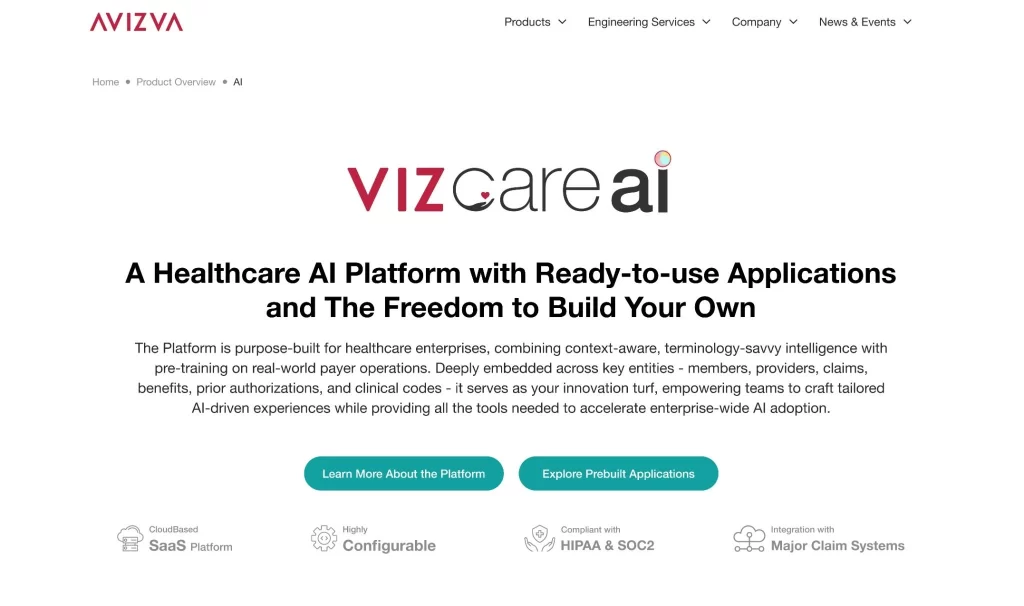
Most AI tools in healthcare are point solutions. They handle one task, for one user type, in one channel. VIZCare AI is different. It is a purpose-built healthcare AI platform designed with the full stakeholder ecosystem in mind, from members and providers to brokers, employers, and operations teams.
At its core, VIZCare AI is pre-trained on real-world payer operations. It understands healthcare-specific terminology, business logic, and data relationships. That means it can handle nuanced queries, such as why a claim was partially paid or whether a procedure requires prior authorization, without requiring months of custom training.
Its agentic architecture, powered by the Presentation Context Protocol (PCP), goes beyond answering questions – it enables real action. Through natural, conversational interactions, the platform can submit claims, update member information, generate quotes, and track prior authorizations, creating a more seamless and action-oriented member experience.
What This Means for Your Members
- Members can ask benefits and coverage questions in plain language and receive clear, accurate answers instantly
- Claims guidance becomes conversational and proactive, reducing frustration and minimizing support dependency
- Automated after-call workflows help accelerate resolutions while allowing service teams to focus on complex member needs
- Real-time access controls and record-level permissions help ensure secure, compliant, and accurate interactions across every touchpoint
- Members experience faster resolutions, more personalized support, and seamless engagement across channels
- Context-aware interactions reduce the need to repeat information during service conversations
| Insight: VIZCare AI is HIPAA, and SOC 2 compliant by design, with data never leaving your infrastructure. Security and great CX are not in tension here. They are architected together. |
VIZCare Xperience: Where Engagement Actually Happens
If VIZCare AI is the intelligence layer, VIZCare Xperience is where that intelligence meets the member. It is a suite of AI-enabled web portals and native mobile applications purpose-built for every stakeholder in the health plan ecosystem.
MemberX gives members a single destination to manage their coverage, track claims, find in-network providers, access benefits documents, and interact with an AI assistant that speaks plain English.
Similar to this MemberX, VIZCare Xperience has portals for other stakeholders, those are ProviderX, EmployerX, and BrokerX with specific capabilities to simplify various operations that each verticals handle.
What ties all four portals together is a shared commitment to self-service that actually works. Each portal is built with human-centered design principles, so members and stakeholders feel confident using it from day one.
What members experience with VIZCare Xperience
- Members can view plan details, accumulators, and tier-based eligibility in one place, without digging through documents or making a single call
- Real-time claim tracking, EOB breakdowns, and plain-language explanations of what was paid, what is pending, and why
- Members can update demographics, add dependents, report life events, and manage coverage simply by chatting with the AI agent, no paperwork required
- Search for in-network providers, compare drug prices, check formulary coverage, and even book appointments directly from the portal
- Whether on web, mobile, or messaging, members get a consistent experience with the ability to switch to a live agent instantly when they need one
| Added Benefit: Organizations using VIZCare Xperience can launch targeted wellness campaigns directly through the portal, personalizing outreach by age, risk profile, or benefit utilization history. |
VIZCare Connect: The Data Foundation That Makes It All Possible
Healthcare member experiences fall apart when the data behind them is unreliable. A member who receives an incorrect EOB, a provider who cannot verify eligibility in real time, or an employer whose enrollment updates take three days to reflect are all experiencing the same underlying problem: disconnected data.
VIZCare Connect is a healthcare data connectivity platform that addresses this from the ground up. It supports real-time data orchestration across internal systems and external stakeholders, including clearing houses, providers, PBMs, payers, and regulatory bodies. With 300-plus pre-built healthcare APIs, it gives development teams the building blocks to power interoperability, AI applications, and operational workflows without starting from scratch.
Its built-in rules engine handles complex data transformations dynamically, while automated reconciliation ensures that errors are caught and corrected before they reach the member-facing layer. The result is a single source of truth that every downstream experience can rely on.
How VIZCare Connect Shapes a better member experience
- Automated data reconciliation and error correction ensure that what a member sees, whether it is their coverage, claim status, or eligibility, reflects the truth across all connected systems
- Real-time synchronization across payers, providers, clearing houses, and PBMs means member records are always current, eliminating delays caused by outdated or siloed information
- Provider data sourced directly from CMS NPPES and PECOS ensures members are always searching from a verified, up-to-date directory when finding care
- Members can trust because every data exchange across the platform is HIPAA and FHIR compliant, so sensitive member information is always handled securely
Practical Customer Experience Strategies in Healthcare
1. Making Every Member Feel Seen Via Personalization
Personalization in health insurance is about knowing that a member who filed three claims in the last 60 days and has a chronic condition flag in their profile needs proactive outreach about a care management program, not a generic wellness newsletter.
VIZCare AI makes this possible by embedding member context directly into every interaction. It surfaces relevant alerts, benefit reminders, and care recommendations based on each member’s actual usage history and health goals. The AI adapts, not just responds.
For payers, this level of personalization drives measurable outcomes: higher engagement with preventive care programs, and members feel genuinely supported rather than processed through a system.
2. Building Trust Through Security and Transparency
In healthcare, trust is built through consistent, accurate, and secure interactions over time. Members need to know that their health data is protected and that the information they receive is always correct.
VIZCare AI operates within isolated environments with no external data training or sharing. VIZCare Connect enforces HIPAA and FHIR compliance at every integration point. And VIZCare Xperience provides end-to-end transparency into workflows, so members always know exactly where their claim, authorization, or enrollment update stands.
Transparency is one of the highly expected factors members look for. Organizations that give members clear, real-time visibility into their own data build the kind of loyalty that sustains long-term retention regardless of market conditions.
| Point to note: Audit your current member communication flows for clarity. If a member cannot understand their EOB without calling your support line, that is a CX gap VIZCare Xperience is built to close. |
Key Benefits of Healthcare Customer Experience Solutions
When healthcare organizations invest in the right CX infrastructure, the returns show up across multiple dimensions at once. Here is what AVIZVA’s customers consistently see after adopting the VIZCare platform suite.
- Personalized, proactive engagement reduces churn and strengthens plan loyalty across enrollment cycles
- Self-service portals and AI automation reduce inbound call volume and manual processing workload simultaneously
- Real-time data orchestration and conversational AI cut resolution times across claims, authorizations, and enrollment
- HIPAA, FHIR, and SOC 2, compliance built into every layer reduces regulatory risk at scale
- 360-degree views across the member lifecycle power smarter care management and targeted engagement
Conclusion
The healthcare insurance industry is at an inflection point. Members have more plan choices, more access to information, and higher expectations than at any previous point in the industry’s history. The organizations that will lead in this environment are the ones that treat experience as a strategic capability, unlike a customer service function.
AVIZVA’s VIZCare platform suite gives all stakeholders the essential tools to make that shift. Together, they form a complete ecosystem for healthcare experience management, one that reduces operational friction, improves member satisfaction, and positions your organization for sustained growth in a market where CX is increasingly the product itself.
FAQs
1. Why is customer experience important in healthcare?
Healthcare customer experience directly shapes how members perceive the value of their health plan. When members find it easy to understand their benefits, track their claims, and get support without friction, they stay enrolled, engage more with their care, and trust their insurer.
Poor experience, on the other hand, drives churn, increases support costs, and damages long-term brand equity. In a market where plan options are growing, health insurance customer experience has become one of the strongest differentiators a payer can invest in.
2. How can healthcare organizations improve customer experience?
The most impactful starting point is eliminating the friction members face in everyday interactions. That means giving members self-service tools that actually work, communicating proactively instead of reactively, and ensuring that every team handling a member query has access to complete and accurate information.
Platforms like VIZCare Xperience address this directly by bringing benefits, claims, provider search, and member communication into a single, intuitive portal that works across web and mobile.
3. How does digital transformation improve healthcare customer experience?
Digital transformation moves healthcare organizations from reactive, manual service delivery to proactive, intelligent engagement. Members get real-time updates instead of waiting on hold. Eligibility checks happen instantly instead of requiring back-and-forth between providers and payers. The shift toward AI, automation, and connected data platforms is what makes healthcare member experience transformation possible at scale, without proportionally scaling operational costs.
4. What are the key challenges in healthcare customer experience?
Most healthcare organizations face the same core set of obstacles. Fragmented systems mean member data is scattered across platforms that do not connect to port data across. Manual workflows slow down claims processing, prior authorizations, and enrollment updates. Siloed teams prevent anyone from owning the full member journey. And communication tends to be reactive rather than proactive, leaving members to chase information on their own. Solving these challenges requires both a connected data layer and a member-facing engagement strategy working together.
5. How does automation improve healthcare service quality?
Automation removes the manual steps that create delays, errors, and inconsistent experiences for members. When claims are routed, validated, and reconciled automatically, processing times drop and accuracy improves.
When eligibility checks and prior authorization requests are handled through automated workflows, providers spend less time on administrative back-and-forth and more time on critical processes. VIZCare AI takes this further by enabling autonomous agents that can update member information, and resolve inquiries through natural conversation, without manual intervention at every step. The result is faster resolution, fewer errors, and a healthcare customer experience that feels responsive.