
Table of Contents
Key Takeaways
- Business Imperative: How a payer wires its systems together sets the ceiling on growth. Once the partner list runs long, integration capacity, not sales appetite, controls how quickly new networks and vendors can go live.
- The Problem: Hand-built connections feel affordable early and turn punishing at volume. The count climbs geometrically as systems are added, and each link carries separate upkeep, separate blind spots, and a dependency on whoever wrote it.
- The Solution: Route most traffic through recognized formats so onboarding turns into setup rather than a build cycle. Reserve bespoke engineering for the handful of cases nothing standard covers, and keep every flow under a single managed roof.
- Key Outcome: Standards win on scale because effort per new partner flattens instead of stacking. Upkeep consolidates, revenue starts sooner on each new relationship, bad data gets caught at the door, and audit readiness comes with the design. VIZcare Connect delivers that layer for payers, TPAs, and PBMs.
Most healthcare integration problems do not start as problems. They often begin with a reasonable decision made probably a few months or years ago, when a payer needed to connect with a provider system, so the technology team builds a custom interface to get data moving quickly.
The challenge emerges as the ecosystem expands. Every new provider group, clearinghouse, PBM, and technology partner can introduce different data formats, transport methods, business rules, and interpretations of core entities such as members, providers, claims, etc. Over time, each custom connection brings its own maintenance requirements, dependencies, failure points, and operational costs.
This is where two integration strategies come into focus. Standards-based healthcare integrations use established healthcare standards such as HL7 v2, FHIR R4, and EDI X12 to create more consistent approaches to exchanging clinical and administrative data. Custom healthcare interfaces, on the other hand, are purpose-built connections engineered around the specific requirements and behavior of individual systems.
Neither approach is inherently right or wrong. The better choice depends on integration complexity, scalability requirements, available engineering resources, long-term maintenance needs, and how extensively the organization expects its data ecosystem to grow.
In this article, we’ll compare HL7-based and custom healthcare interfaces across the factors that matter most at enterprise scale and explore where each approach makes the most sense.
Approach 1: HL7 and Standards-Based Healthcare Integration
What It Is
HL7 integration software enables healthcare systems to exchange information using standardized formats and messaging conventions. Rather than building unique logic for every system-to-system connection, an integration layer can receive, transform, validate, map, and route data between applications according to predefined rules.
HL7 v2 remains widely used for clinical messaging, including ADT events, orders, and results across hospital and payer environments. FHIR R4 introduced a resource-based, API driven approach to healthcare data exchange and plays an important role in modern digital health applications and CMS interoperability requirements.
On the administrative side, EDI X12 standards support many of the transactions that power payer operations, including 834 enrollment, 837 claims, 270/271 eligibility, and 278 prior authorizations. While X12 is separate from HL7, enterprise healthcare integration platforms often need to support both standards alongside APIs, files, and legacy integration methods.
A modern healthcare data integration platform brings these different exchange methods together through a common orchestration layer, allowing organizations to configure data mapping, validation, routing & monitoring without developing every integration from scratch.
Best For
Standards-based integration is particularly valuable for Payers, TPAs, PBMs, health systems, and healthcare technology organizations managing multiple systems and an expanding network of trading partners.
It becomes increasingly advantageous when organizations need to:
- Onboard new providers, vendors, or trading partners regularly
- Exchange clinical and administrative data across multiple systems
- Support both legacy and modern interoperability standards
- Reduce dependence on individually maintained point-to-point interfaces
- Establish a scalable foundation for future integrations
For organizations operating within a growing healthcare ecosystem, standards-based integration provides a more repeatable approach to connectivity while still allowing customization where specific workflows or partner requirements demand it.
Pros
- More Scalable integrations: Standards-based integration creates a repeatable foundation for connecting new systems and partners. When both parties support compatible standards and implementation guides, organizations can reuse mappings, workflows, and integration patterns rather than building every connection entirely from scratch.
- Improved Interoperability across healthcare systems: Standards such as HL7 and FHIR establish common structures and conventions for exchanging healthcare information. This reduces but does not eliminate the mapping and implementation effort required when connecting systems with different data models and workflows..
- Reduced dependency on one-off interface development: Reusable standards, integration patterns, and configurable mappings can reduce the engineering effort required to build and maintain individual point-to-point interfaces, allowing technology teams to focus more resources on higher-value initiatives.
- Stronger Alignment with Interoperability Requirements: FHIR-based APIs play an important role in several CMS interoperability requirements, making standards-based architecture an important foundation for regulatory initiatives. However, standards conformance alone does not guarantee compliance; organizations must also address implementation guides, security, consent, governance, and other applicable requirements.
- Faster partner onboarding: When trading partners follow compatible standards and implementation guides, much of the underlying data structure is already defined. This can reduce specification, mapping, testing, and development effort, helping organizations onboard new partners more efficiently.
Considerations
Standards Still Require Implementation Expertise
Healthcare standards are not plug-and-play. HL7 v2 allows significant implementation variation, including optional fields and custom Z-segments, which means two organizations exchanging the same type of message may structure or populate it differently. Teams still need healthcare integration expertise to manage version differences, mappings, transformations, terminology, and the relationship between legacy HL7 messages and modern FHIR resources.
Complex Business Requirements Still Require Customization
Standards provide a common framework for exchanging data, but they do not capture every organization-specific business rule. Accumulator logic, plan-specific benefit structures, proprietary pricing models, and specialized workflows may require additional transformation, orchestration, or custom logic within the integration architecture.
Standards Need the Right Integration Architecture Behind Them
Supporting HL7 or FHIR alone does not create true enterprise healthcare data interoperability. Healthcare organizations often need to manage HL7, FHIR, X12 EDI, APIs, files, and proprietary formats simultaneously while applying consistent validation, transformation, security, governance, and transaction monitoring.
This is where healthcare-native connectivity platforms can simplify the integration landscape. VIZCare Connect by AVIZVA, for example, provides 300+ purpose-built healthcare APIs designed to help payers, TPAs, and PBMs connect healthcare data and workflows across the enterprise. By bringing healthcare APIs, data orchestration, and operational visibility into a unified connectivity layer, organizations can support standards-based interoperability while retaining the flexibility required for complex payer-specific integrations.

Approach 2: Custom Healthcare Interfaces
What It Is
A custom healthcare interface is a purpose-built connection designed around the specific requirement of two systems or a particular workflow. Developers map the source and destination data, define transformation and validation rules, handle exceptions, and build the logic required to move information reliably between the applications
Unlike reusable standards-based integration patterns, custom interfaces are typically optimized for a specific use case. They may still use standards such as HL7, FHIR, or X12, but often include proprietary mappings, business rules, file formats, or transport methods tailored to the systems involved.
For certain integration scenarios, this can be a practical and efficient approach. For example, if a legacy claims platform produces a flat file through SFTP and a downstream application requires only a small subset of that data, building a focused interface may be simpler than introducing a broader standards-based architecture solely for that connection.
Best For
Custom healthcare interfaces are particularly useful when integration requirements are limited, highly specialized, or unlikely to change significantly.
They may make sense when:
- Only a small, stable number of systems need to be connected
- A legacy application does not support modern interoperability standards
- Workflows require highly specific business logic
- Proprietary data structures must be exchanged
- The cost and complexity of introducing a broader integration platform are not justified by the current scope
Custom interfaces can also be appropriate when established healthcare standards do not fully represent the information being exchanged. Proprietary risk scores, organization-specific analytics outputs, internal business models, and vendor-specific data structures, for example, may require custom mappings or APIs.
The trade-off emerges as the integration ecosystem grows. What is efficient for a handful of connections can become increasingly difficult to govern, monitor, and maintain when dozens of individually engineered interfaces begin interacting across the enterprise.
Pros
Greater Control Over Integration Behavior
Custom interfaces give development teams direct control over mappings, transformations, validation rules, exception handling, and workflow-specific logic. This makes them particularly useful when an integration must accommodate highly specialized business requirements.
Flexibility for Specialized Data Exchange
Proprietary data structures and organization-specific information that do not map cleanly to established healthcare standards can be exchanged in formats designed specifically for the systems involved.
Potentially Lower Upfront Complexity for Limited Use Cases
For a small number of straightforward integrations, a custom interface may avoid the initial implementation and configuration effort associated with introducing a broader integration platform. However, this advantage can diminish as the number and complexity of interfaces increase.
Optimization for Specific Workloads
Because custom interfaces are designed around a defined workflow, teams can optimize processing, transformations, and data movement for that particular use case. This can be valuable for specialized or performance-sensitive integrations where precise control over implementation is required.
Challenges
Maintenance Complexity Grows Rapidly
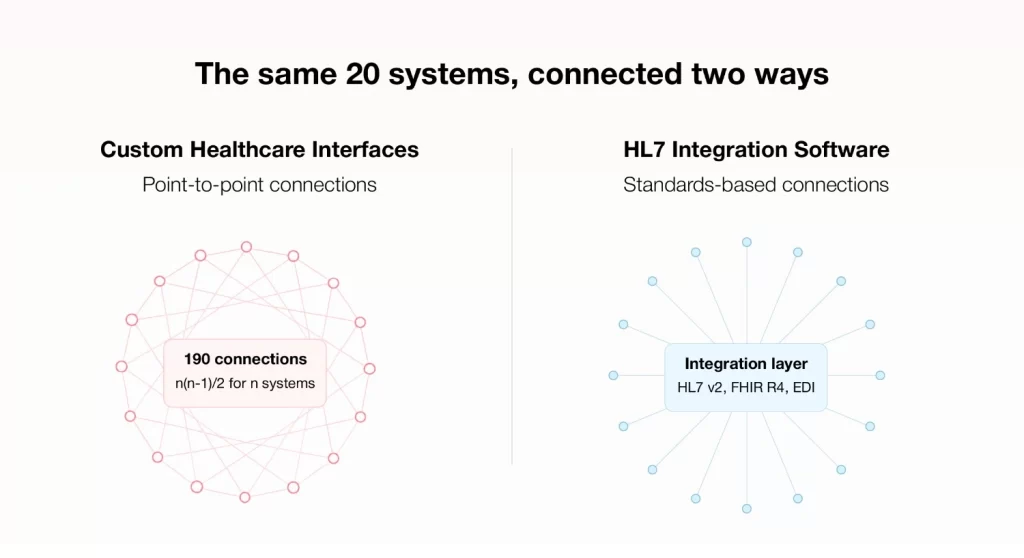
As the number of connected systems increases, point-to-point architectures can become increasingly difficult to maintain. In a fully interconnected environment, five systems could require up to 10 individual connections, while 20 systems could require as many as 190.
Not every healthcare environment requires every system to connect directly to every other system, but the underlying challenge remains: each custom interface introduces its own mappings, dependencies, monitoring requirements, error handling, testing, and maintenance responsibilities.
Over time, this creates an expanding integration footprint that becomes harder to govern and increasingly dependent on specialized knowledge of how individual interfaces were originally designed.
Ongoing Development Becomes a Long-Term Commitment
Custom interfaces require continuous maintenance as vendor APIs evolve, healthcare code sets change, security requirements are updated, and regulatory requirements introduce new data exchange needs. As the integration footprint expands, engineering teams can spend increasing amounts of time maintaining existing connections rather than building new capabilities.
Scalability Becomes an Operational Challenge
Custom interfaces may continue to function technically as the ecosystem grows, but the effort required to build, test, deploy, and maintain each new connection can slow partner onboarding. Over time, growing integration backlogs can delay new initiatives and limit how quickly the organization responds to business opportunities.
End-to-End Visibility Becomes Harder
When integrations are distributed across independently developed interfaces, troubleshooting can require teams to trace transactions across multiple applications, logs, and monitoring tools. Without centralized observability, identifying where a claim, eligibility request, or other transaction failed can become time-consuming and operationally expensive.
The Core Comparison: HL7 Integration Software vs Custom Interfaces
| Criteria | Standards-based Integration Software | Custom Healthcare Interfaces |
| Scalability | Reusable standards, mappings, and integration patterns can make adding new partners more repeatable as the ecosystem grows. | Each new connection may require additional development, testing, and maintenance, increasing complexity as the integration footprint expands |
| Implementation effort | Typically requires greater upfront investment in platform configuration, mappings, governance, and integration expertise. | Can be faster and simpler for a small number of well-defined connections, but effort increases as more interfaces are introduced. |
| Maintenance | Centralized integration architecture can simplify monitoring, mapping changes, version management, and governance across multiple connections. | Maintenance is distributed across individual interfaces, potentially increasing engineering effort and knowledge dependencies over time. |
| Interoperability | Standards such as HL7 and FHIR establish common structures and conventions that reduce the effort required to exchange data between compatible systems. | Optimized for specific endpoints and workflows, making reuse across additional systems more difficult without further development. |
| Long-term cost | Higher upfront investment may be offset by greater reuse and lower incremental integration effort as the ecosystem scales. | May have lower initial costs for limited use cases, but development and maintenance costs can increase as the number of interfaces grows. |
| Flexibility | Supports standardized exchange while allowing transformations, extensions, mappings, and business rules for organization-specific requirements. | Offers extensive control over individual integrations but can make enterprise-wide standardization and governance more difficult. |
| Compliance readiness | Standards-based architectures can provide a stronger foundation for meeting applicable interoperability, security, auditability, and governance requirements. Compliance still depends on implementation and organizational controls. | Compliance, security, auditability, and governance controls must be implemented and maintained across the relevant custom integrations and supporting infrastructure. |
| Operational visibility | Centralized integration platforms can provide end-to-end transaction monitoring, error tracking, and operational visibility across multiple data flows. | Visibility may be distributed across application logs and monitoring tools unless centralized observability is deliberately implemented. |
Key Differences In Details
Custom interfaces optimize for the specific. Standards-based integration optimizes for the collective. That distinction explains much of the difference between the two approaches.
For organizations with a small, stable integration footprint, custom interfaces can deliver significant value. When only a limited number of systems need to exchange highly specific data, the precision and control of a purpose-built connection may outweigh the benefits of introducing a broader integration architecture.
The equation changes as the ecosystem expands. Standards-based healthcare integration creates reusable patterns for data exchange, mapping, validation, and governance. Each new partner may still require configuration and testing, but teams can build on established integration patterns rather than starting every connection from scratch.
The challenge is that integration strategies are often evaluated against today’s requirements rather than tomorrow’s scale. Point-to-point development may work efficiently at first, but as systems, partners, and data flows multiply, maintenance effort, technical dependencies, and operational complexity can grow with them.
At that stage, modernization becomes more difficult. Organizations may need to migrate or refactor multiple interfaces while keeping existing data flows operational, turning what began as a series of practical integration decisions into a larger architectural challenge.
Note: Payers, TPAs, and PBMs facing that pattern need more than a message translator. They need a layer that connects fragmented systems through HL7, FHIR, and EDI, applies transformation rules consistently, and surfaces what is happening inside every transaction. VIZcare Connect from AVIZVA was built for that requirement, combining real-time data orchestration, a governed healthcare API suite, and preloaded provider and code set data sourced from CMS NPPES and PECOS.
Real World Healthcare Integration Scenarios
Scenario 1: Healthcare Payers Expanding Provider Networks
Consider a payer expanding into three new state markets and onboarding hundreds of provider organizations. The process can involve provider demographics, credentialing information, network participation data, contract details, and claims-related information that must be validated and synchronized across multiple payer systems.
With custom interfaces, each new partner or data source may require its own mapping, transformation rules, testing, and maintenance. As onboarding volume increases, integration development can become a bottleneck, potentially extending implementation timelines and increasing the burden on engineering teams.
With a standards-based integration architecture, organizations can reuse established mappings, validation rules, workflows, and integration patterns across new connections. Where supported, standards such as FHIR can provide structured representations of provider information through resources such as Practitioner, PractitionerRole, and Organization, while other provider data may continue to arrive through APIs, files, or standardized roster formats.
A centralized integration layer can then validate incoming information against trusted provider reference data, apply business rules, and route it to downstream network management and operational systems.
Scenario 2: PBMs Connecting Pharmacy Data Systems
Pharmacy benefit operations depend on timely, accurate data exchange across multiple systems. Member eligibility needs to be available at the point of service, formulary and coverage information must reflect current benefit rules, and accumulator data often needs to remain coordinated across pharmacy and medical benefit workflows.
With multiple custom interfaces, pharmacy networks, claims processing platforms, eligibility systems, and member-facing applications may rely on independently developed data flows with different update schedules and monitoring processes. As the ecosystem grows, maintaining consistency across these connections can become increasingly complex, increasing the risk of outdated information, reconciliation issues, and avoidable transaction errors.
With a standards-based integration architecture, organizations can manage multiple healthcare exchange standards through a centralized orchestration layer. NCPDP standards can support pharmacy transactions, X12 can facilitate applicable administrative exchanges, and FHIR APIs can enable modern member- and application-facing data access.
Centralized validation, transformation, routing, and monitoring help keep information synchronized across connected systems while making discrepancies easier to identify and resolve.
Scenario 3: When Custom Interfaces Make More Sense
Custom interfaces remain a practical choice in specific situations. Treating standards-based integration as universally superior can introduce unnecessary complexity where a focused connection would solve the problem more efficiently.
Proprietary or Highly Specialized Data
Internal risk scores, organization-specific analytics outputs, proprietary business models, and vendor-specific payloads may not map naturally to standard healthcare resources. While standards such as FHIR can often be extended or profiled to accommodate specialized data, a custom interface may be more practical when interoperability beyond the immediate use case provides limited value.
Legacy Systems with Limited Integration Capabilities
Some legacy platforms may only support flat files, database extracts, proprietary formats, or older communication methods. If a system is approaching retirement or replacement, investing heavily in modernizing its native integration capabilities may not be justified. A focused custom interface can provide a practical bridge to downstream systems.
Specialized Performance Requirements
Certain high-volume or latency-sensitive workloads may benefit from purpose-built integration patterns optimized for their specific processing requirements. The decision should be based on measured performance needs rather than an assumption that standards-based platforms cannot handle scale.
Short-Lived or Experimental Integrations
A temporary pilot, proof of concept, or limited-duration partner connection may not require the same architectural investment as a long-term enterprise integration. A lightweight custom approach can sometimes provide faster time-to-value while keeping implementation proportional to the expected lifespan of the connection.
The distinction is ultimately one of scope and reuse. Custom interfaces work best when they solve a clearly defined requirement where reuse is limited. Problems emerge when individually engineered connections become the default integration strategy across a growing enterprise ecosystem.
The Verdict: Which Approach Scales Better?
For complex and expanding healthcare ecosystems, standards-based integration generally provides a more scalable foundation than relying primarily on individually engineered point-to-point interfaces. But in practice, most enterprise healthcare environments need both.
The more important question is not whether standards or custom interfaces win. It is whether both can be managed through a coherent integration architecture or remain distributed across separate systems, teams, and monitoring processes.
Standards provide repeatability, while custom integration provides flexibility where unique requirements demand it. A scalable architecture should support both, using standards wherever practical and custom logic where it creates genuine business value.
The goal isn’t to eliminate custom integration. It’s to make custom integration the exception rather than the architecture.
What a Centralized Healthcare Integration Architecture Should Handle
Bringing standards-based and custom integrations into a more unified architecture requires capabilities that extend well beyond message routing. When evaluating an HL7 integration solution or broader healthcare interoperability platform, consider these seven areas.
- Integration orchestration- The platform should coordinate multi-step data flows across internal systems, external partners, APIs, and healthcare transactions. Workflow-driven orchestration reduces manual handoffs and helps maintain consistency as information moves between systems.
- Centralized monitoring- Operations teams need transaction-level visibility across integration flows, including the ability to identify failures, trace dependencies, and investigate bottlenecks from a centralized environment rather than navigating multiple disconnected logs
- Data transformation- A configurable transformation layer should support mappings between HL7, FHIR, X12 EDI, proprietary formats, and internal data models while applying partner and plan-specific business rules where required.
- Validation- Incoming and outgoing data should be validated against applicable schemas, implementation guides, profiles, terminology, and business rules. Identifying discrepancies early can reduce the risk of invalid or incomplete information propagating into downstream workflows.
- Security- Healthcare integration architecture should support appropriate safeguards for sensitive healthcare data, including encryption, authentication and authorization controls, access policies, logging, and auditability aligned with applicable organizational and regulatory requirements.
- Governance- As integration ecosystems expand, organizations need disciplined management of mappings, APIs, versions, dependencies, data lineage, configuration changes, and deployment processes. Centralized governance makes it easier to understand how changes to one integration may affect others.
- API management- Modern interoperability increasingly requires healthcare data to be securely available through APIs. API discovery, access management, versioning, documentation, monitoring, and lifecycle governance help internal teams and external partners consume data through controlled interfaces rather than tightly coupling applications to underlying systems.
The Business Case For Consolidation
The value of a healthcare integration platform extends beyond the number of interfaces it replaces. The stronger business case comes from reducing the operational complexity associated with managing a growing integration ecosystem.
Four areas are particularly important.
Reduced Maintenance Complexity
Centralizing mappings, monitoring, transformations, and governance can reduce duplicated engineering effort across individually managed interfaces. Instead of troubleshooting and maintaining each connection in isolation, teams can reuse integration patterns and manage more of the environment through common tooling and processes.
More Efficient Partner Onboarding
Reusable mappings, standards, APIs, validation rules, and onboarding workflows can reduce the amount of custom development required for each new provider, vendor, or trading partner. The actual improvement will vary by integration complexity and partner readiness, but the process becomes more repeatable as the ecosystem grows.
Lower Downstream Remediation Effort
Validating information before it reaches downstream applications can help identify missing, malformed, or inconsistent data earlier. This can reduce avoidable operational work associated with investigating transaction failures, correcting data, and reconciling inconsistencies across systems.
Greater Adaptability to Regulatory Change
Centralized architecture can make it easier to implement and govern changes required by evolving interoperability and data-exchange requirements. Rather than independently modifying numerous interfaces, organizations may be able to apply some changes through shared mappings, APIs, policies, and integration components. Regulatory compliance, however, still depends on the organization’s broader technical, operational, security, and governance controls.
Look Beyond the Platform License
The most useful comparison isn’t simply platform cost versus custom development cost.
Organizations should evaluate the total cost of their existing integration environment, including:
- Engineering time spent developing and maintaining interfaces
- Infrastructure and monitoring costs
- Partner onboarding effort
- Operational effort spent investigating integration failures
- Data reconciliation and remediation
- Security and governance overhead
- Changes required as standards and regulatory requirements evolve
Custom interfaces can appear inexpensive when each connection is evaluated independently. The economics can change as the ecosystem expands and the organization begins carrying the cumulative cost of maintaining, monitoring, governing, and modifying those connections.
That’s why the right integration strategy should be evaluated against the total cost and complexity of the integration estate and not the price of building the next interface.
Conclusion: Scale Comes From the Right Integration Strategy
Custom healthcare interfaces solve specific problems well, but their maintenance and governance requirements can grow as they are used across a broader integration ecosystem. Standards-based healthcare integration typically requires greater upfront investment, but creates reusable patterns that can reduce the effort required to build, manage, and scale future connections.
The organizations best positioned to scale aren’t necessarily those that choose one approach over the other. They are the ones that standardize data exchange wherever practical, reserve custom development for genuine exceptions, and manage both through a connected architecture with clear visibility across integration flows.
Three questions can help determine where your organization stands today:
- How many new integrations have you added in the last 24 months?
- How long does it typically take to onboard a new trading partner?
- When a transaction fails, how many systems or tools does your team need to investigate before finding the cause?
The answers reveal more than the number of interfaces you manage. They show whether your integration architecture is enabling growth or becoming another source of operational complexity.
Ultimately, the question isn’t HL7 or custom interfaces.
It’s how much of your integration ecosystem can be standardized without sacrificing the flexibility your business genuinely needs.

FAQs
1. What is the difference between HL7 integration and custom healthcare interfaces?
HL7 integration uses established healthcare data standards to connect systems, while custom healthcare interfaces are built specifically for a particular workflow, application, or business requirement.
HL7 integration allows healthcare organizations to exchange information such as patient records, lab results, claims data, and clinical information across different systems using a common communication standard. This makes it easier to connect EHRs, payer platforms, labs, and other healthcare applications.
Custom healthcare interfaces, on the other hand, are designed when standard integrations cannot fully support a unique business process or data requirement. They provide more flexibility but usually require more development effort, maintenance, and ongoing updates.
For most healthcare organizations, HL7 integration provides a scalable foundation, while custom interfaces are best used for specific scenarios where standard approaches are not enough.
2. Which is better: HL7 integration or custom healthcare interfaces?
For most healthcare organizations, HL7 integration is the better choice when scalability, interoperability, and long-term maintenance are priorities.
HL7-based integrations help organizations connect multiple healthcare systems without creating separate connections for every application. This reduces integration complexity and makes it easier to support future systems and regulatory requirements.
Custom healthcare interfaces are valuable when organizations have highly specialized workflows that cannot be supported through standard healthcare protocols. However, relying heavily on custom interfaces can increase technical debt because every change may require additional development and testing.
The right approach is often a combination: use HL7 integration as the core interoperability layer and build custom interfaces only where unique business needs require them.
3. What are the benefits of HL7 data integration?
HL7 data integration helps healthcare organizations exchange information faster, improve interoperability, and reduce manual data handling across systems.
Key benefits include:
- Better system connectivity: Enables communication between EHRs, payer systems, labs, pharmacies, and other healthcare applications.
- Reduced manual work: Automates data exchange that would otherwise require manual entry or file transfers.
- Improved data accuracy: Reduces errors caused by duplicate data entry and inconsistent information.
- Faster access to information: Helps providers, payers, and healthcare teams access relevant data when they need it.
- Scalable interoperability: Creates a foundation for connecting new systems, partners, and digital healthcare applications.
For healthcare organizations managing complex ecosystems, HL7 data integration helps create a more connected and reliable data exchange environment.
4. When should healthcare organizations use custom interfaces?
Healthcare organizations should use custom interfaces when standard integration methods cannot support specific workflows, data requirements, or business processes.
Custom interfaces may be needed when:
- A legacy system does not support standard healthcare protocols.
- An organization has unique workflows that require specialized data processing.
- Existing HL7 integrations cannot handle specific transformation or routing requirements.
- Business rules require customized validation or automation logic.
However, organizations should evaluate the long-term impact before building custom interfaces. While they solve immediate challenges, they can increase maintenance costs and make future integrations more complex.
A balanced approach is to use standards-based HL7 integration wherever possible and reserve custom interfaces for situations where they deliver clear business value.