
Table of Contents
Key Takeaways
- The Problem: Healthcare insurers often invest in new technology but still end up with disconnected systems, slow workflows, and poor visibility.
- The Shift: Move away from isolated tools and toward a connected, scalable, and compliance-ready technology foundation.
- The Fix: Choose insurance IT solutions that support interoperability, compliance, unified data, scalability, and AI readiness.
- Keep reading to see how to choose the right insurance IT solutions for long-term growth, faster execution, and better member experiences.
In 2026, healthcare insurers are no longer competing solely on the adoption of modern technologies, but on their ability to deliver seamless, on-demand engagement. Payers are now expected to provide consumer-grade experiences while operating within the strict boundaries of HIPAA and an increasingly complex regulatory landscape.
CIOs must figure out how to enable insurance software modernization without disrupting daily operations, all while keeping pace with competitors who bring new products to market in weeks, not months.
Modernization, however, is not just about adopting new technologies; it requires a well-defined roadmap to achieve true digital maturity.
The growing demand for robust insurance IT solutions has pushed healthcare organizations to rethink their entire technology strategy. Fragmented digital insurance systems are no longer viable when stakeholders expect real-time, intelligent, and fully connected experiences.
In this blog, we will explore :
- Why traditional IT decisions often lead to ‘point solution’ fatigue
- The five non-negotiable criteria for selecting future-ready healthcare insurance technology solutions
- A seven-step roadmap to align technology with the broader healthcare strategy
- How VIZCare by AVIZVA accelerates digital transformation and drives business impact
Why Healthcare Insurance Tech Investments Often Miss the Mark
The insurance platform market is expected to reach $229 billion by 2029, yet a research from KPMG reveals that only a quarter of insurance transformations actually succeed.
Despite significant investment in IT modernization, many healthcare insurers find their digital transformation initiatives falling short. Failure usually stems from the way decisions are made and executed.
Following are the key areas where decisions fail :
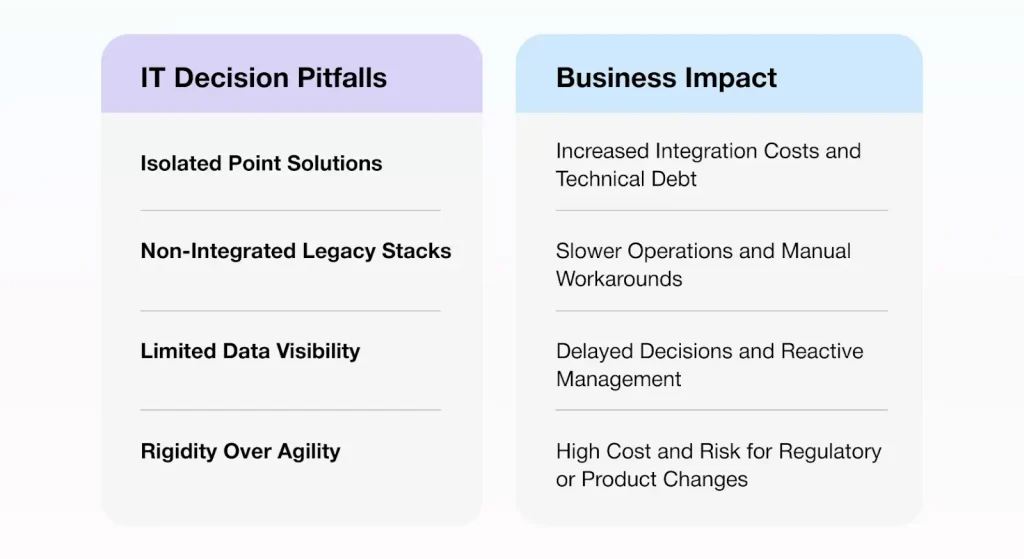
In practice, successful healthcare insurance software modernization occurs when insurers avoid simply replacing one silo with another and instead focus on integrated, end-to-end solutions.
5 Non-Negotiable Criteria For Selecting Your Next IT Solution
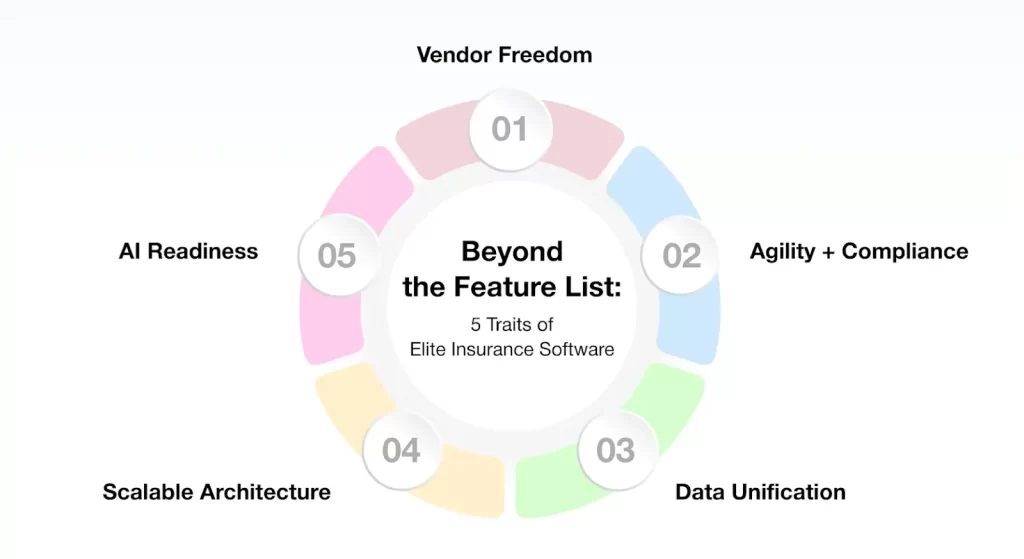
Choosing the right healthcare insurance IT solutions requires more than a simple feature comparison. The true differentiator is whether a solution can adapt and scale with your business while minimizing operational risk and complexity.
In 2026, the following five criteria are essential for any high-performing healthcare insurance technology platform.
1. Interoperability Without Vendor Lock-In
A modern healthcare insurance technology platform must integrate seamlessly with both existing core systems and future third-party solutions without creating dependency on a single vendor.
Key Considerations :
- Prioritize insurance solutions software or platforms with open APIs and standards-based connectivity, such as FHIR, supported by solutions such as VIZCare Connect
- Avoid isolated data dependencies; maintain full control over data movement
- Leverage purpose-built insurance data integration solutions like VIZCare Connect, which offers a robust suite of 300+ healthcare APIs covering enrollment, benefits, prior authorizations, and seamless cross-system connectivity.
- Evaluate IT solutions for insurance companies that support multiple integration protocols ensuring compatibility with both legacy and modern systems.
2. Speed To Market With Built-In Compliance
Healthcare insurers need to launch products, update plans, and respond to regulatory changes faster than ever. A platform that accelerates delivery while embedding compliance reduces operational risk and supports innovation.
Key Considerations :
- Choose insurance technology platforms with pre-configured HIPAA and SOC 2 guardrails, like VIZCare suite of products
- Ensure the platform supports rapid plan updates and workflow changes in days, not months
- Compliance should be embedded into processes from the start, not bolted on later
3. Data As A Strategic, Shared Asset
A modern healthcare insurance technology platform must treat data as a unified, governed, and accessible asset, not as fragmented information stored across disconnected systems. When data is structured and shared intelligently, it becomes the foundation for operational efficiency, regulatory transparency, and advanced analytics.
Key Considerations :
- Prioritize platforms that unify operational and analytical data across claims, enrollment, billing, and servicing workflows
- Ensure real-time visibility into end-to-end processes to eliminate silos and reduce manual reconciliation
- Select solutions with structured, clean data models that enable AI, predictive analytics, and automation
- Maintain strong data governance and accessibility controls without restricting cross-functional collaboration
- Check for strong insurance data integration solutions like VIZCare Connect that provide real-time data orchestration and synchronization.
- The most effective digital insurance systems also include preloaded and continuously updated healthcare industry datasets, reducing the burden of manual data management.
4. Scalability for Growth and Operational Complexity
A modern healthcare insurance technology platform must scale seamlessly as transaction volumes increase, new products launch, and operational complexity expands. Growth should not introduce performance degradation, system strain, or architectural limitations.
Key Considerations :
- Prioritize cloud-native platforms such as the VIZCare product suite that scale elastically to handle enrollment spikes, claims surges, and peak processing periods
- Ensure the architecture supports the addition of new business lines, distribution channels, and partner ecosystems without system rework
- Select insurance IT solutions designed for multi-entity, multi-product, and multi-geography operations
- Choose insurance solutions software with modular, extensible frameworks that adapt to evolving business models and regulatory environments
5. Built-In Intelligence And AI Readiness
A modern healthcare insurance technology platform must do more than store and process data; it must transform information into actionable intelligence. Embedded analytics and AI capabilities should enhance decision-making, streamline operations, and elevate consumer experiences without requiring separate, bolt-on solutions.
Key Considerations :
- Prioritize platforms with embedded analytics that surface real-time insights and ‘next-best actions’ across claims, enrollment, billing, and servicing workflows
- Ensure the data architecture supports AI models with clean, structured, and continuously updated datasets
- Select insurance software solutions designed to enable conversational interfaces and intelligent agents capable of resolving consumer intent efficiently
- Choose advanced insurance technology platforms, where intelligence is integrated directly into workflows, not layered on top as a disconnected capability

The Roadmap : Aligning IT Solutions with Your Healthcare Insurance Strategy
Digital transformation is not a one-time initiative; it is a sustained, strategic evolution that reshapes operations, customer engagement, and competitive positioning. Research from Deloitte shows that organizations with clearly defined digital roadmaps are significantly more likely to achieve their transformation objectives than those adopting technology in a reactive or fragmented manner.
To ensure your technology investments translate into measurable business value, you must follow this structured 7-step strategic roadmap :
Begin with a comprehensive and objective assessment of your current technology landscape. This evaluation should examine core systems, integration architecture, data accessibility, workflow efficiency, compliance posture, and scalability limitations.
Key Questions to Ask :
- Where do manual handoffs, redundant processes, or rework still occur?
- Which legacy systems constrain speed, transparency, or product innovation?
- How seamlessly does data flow across departments, partners, and platforms?
- How well does the IT solutions for insurance companies support real-time data visibility?
Step 2 : Establish Clear Transformation Goals
Anchor your transformation initiative to clearly defined, measurable KPIs such as reduced cost to serve, improved first-contact resolution, or faster time to market for new products.
Step 3 : Develop a Comprehensive Strategy
Design a transformation roadmap that goes beyond software selection. It should address not only technology architecture, but also organizational culture, data governance, and security and compliance requirements.
Step 4: Implement Key Technology Solutions
Deploy modular, interoperable digital healthcare insurance systems that enable phased modernization without disrupting day-to-day operations.
Step 5: Train Staff To Execute With Confidence
Equip your teams with the skills and clarity needed to work effectively alongside AI-driven tools and automated workflows.
Step 6: Monitor Performance and Drive Optimization
Leverage real-time dashboards to track performance against your defined KPIs and identify areas for improvement.
Step 7: Embed Technology For Sustainable Growth
Integrate your new IT capabilities into the core business strategy to ensure they drive long-term scalability, adaptability, and readiness for future market shifts.
Why AVIZVA’s VIZCare Suite is the Strategic Choice for Your Digital Roadmap
Choosing the right healthcare insurance IT solution means moving beyond disconnected, patchwork technologies. True digital transformation requires a strategic partner : one that delivers not just standalone tools, but a fully integrated ecosystem purpose-built for the complexities of healthcare insurance.
AVIZVA’s VIZCare Suite serves as that strategic engine – designed to seamlessly bridge the stability of legacy core systems with the agility, innovation, and scalability demanded by the 2026 healthcare market.
Reengineering Payer Operations with VIZCare
True transformation isn’t a disruptive ‘rip-and-replace’ overhaul : it’s the intelligent orchestration of data, people, and processes working in sync. It’s about evolving your ecosystem without sacrificing operational stability.
VIZCare by AVIZVA delivers exactly that. It is an AI-powered healthcare technology solution suite designed to transform healthcare operations, enhance consumer engagement and drive seamless data interoperability and connectivity. VIZCare comprises the following four synergistic products :
- VIZCare AI: A Healthcare AI platform with ready-to-deploy agents and freedom to build your own Applications. The platform is purpose-built for healthcare enterprises, combining context-aware, terminology-savvy intelligence with pre-training on real-world payer operations.
- VIZCare Xperience: A suite of AI enabled web portals & native mobile applications for all healthcare stakeholders & consumers. Designed to simplify and accelerate access to care, this suite brings all actions and information to the fingertips of the healthcare consumers.
- VIZCare Empower: An AI-enabled, unified platform for internal teams to manage the end-to-end lifecycle of healthcare business operations. It enables faster execution and a more connected service experience across functions.
- VIZCare Connect: A healthcare data connectivity platform designed to address the end-to-end data integration & interoperability needs of healthcare enterprises. The platform provides full real-time visibility into data movements, dependencies, and bottlenecks – empowering informed decision-making and ensuring efficient management across the entire data lifecycle.
Individually, VIZCare’s solution addresses a critical healthcare business challenge. Together, they form a unified, intelligent ecosystem : powering seamless data integration, enabling agile operations, ensuring supercharged consumer experience and embedding analytics and AI readiness into the core of your enterprise.
Choosing right insurance IT solutions aren’t about adding more technology to your stack. It’s about selecting a strategic partner who can help you evolve with clarity, control, and confidence; while building a future-ready foundation for sustainable growth.
Final Thoughts
Digital transformation in 2026 is no longer just a technology upgrade – it’s a comprehensive reinvention of the business itself. Organizations that will thrive in rapidly evolving market conditions are those that prioritize operational efficiency, intelligent decision-making, robust security, resource optimization, and above all a truly customer-centric approach.
With an end-to-end healthcare technology ecosystem such as the VIZCare suite by AVIZVA, organizations gain far more than advanced tools and are ahead in the market with integrated insurance IT solutions. They unlock seamless interoperability, AI-powered intelligence, enhanced consumer experiences, and more agile, efficient operations.
Ready to accelerate your journey to digital maturity? Book a Demo with AVIZVA and discover how VIZCare can transform your business.
FAQs
1. What does digital transformation mean for a healthcare insurance company?
For healthcare insurers, digital transformation means modernizing systems, data, and workflows to push performance, compliance, and member servicing. It fundamentally changes how you deliver value by automating administrative tasks and creating a more connected ecosystem for brokers and members.
2. Why is choosing the right IT solution critical for insurance digital transformation?
The right insurance IT solutions determine whether modernization reduces complexity or adds to it.
Poor choices create disconnected systems and slow progress, while the right insurance technology platforms enable:
- Interoperability across existing systems.
- Faster response to regulatory and market change.
- Long-term scalability and adaptability.
3. What types of IT solutions should healthcare insurers prioritize?
You should prioritize modular insurance technology platforms, such as those found in the VIZCare suite, that offer:
- Systems that stay in sync. So accurate, real-time information is accessible across every touchpoint.
- Ready-to-use healthcare tools that get teams running faster with 300+ prebuilt workflows.
- AI that understands healthcare to handle queries, claims, and decisions.
- One platform for every internal team to onboard and handle operations.
- Compliance built in, with security and regulatory standards enforced across the entire platform.
4. How can insurance organizations prepare teams for adopting new IT solutions?
Preparation starts with aligning technology changes to business goals. Insurers should adopt a phased rollout approach, beginning with internal teams and workflows before expanding adoption more broadly.
As familiarity grows, role-based training, cross-functional collaboration, and clear communication help scale adoption. When teams see how new tools simplify daily tasks and improve outcomes, readiness and acceptance follow naturally.
5. What common challenges should insurers anticipate when implementing new IT solutions?
Beyond budget constraints, you must proactively manage:
- Legacy Integration Hurdles: Bridging modern APIs with decades-old core digital insurance systems that were not built for cloud connectivity.
- Complex Data Migration: The risk of data loss or reliability issues when moving sensitive records across platforms.
- Regulatory Compliance: Navigating the non-negotiable security requirements of HIPAA and other evolving privacy mandates.