
Table of Contents
Key Takeaways
- The Data Divide: Disconnected healthcare systems create barriers to accessing unified, accurate data.
- The Integration Challenges: Data silos and inconsistent formats hinder information exchange across healthcare systems.
- The Need for Connectivity: Healthcare organizations need secure, interoperable systems to connect data sources and improve accessibility.
- The Organizational Benefits: Integrated data supports accurate claims processing, informed decisions, and coordinated care.
- AVIZVA’s Approach: AVIZVA helps healthcare organizations connect disparate systems and enable secure, standardized healthcare data exchange.
Healthcare data integration connects information from multiple healthcare systems, including EHRs, claims platforms, pharmacy systems, and consumer portals, into a unified data environment. It helps healthcare organizations improve data exchange, reduce operational gaps, and access accurate information for better decision-making.
The market is predicted to grow to USD 43.66 billion by 2034 from USD 23.48 billion in 2025, reflecting a compound annual growth rate (CAGR) of 7.13% during the forecast period. (Market Research Future, 2025)
This market expansion is mainly driven by the widespread adoption of EHR systems and the increasing need for data-driven decision-making across healthcare enterprises. What fuels this growth further is the rise in government regulations aimed at enhancing data interoperability and fostering patient-centered care.
To keep up with these industry developments, healthcare stakeholders, including providers, insurers, pharmacies, and public health agencies, are increasingly leveraging data integration technologies to reduce operational costs, improve patient outcomes, and streamline processes across their ecosystem.
As the healthcare industry accelerates toward a more interconnected, data-driven future, this blog delves into the opportunities, challenges, and best practices for successful healthcare data integration.
Data Integration in Healthcare
A healthcare enterprise’s ability to deliver quality care relies on its capacity to access and make sense of vital healthcare data in real time. However, this healthcare data resides in silos across multiple systems such as insurance claims, pharmacy systems, electronic health records (EHRs), and consumer portals, creating significant barriers for effective access and analysis. Healthcare data integration systems help connect these sources, enabling organizations to bring together information from different platforms into a unified data environment.
Data integration eliminates these barriers by unifying data from these disparate sources into a single, unified repository. This provides healthcare enterprises with a comprehensive, 360-degree view of a patient’s/member’s health.
Furthermore, the cleaning, standardization and organization of data undertaken during the integration process ensures that the consolidated data is not just accurate, but also structured for easy extraction of actionable insights. These insights allow enterprises to optimize decision-making, reduce operational costs, and enhance the overall care delivery.
Benefits Of Data Integration In Healthcare
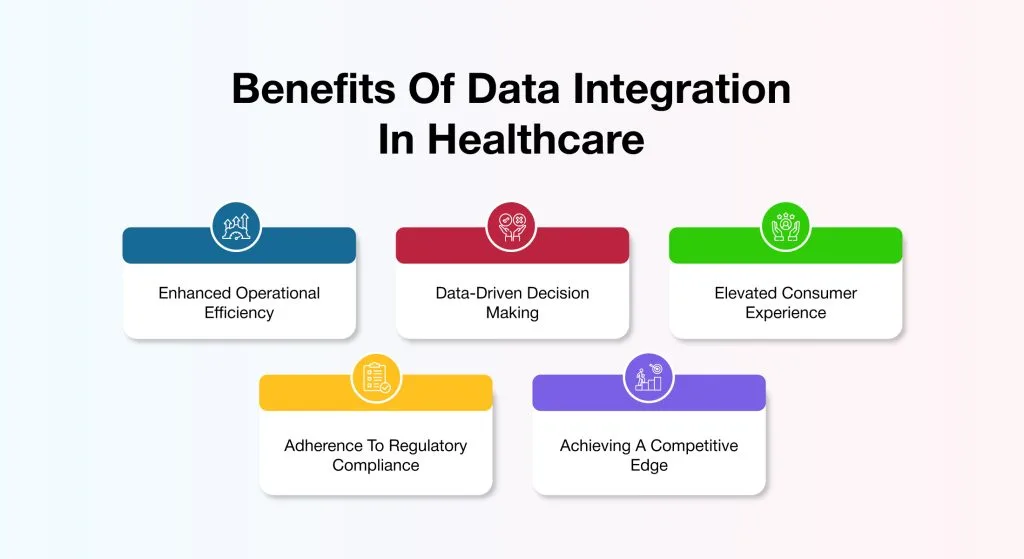
1. Enhanced Operational Efficiency
To ensure effective healthcare delivery, enterprises must manage a variety of high-volume administrative processes, including member enrollment, eligibility verification, prior authorization, claim adjudication, invoicing & billing management, payment processing and so on. Each of these processes relies on pulling large volumes of data from multiple disconnected systems.
By leveraging real-time data integration, healthcare enterprises can consolidate all the vital data into one centralized location. This eliminates the need for traditional data entry across different systems, minimizes errors and streamlines administrative workflows across the board.
For example, during the claims adjudication process, the integration platform can cross-reference claims data with coverage details, billing codes, and past medical records – all at a single place. This ensures accurate claim processing, reduces the risk of errors, prevents fraud and accelerates overall claim resolution.
2. Data Driven Decision Making
Predictive analytics is a powerful tool for healthcare enterprises to safeguard their financial stability and drive long-term growth. By integrating data, healthcare enterprises gain a holistic, 360-degree view of member utilization, costs, and health outcomes. This comprehensive visibility equips them with actionable insights into at-risk populations and emerging care needs, allowing for more informed decision-making and proactive care management.
Additionally, the ability to identify care gaps and perform accurate risk scoring enhances the enterprise’s ability to support risk adjustment and drive effective population health initiatives.
3. Elevated Consumer Experience
Today, healthcare consumers expect personalized, seamless, and consistent care delivery from all involved stakeholders, including healthcare providers, pharmacies, TPAs, payers, and more. However, these stakeholders often store consumer data in disconnected, siloed systems, leading to fragmented care experiences and missed opportunities for personalized care.
Data integration addresses this challenge by consolidating consumer data from disparate sources into a centralized, unified profile. This centralized data enables better coordination among healthcare stakeholders, improving the quality and continuity of care throughout the consumer’s journey.
Furthermore, the integration process allows healthcare enterprises to analyze this consolidated data and gain deeper insights into individual consumer preferences and needs. This, in turn, allows them to deliver personalized services and engage with consumers with more precise, targeted communication.
4. Adherence To Regulatory Compliance
The healthcare industry has to follow stringent regulations that mandate the secure storage, management, and sharing of sensitive healthcare data across systems. The Health Insurance Portability and Accountability Act establishes privacy & security standards for patient health information; the CMS and ONC Interoperability laws mandate secure and standardized data interchange across systems.
Health service data integration also supports more coordinated member experiences by helping healthcare stakeholders access updated information across the care journey.
Data integration takes an important role in helping healthcare enterprises achieve regulatory compliance by providing a centralized platform for managing and securing sensitive consumer data. Moreover, real-time monitoring and auditing capabilities offered by data integrated platforms helps enterprises prevent unauthorized access and mitigate the risk of data breaches.
5. Achieving A Competitive Edge
The healthcare landscape is becoming increasingly competitive. To stay ahead of industry innovation and navigate competitive pressures, enterprises can harness the power of cutting-edge data integration technologies.
By consolidating data across systems, enterprises can create a strong foundation for adopting emerging technologies like AI, machine learning, and telehealth. This would not only drive improvements in operational efficiency and decision-making but also elevate the consumer experience.
Furthermore, data integration would support scalability, allowing enterprises to manage growing member volumes and adapt to evolving regulatory demands without disrupting workflows.
Key Technologies Driving Successful Healthcare Data Interoperability & Integration
Achieving frictionless data interoperability relies on technologies and standards that help organizations collect, transform, exchange, and analyze information across different healthcare systems. These include APIs, ETL processes, integration platforms, and healthcare data standards such as HL7 and FHIR. The key components are explained below:
1. Extract, Transform, Load (ETL) : ETL is a fundamental process in healthcare data exchange. It includes extracting raw data from different sources, transforming it into a standardized, usable format, and then loading it into a central storage system for easy access and analysis.
This process supports both large-scale batch processing and smaller, real-time updates using Change Data Capture (CDC). ETL also plays a key role in data cleansing, quality checks, aggregation, and reconciliation, ensuring that the data remains accurate, reliable, and ready for use in decision-making.
2. Enterprise Information Integration (EII) : EII facilitates real-time data access by connecting multiple disparate data sources and providing a unified view. It empowers users to query and analyze data through a simplified interface without the need to manage complex integrations.
The system handles different formats and sources in the background, allowing for seamless, real-time analysis and reporting, all without requiring data to be physically moved between systems.
3. Enterprise Data Replication (EDR) : EDR focuses on moving data efficiently. Unlike ETL, it does not transform data but it simply copies complex data from multiple sources and delivers it to target destinations in real-time. This ensures that enterprises are updated with the latest information and data is always available when needed.
4. Data Visualization : It is a powerful tool for converting raw data into actionable insights. Modern analytics platforms connect seamlessly with common data sources, enabling users to create intuitive dashboards, reports, and charts. These visualizations make it easier to track key metrics, identify trends, and monitor progress toward objectives.
Data visualization makes business intelligence more accessible and actionable by empowering stakeholders with the insights they need to make informed decisions
Primary Challenges Faced During Integration Of Healthcare Data

Common challenges include maintaining data quality, protecting sensitive healthcare information, and meeting strict regulatory requirements such as HIPAA.
The following points explain the key challenges healthcare organizations face during integration and how these issues affect operational efficiency and member outcomes.
1. Bridging The Gap Between Legacy Systems & Modern Digital Tools
Many healthcare enterprises continue to rely on legacy systems that were not built to meet modern data-sharing requirements. These outdated platforms often lack API support and real-time integration capabilities, making seamless data exchange a challenge.
Thus, integrating these legacy systems with modern healthcare technologies becomes a time-consuming and costly process. It can lead to extended downtime and diminished scalability, limiting an enterprise’s ability to quickly adapt to evolving healthcare models and regulatory requirements.
2. Achieving Standardization Across Diverse Data Formats
Healthcare systems store data in a wide range of formats, such as HL7, CCDA, FHIR, EDI X12, IHE, DICOM, NCPDP, ICD-10, and QRDA, among others. The absence of a standardized data storage approach complicates the integration and harmonization of data from these disparate sources.
This inconsistency can result in system errors, compromised data quality, reduced usability, inaccuracies, and incomplete insights, ultimately hindering effective decision-making.
3. Maintaining Data Quality & Accuracy
Data integration involves consolidating information from various systems, such as insurance claims, electronic health records (EHRs), pharmacy systems, and patient portals. However, discrepancies such as incomplete, outdated, or duplicated data can arise within any of these systems, potentially undermining the overall quality and accuracy of the integrated data.
This compromised data quality can lead to errors in claims adjudication, incorrect eligibility checks, and misinformed decision-making.
4. Ensuring Data Security, Privacy & Compliance
Healthcare data is highly sensitive and subject to strict regulations, like HIPAA (Health Insurance Portability and Accountability Act) and rules protecting PHI (Protected Health Information). When integrating data across various systems, it becomes crucial to implement security measures to safeguard member information and maintain compliance with regulatory frameworks.
Any security lapse during the integration process could expose sensitive data to unauthorized access, risking member privacy and potentially leading to significant legal consequences.
Best Practices For Healthcare Data Integration

1. Adopting A Focused Integration Strategy
Healthcare enterprises manage large volumes of data, including sensitive member records, insurance claims, lab results, and pharmacy transactions. Before integrating this data, it’s crucial to identify the most valuable information and understand why it matters. Without a well-defined strategy, the integration process can become fragmented and inefficient, undermining its potential to improve decision-making and operational outcomes.
Key questions healthcare enterprises should ask themselves include: Are their current EHR and EMR systems meeting enterprise needs, or do they require improvements? What operational inefficiencies or care gaps are being caused by disconnected data? How is data currently being utilized, and where can integration help drive more informed, effective decision-making?
By addressing these strategic questions, healthcare enterprises can ensure that their data integration efforts align with organizational objectives, regulatory requirements, and the evolving needs of the industry.
2. Embracing An API-Driven Real-Time Data Exchange
Many healthcare enterprises continue to rely on traditional flat files for data exchange because of their simplicity and cost-effectiveness in batch processing. However, these files lack the flexibility required for real-time updates and often necessitate significant transformation to fit structured systems, resulting in delays and inefficiencies.
In contrast, Application Programming Interfaces (APIs) enable seamless, real-time data exchange, ensuring the flow of up-to-date and accurate information across systems. APIs improve interoperability, enhance decision-making, and support automation.
Although implementing APIs requires specialized technical expertise for development, integration, and ongoing maintenance as standards evolve, adopting API-driven data exchange allows healthcare enterprises to boost efficiency, minimize errors, and streamline workflows.
3. Designing Scalable Integration Platforms
As healthcare enterprises expand, their data integration requirements become more complex. A future-proof integration strategy must be flexible enough to incorporate new systems, data sources, and regulatory changes, all while maintaining optimal performance. Scalability is essential to ensure that as data volumes grow, the systems remain efficient, responsive, and capable of handling complex workflows.
Is your current integration platform equipped to scale with rising data demands? If not, partnering with a healthcare technology expert like AVIZVA could be the solution. Our robust and flexible integration solutions ensure seamless data management, allowing enterprises to scale without disruptions and maintain optimal performance.
4. Standardization of Data Formats Across Systems
Healthcare data is stored in diverse formats across multiple systems within the healthcare ecosystem. This inconsistency complicates and slows down the integration process. Without a standardized approach, enterprises need to perform extensive data transformation before they can share and analyze the information. This leads to significant delays in data processing, a higher likelihood of inaccuracies, and increased operational costs.
To overcome these challenges of data inconsistency, healthcare enterprises must adopt industry-standard data formats such as FHIR, HL7, EDI X12, CCDA, NCPDP, and DICOM. This standardization will enable enterprises to streamline data exchange, enhance regulatory compliance, and drive faster, more informed decision-making.
Drive Seamless & Secure Data Integration By Partnering With AVIZVA
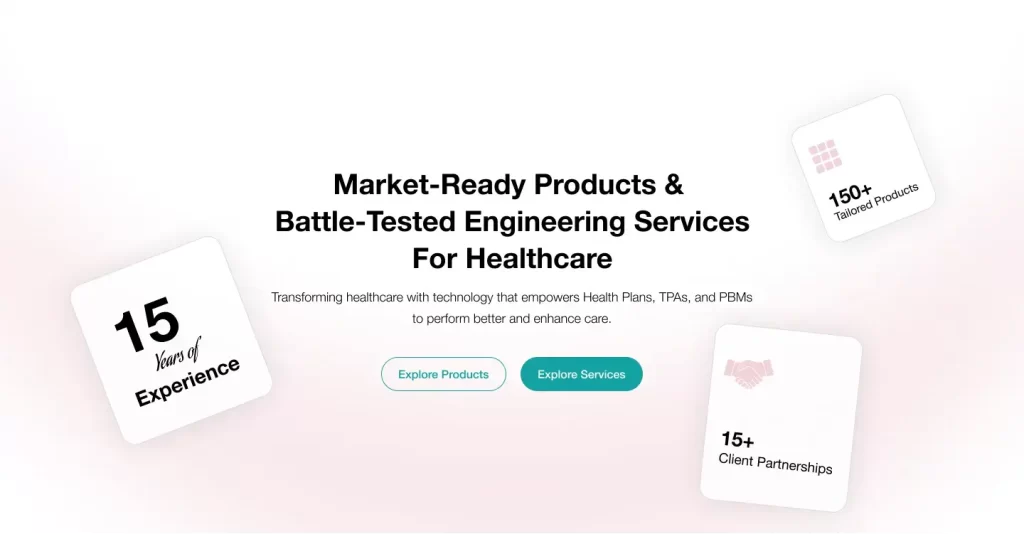
AVIZVA is a healthcare technology company that specializes in empowering Payers, TPAs, and PBMs with seamless, secure and compliant data integration solutions.
Built on next-generation robust architecture, AVIZVA’s integration solutions are designed to manage all types of healthcare data, including claims, eligibility, benefits, accumulators, and prior authorizations, across diverse healthcare data formats such as HL7, CCDA, FHIR, EDI X12, IHE, DICOM, NCPDP, ICD-10, and QRDA.
Here’s why you should partner with AVIZVA to meet your data integration needs:

- Deep-Rooted Expertise – With 15 years of industry experience, AVIZVA has delivered over 150 custom-built solutions for healthcare insurers, PBMs, and TPAs. Their engineering expertise spans designing and developing self-service experience products for consumers, managing data integration across external parties and internal systems, building innovative, industry-first products such as an in-flight drug pricing arbitrage engine, and so on.
- Accelerated Development – AVIZVA leverages ready-to-use Software Development Kits (SDKs) that are designed for user experience, microservices, and integration applications. These SDKs are equipped with built-in frameworks and best-in-class execution standards, enabling rapid, high-quality development.
- Impeccable Quality – AVIZVA embeds quality assurance into every stage of development. This covers code, functionality, security, and performance, all of which are built into frameworks pre-integrated with AVIZVA SDKs. These frameworks ensure adherence to quality standards from the moment the first line of code is written. Additionally, automated execution of all quality aspects is integrated with the Build and Release process, ensuring nothing is overlooked.
- Impenetrable Security – From design to deployment, security is embedded at every stage of application development at AVIZVA. Their applications are built to withstand threats while ensuring seamless access control, encryption, and continuous monitoring.
- Predictable Delivery – AVIZVA helps organizations plan and track large-scale implementations while maintaining the agility needed for iterative improvements. By leveraging automated planning and reporting frameworks, they enable enterprises to have real-time visibility and control over the development progress.
Conclusion
To stay ahead in the increasingly data-driven healthcare landscape, enterprises must embrace future-looking data integration solutions. These solutions enable healthcare enterprises to streamline operations, enhance care coordination, and drive better health outcomes.
Successful integration relies on a focused strategy that includes embracing an API-driven approach for seamless data exchange, designing scalable platforms, and standardizing data across systems. Additionally, training internal teams on data integration best practices ensures a smooth and effective implementation, further driving success.
As healthcare enterprises embrace digital transformation, the ones that prioritize robust data integration strategies will lead the way. Thus, the future truly belongs to enterprises that put the right data in the right hands at the right time.
At AVIZVA, we specialize in building intelligent and easy-to-plug data integration solutions. Are you a healthcare enterprise who is navigating data connectivity challenges? Get in touch with AVIZVA now!

FAQs
1. What is healthcare data integration?
Healthcare data integration is the process of bringing together information from multiple systems, applications, and data sources into a unified, consistent view. In the world of health insurance and healthcare delivery, this means connecting claims data, member information, provider details, clinical records, and regulatory datasets so that they don’t live in isolated silos.
Instead of teams juggling spreadsheets, reconciling mismatched files, or logging into multiple platforms, integration allows data to flow seamlessly across the enterprise. It ensures that a prior authorization in one system, a claim in another, and a provider credential in a third all “speak the same language.
2. What are the common challenges in healthcare data integration?
Data integration challenges in healthcare hold the promise of creating a seamless flow of information across systems, empowering payors, providers, and members alike. Yet, achieving this vision is no small feat. Organizations often encounter several hurdles that can slow down or complicate their integration journey:
- Fragmented Data Sources
Healthcare data lives in many places, including claims platforms, EHRs, enrollment systems, pharmacy databases, and beyond. Bringing these disparate sources together into a unified view is often complex and time-consuming.
- Variety of Data Formats
From EDI and HL7 to NCPDP, NDC codes, and proprietary formats, healthcare data isn’t standardized. Integrating across multiple formats requires deep technical and domain expertise.
- Data Quality Issues
Duplicate records, missing fields, or outdated information can compromise the integrity of integrated data. Poor-quality data not only slows down operations but can also lead to errors in decision-making.
- Regulatory & Compliance Barriers
Strict standards like HIPAA, GDPR, and HITRUST require secure handling of data. Integration solutions must balance seamless connectivity with robust compliance and privacy safeguards.
- Scalability Concerns
As organizations grow, so does the volume and velocity of healthcare data. Many integration systems struggle to handle large-scale data exchanges without performance issues.
- Interoperability Gaps
Different healthcare systems may not “talk” to each other effectively. Lack of true interoperability often forces enterprises to rely on workarounds, manual intervention, or costly custom development.
- Limited Real-Time Access
In many cases, data is shared in batches rather than in real time, delaying insights that could improve care coordination, claims processing, and member experience.
3. How can interoperability improve healthcare outcomes?
Interoperability enables seamless data exchange across providers, payers, and members, ensuring that accurate and timely health information is available at every point of care. By eliminating data silos, it reduces errors, avoids duplicate tests, and accelerates decision-making. Members benefit from more coordinated care, while providers gain a holistic view of medical histories, leading to better diagnoses and treatment plans. For healthcare enterprises, it translates into improved efficiency, lower administrative costs, and ultimately, healthier patient populations.
4. What are best practices for integrating healthcare data systems?
Standardizing integration protocols makes system-to-system connections far more secure and reliable. This gives technical and operational teams the clean, connected data they need to run enterprise workflows smoothly. Here are a few best practices:
- Adopt Industry Standards Early
- Prioritize Data Quality & Governance
- Design for Interoperability, Not Just Connectivity
- Build with Security & Compliance at the Core
- Leverage API-First Architectures
- Enable Real-Time Data Exchange
- Invest in Monitoring & Transparency Tools
- Engage Stakeholders Across the Value Chain
5. Is data integration in healthcare compliant with HIPAA?
Yes, when implemented correctly. Healthcare API integration must follow strict HIPAA guidelines to ensure the confidentiality, integrity, and security of patient health information (PHI). This means using secure data transfer protocols, access controls, encryption, and audit trails. By adhering to HIPAA standards, integrated systems not only safeguard sensitive data but also build trust among patients, providers, and payers.
6. How to integrate healthcare data from multiple systems?
Healthcare data can be integrated from multiple systems by following a structured process:
- Identify healthcare data sources such as EHRs, claims platforms, pharmacy systems, and member portals that need to exchange information.
- Connect the systems using integration methods such as APIs, ETL pipelines, or healthcare integration platforms.
- Map and transform data into compatible formats using standards such as HL7 and FHIR so different systems can understand and exchange information.
- Validate and standardize the data to remove inconsistencies, duplicate records, and incomplete information.
- Securely exchange and monitor data flows while maintaining compliance with healthcare regulations such as HIPAA.
7. How can I ensure compliance with healthcare regulations while integrating data?
Healthcare organizations can maintain compliance during data integration by implementing security controls, encryption, access management, audit trails, and healthcare interoperability standards. A well-designed and secure integration platform like AVIZVA’s VIZCare Connect helps healthcare enterprises manage data exchange across systems with capabilities such as data validation, secure connectivity, and support for healthcare standards like HL7 and FHIR.