
Table of Contents
Key Takeaways
- The Problem: Customer service in health insurance is slow, fragmented, and heavily manual, leading to long wait times, repetitive queries, and poor member experiences.
- The Shift: AI is transforming support with instant responses, personalized interactions, and real-time agent assistance, moving customer service from reactive to proactive.
- The Fix: Use AI-powered conversational tools and self-service platforms to resolve queries faster, reduce support load, and deliver consistent, context-aware experiences across all touchpoints.
- Keep reading to see how AI-driven self-service, personalization, and automation are reshaping customer service in health insurance.
Let’s be honest – navigating customer service in health insurance can feel like a never-ending maze.
Picture this: A member is just trying to check on a claim. They call the support line, go through a bunch of confusing menus, type in policy numbers over and over, and then wait. And wait. Still no real help.
On the other hand, the support team is also overwhelmed. They’re trying to handle tons of calls, each with its own issue, all while keeping up with changing rules and regulations.
It’s tough on both sides. The system is slow, stressful, and built on a one-size-fits-all model that no longer works.
- Never-ending wait times.
- Processes are too complicated.
- Responses feel robotic.
- And too much still depends on manual effort.
But here’s the good news: AI is revolutionizing customer service in health insurance making it faster, smarter, and far more human. It helps cut through the usual mess with quicker answers, smarter tools, and support that actually feels personal. No more “please hold” loops. No more repeating the same question over and over.
How AI Is Reshaping Health Insurance Customer Service
AI-driven systems are now helping insurers :
- Handle routine queries instantly
- Deliver tailored answers based on your specific plan
- Route requests to the right person – without detours
- And free up agents to focus on the complex stuff that needs a human touch
It’s not just about speed, it’s about feeling heard. In this blog, we’ll dive into how AI is addressing these challenges head-on, reshaping the way insurers interact with their members. Let’s explore how AI is stepping in to offer.
In this blog, we’ll explore five practical ways AI is rewriting the customer service playbook in healthcare and why insurers can’t afford to wait.
Why Is Health Insurance Customer Service Still So Frustrating?
Let’s face it, customer service in health insurance has long been stuck in an outdated loop of old tools and tired systems. Think phone lines that never stopped ringing, clunky spreadsheets, and legacy CRMs that seem to complicate even the simplest tasks.
Before AI came into the picture, this was the everyday reality for most insurers; more paperwork, more pressure, and ballooning operational costs just to keep up with basic service expectations.
Let’s rewind and take a closer look at what the world looked like – both for the people seeking help and the teams trying to provide it.
1. When a Simple Question Turns Into an Hour-Long Hold
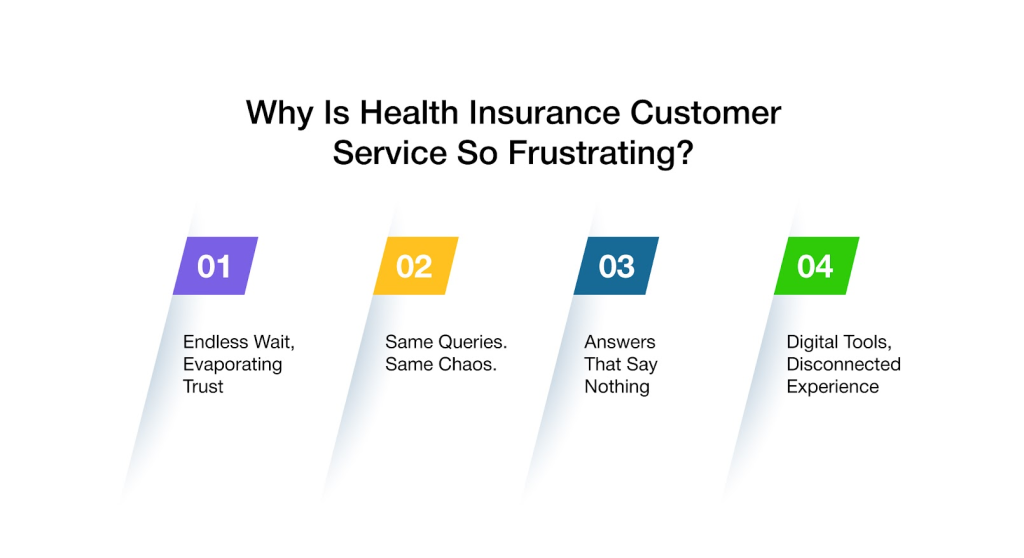
Picture a member opening an unexpected medical bill and then dialing their insurance provider, hoping for clarity. Instead, he is put on hold – 10 minutes, 20 minutes… nearly an hour passes with no resolution in sight. What begins as a simple question quickly becomes an exhausting ordeal. The trust they place in their insurer? Starting to erode.
2. Stuck on Repeat: The Cost of Repetitive Queries
Support agents, meanwhile, are drowning with repetitive queries : “Is this covered?” “What’s the status of my claim?” “Am I eligible for this treatment?” Answering the same questions day in and day out not only wastes valuable time – it also means more urgent or complex consumer issues get pushed to the side.
3. Scripted Responses, Real Disappointment
Today’s members expect more than scripted answers – they want personalized, relevant support based on their unique plans. But traditional systems can’t deliver that. Instead, members often receive generic responses that fail to resolve their concerns, leaving them feeling like just another ticket in a long queue.
4. Digital Self-Service? More Like Digital Stress
Even when digital portals exist, they are far from user-friendly. Frustrated by confusing layouts or outdated data, members give up and pick up the phone—further overwhelming already stretched call center teams.
How AI Is Transforming Customer Service in Health Insurance
Your support team is buried under thousands of inquiries, but one call stands out : a member confused about an out-of-network charge. The answer is simple, yet ther are placed on hold, passed between agents or stuck while someone toggles between systems just to find the right info.
Now, multiply that moment by every call, every day.
That’s where AI steps in – and it’s changing everything.
1. AI-Powered Conversations : Instant Help, Zero Hold Time
Think of AI virtual assistants as tireless teammates – always on, always ready to assist. They handle common member questions like checking claim status, explanation of benefits (EOB), or confirming eligibility, with clear, jargon-free responses.
No more long waits. No more repeating the same question. Just fast, clear answers when you need them.
By taking care of routine queries, AI dramatically reduces call volumes – freeing up human agents to focus on complex or high-emotion cases. It’s a win-win for both servicing teams and consumers.
Meet VIZCare AI: Built for Healthcare, Designed for Impact
One standout in this space is VIZCare AI, developed by AVIZVA. Purpose-built for the healthcare and insurance ecosystem, and tailored to optimize the consumer’s experience with instant answers to their questions. Our AI-based assistant is designed to provide a self-service experience without long wait lines or phone calls.
VIZCare AI is not only fast but also secure and fully compliant with healthcare regulations, ensuring consumers get the help they need with confidence and ease.
VIZCare AI couples conversational intelligence with domain-specific understanding to ease member interactions, enable query resolution with dexterity, and proactively guide members through the service journey. Backed by a secure, HIPAA-compliant architecture, it never compromises on speed, reliability, or compliance, ensuring the member receives the right kind of help and support with ease and confidence.
2. Personalized Interactions
Think of it like this: instead of treating your customers like just another number, AI actually gets to know them.
AI allows insurers to move past generic, one-size-fits-all service by truly understanding each member. By analyzing prior claims, plan usage, and past interactions, AI can proactively offer relevant advice and timely reminders—whether it’s a notification about an upcoming wellness visit or a real-time update on a claim.
This level of personalization helps members feel seen and understood, not just processed. It fosters trust, strengthens relationships, and transforms routine support into meaningful engagement.
3. Faster Backend Support for Agents
AI isn’t just transforming the member experience – it’s becoming a behind-the-scenes powerhouse for customer support teams, too.
Instead of toggling between disconnected systems, agents now get instant access to the information they need. AI pulls real-time data from policies, claims, and provider records, reducing delayed handoffs and customer frustration.
Platforms like VIZCare Empower take this a step further. While an agent is on a call or chat, the system offers real-time suggestions, automatically creates notes or sets follow-up tasks, and even generates live transcripts, so agents can stay focused on helping and not typing.
The result?
- Faster, more accurate responses
- Happier, more loyal customers
- Empowered Support Teams that can finally breathe
Together, these tools make every insurance support interaction faster, smoother, and more personal.
Is Self-Service the New Frontline in Customer Experience?
In today’s digital world, health insurance members don’t want to wait on hold or struggle through chunky portals just to check claims or download a form. They expect seamless, on-demand service – just like they get from their favourite e-commerce or banking apps.
And now, thanks to AI, that expectation is becoming a reality.
How AI Is Powering Smarter Self-Service?
AI is transforming self-service from a static FAQ section into a dynamic, responsive experience. Members can now handle tasks that once required an agent—quickly, easily, and on their own terms:
- Instantly check claim status
- Download ID cards, EOBs, or other essential documents with just a click.
- Compare plan options and benefit details
- Ask natural language questions like “Is this lab test covered?”—and get tailored, accurate answers
Not Just Chatbots—Conversational Intelligence
Forget robotic scripts. Today’s AI-driven support tools understand intent, context, and even past interactions. They learn continuously to offer smarter responses—making conversations feel less transactional and more human.
It’s not about clicking through menus. It’s about empowering members to get real answers, fast.
Impact of AI-Driven Self-Service on Customer Service in Health Care
Let’s break down how this shift is helping everyone, from members to insurers:
✅ Reduces Load on Support Teams :
Free up agents to focus on complex, high-touch cases
✅ 24/7 Member Support
Resolve issues anytime—no waiting, no office hours
✅ Fewer Calls, Lower Costs
Automate routine tasks without sacrificing service quality
✅Stronger Member Loyalty
Personalized, responsive support builds trust
✅ Happier, More Loyal Members
When members feel in control, trust grows. They’re more likely to renew and recommend your plan to others.
✅A Clear Competitive Advantage
Modern self-service is a major differentiator in today’s crowded market
AVIZVA: Your Trusted AI Partner for Smarter Customer Service
The future of customer service in health insurance is not just faster responses, it’s connected, intuitive, and personalized experiences across every interaction. This is where VIZCare Xperience, AVIZVA’s unified experience platform, plays a pivotal role.
Customer service on health insurance must not cater to a single audience but instead seamlessly sustain four very different groups-labeled members, brokers, providers, and employers-who call for quite distinctive needs, expectations, and workflows.
VIZCare Xperience was crafted to consolidate all these interactions into a single, contiguous experience ecosystem, thanks to artificial intelligence that ensures the right information is delivered to all stakeholders at all times and in the right context.
At the core of VIZCare Xperience lies AI-driven intelligence from VIZCare AI, enabling insurers to move beyond basic support interactions and deliver truly responsive, self-service-led customer journeys.
For Members: AI-Powered, Self-Service Customer Experiences
MemberX transforms customer service by replacing static portals and reactive support with intelligent, guided interactions. Powered by AI from VIZCare AI, MemberX enables:
- Context-aware service responses
Delivers accurate answers to claims, benefits, eligibility, and coverage queries by understanding member context, not just keywords.
- Guided self-service journeys
Moves beyond FAQs with step-by-step assistance for common service needs, reducing confusion and unnecessary support requests.
- Intelligent workflow automation
Enables faster resolution by triggering service actions, updates, and follow-ups directly within the experience.
- Consistent, compliant communication
Ensures every interaction is secure, auditable, and aligned with enterprise compliance standards.
- Reduced service friction
Minimizes repeat inquiries and handoffs, creating smoother, more intuitive customer service experiences.
Curious on how it transforms customer service into a guided, self-service experience. Book a call with our experts.
One Platform, Multiple Stakeholders & All Connected
While MemberX anchors the customer service experience, VIZCare Xperience also extends AI-powered interactions across the broader ecosystem:
- BrokerX – Enables faster access to plan, eligibility, and policy information with reduced back-and-forth.
- ProviderX – Streamlines inquiries related to claims, authorizations, and coverage through contextual AI workflows.
- EmployerX – Delivers visibility into plans, coverage summaries, and service updates with consistent, compliant communication.
Each experience is tailored to its audience, yet connected through a single AI-driven platform.
How AI Agents in VIZCare AI Transform Customer Service
At the core of VIZCare AI is an agentic architecture designed specifically for healthcare insurance operations:
Member Service Agents
Member Agents deliver personalized, self-service support that helps members get answers, complete tasks, and resolve issues. They help with:
- 360° Member Information Access
Enable members to retrieve profile details, benefits, coverage information, and plan-specific insights through simple, conversational interactions, without navigating multiple portals or documents. - Simplified Plan & Coverage Explanations
Translate complex plan documents, EOBs, and certificates of coverage into clear, plain-language answers so members understand what’s covered, how it works, and what to expect. - Guided Claims & Payment Clarity
Break down claim statuses, payments, and balances into easy-to-understand insights, explaining not just what happened, but why, including rejections, partial payments, or member responsibility. - Seamless Member Updates & Changes
Allow members to update personal, demographic, or contact information conversationally, with changes applied instantly, eliminating forms, follow-ups, and manual processing. - End-to-End Claim Actions & Assistance
Guide members through filing or appealing claims step by step, ensuring accuracy and completeness while submitting requests on their behalf for a smooth, stress-free experience.
What Makes VIZCare AI Different from Generic Customer Service AI
- Healthcare-native intelligence trained on insurance terminology, workflows, and compliance needs
- Context-aware conversations that adapt to the member’s plan, history, and stage of interaction
- Secure, HIPAA-compliant architecture designed for enterprise healthcare environments
- Always-on, omnichannel support across chat, web, and mobile, without losing continuity
By combining conversational intelligence with deep healthcare understanding, VIZCare AI turns customer service into a guided, self-service-first experience, one that feels faster, clearer, and far less frustrating.
Conclusion
Health insurance customer experience doesn’t have to be slow, frustrating, or impersonal. With AI-powered tools like VIZCare AI, insurers can meet today’s expectations and set the bar for what great service should look like.
AVIZVA’s platforms don’t just improve support, they help you build lasting trust, stronger engagement, and a more efficient operation.
Tired of Long Waits and Clunky Portals?
So are your members. Let AVIZVA help you give them the service they deserve. Book a call today and let’s reimagine support, together.
FAQs
1. How does VIZCare empower healthcare operations and improve efficiency?
VIZCare brings healthcare operations to life by implementing real-time data, intelligent automation, and patient-centered insight into workflows. This process will minimize manual activities, optimize inter-department communication, and enhance the speed and efficiency of helping patient outcomes.
2. How does AI improve response times and efficiency in health insurance customer service?
AI can quickly channel inquiries, connect to resources, and automate contexts, cognitive tasks (like status of claims or information about policy coverage), reducing wait times, mistakes, and helping customers to gain faster, reliable, and important help anytime and from anywhere.
3. What challenges do health insurers face when implementing AI in their customer service operations?
There are some exceptional challenges for organizations adopting AI, integrating AI into legacy systems, patient privacy and protections, patient trust, and teaching AI how to help manage even more nuanced, complex human interactions with an emotional element, and a human touch will always be a challenge when automating interactions.
4. How can AI-driven chatbots provide better support for health insurance customers?
Automating interactions with AI Chatbots also helps support 24/7 inquiry, providing quick directions for FAQs, streamlining the process for policy lookups, assisting customers in identifying claims successfully in most instances and with fair accuracy, but knowing AI can learn, methodically over time, providing increased support while more frequently freeing up humans to assist on more complex claims.
5. What are the potential drawbacks of relying too heavily on AI for customer service in health insurance?
An over-reliance on AI can also lead to worthwhile interactions that are less human, and in some cases, contact involving emotions could be poorly handled as a lack of experience, and so less tech-savvy customers would be creating distance, which can be problematic when you can’t find human assistance easily.
6. How can AI help health insurance companies predict and solve customer issues before they arise?
AI evaluates behavioral data, claim histories, and interaction patterns to pinpoint potential issues before they arise. For example, it can predict needs, signal confusion over enrollment plans or delayed claims, and instigate proactive outreach to mitigate repeating issues and enhance customer satisfaction and retention.
7. What are the risks associated with the misuse of customer data when AI is integrated into customer service?
The illegal or improper use of data will lead to security breaches, regulatory infractions, and a loss of customer trust. AI systems must be built to be transparent and compliant, and AI systems managing sensitive health-related or personal information must be secure.
8. How should insurers start implementing AI for customer support without disrupting service?
Insurers should adopt a phased AI approach, starting with internal system integration before expanding to consumer-facing use cases.
- The first step would be to link AI with the internal CRM and support systems in order to help the teams with quicker access to information and uniform replies.
- Then, the introduction of AI would be properly placed on the consumer front for inquiries that require not more than policy details or claim status.
- With the adoption of maturing, slowly and surely, the company would be able to provide personalized recommendations and proactive support.
Modular platforms like VIZCare AI support this step-by-step rollout, enabling insurers to scale capabilities without disrupting live operations.
9. Will AI replace human customer service agents in health insurance?
No, AI will not replace human agents; it will empower them. Handling routine and data-intensive tasks frees the agent to tackle more complex, emotional, or high-stakes member issues. Empathy and trust still matter greatly in healthcare insurance, and AI significantly enhances that human connection by offering much faster insights, coupled with context-aware support.
10. What is the best AI tool for customer service?
From a healthcare insurer’s standpoint, an AI software designed explicitly for this purpose, which understands medical terms and works in conjunction with healthcare service regulations, would be the best choice. VIZCare AI excels through its healthcare-native intelligence, HIPAA compliance, and conversational capabilities, offering customized, accurate, and compliant support.
11. What use cases exist for AI in health insurance customer service beyond chatbots?
AI goes far beyond chatbots; it powers intelligent self-service portals, real-time claim tracking, automated eligibility checks, agent assistance, and predictive analytics for member outreach. Additionally, in health insurance, AI supports back-end workflows, including documentation, prior authorization, and sentiment-based escalation management.