
Table of Contents
Key Takeaways
- Business Imperative: By 2026, the healthcare member experience will be one of the major factors that determine retention, loyalty, and cost efficiency for insurers.
- The Problem: Insurers are still working with outdated service models that are mostly reactive, and disconnected channels which results in poor personalization and little digital adoption.
- The Solution: Transform healthcare member experience by applying an AI-based, proactive, and personalized engagement best practice.
- Pillars: Unified member view • Predictive engagement • Personalization at scale • True omnichannel continuity
- Key Outcome: Healthcare insurers are getting the opportunity to be a step ahead of their customers, providing hassle-free experiences that will eventually lead to customer satisfaction, retention, and better operational efficiency through the use of platforms like VIZCare Xperience, designed for this purpose.
It’s 2026, and healthcare insurers are no longer differentiated by claims turnaround times or plan coverage alone. Increasingly, competitive advantage is being defined by the healthcare member experience, i.e. the ability to build trust, deliver clarity, and create meaningful engagement across every interaction.
Members expect more than transactional support. They want personalized guidance, proactive communication, and seamless experiences that mirror the digital interactions they receive in other industries. Insurers that fail to meet these expectations risk declining satisfaction, lower retention, and a widening competitive gap.
To keep pace, healthcare organizations are turning to AI-driven engagement strategies that enable them to anticipate member needs, personalize interactions and deliver support at the moments that matter most. By combining predictive insights with coordinated omnichannel experience, insurers can move beyond reactive service models and create more connected, member centric journeys.
The future of healthcare member engagement belongs to organizations that can deliver personalized experiences at scale while maintaining operational efficiency and trust. In this blog, we explore the best practices health insurers should adopt to build a future-ready healthcare member experience strategy for 2026 and beyond.
The Current State of Healthcare Member Experience
Healthcare member expectations have evolved significantly, but many insurers continue to rely on service models designed for a different era. The result is a growing disconnect between what members expect and what they actually experience.
Today’s healthcare members are no longer looking for transactional interactions. They expect the same level of convenience, personalization, transparency, and responsiveness they receive from leading digital brands in retail, banking, and travel.
Members Want More Than Transactions . They Want Experiences.
Modern healthcare consumers expect clear answers, personalized guidance, and seamless digital interactions throughout their journey. Whether they are checking claim status, understanding benefits, or seeking support, they want information that is accessible, contextual, and easy to understand.
The demand for a better experience is reflected in consumer sentiment:
- 78% of health insurance customers say their experience with an insurer directly influences their decision to stay or switch providers.
- 74% of consumers say that (EOB) statements and complex bills puzzle them.
- 67% expect real-time claim status updates, highlighting a growing demand for transparency and proactive communication.
These findings reveal a fundamental shift in member expectations. Members no longer judge insurers solely on coverage and cost. They increasingly evaluate them based on the quality, simplicity, and responsiveness of the experience they provide.
Reactive Support Creates Bad Experiences
Many healthcare insurers still operate with service models that depend heavily on member-initiated interactions. Whether tracking a claim, understanding coverage, or following up on a request, members are often required to seek out information themselves rather than receiving timely, proactive communication.
- Long wait times for support
- Repeating request for same information across channels
- Limited visibility into previous interactions and member history
- Inconsistent experiences as member move between digital & human-assisted touchpoints
When support is reactive rather than proactive, members are forced to invest time and effort simply to get answers. The result is frustration, lower satisfaction, and reduced trust in the health plan. As expectations continue to rise, insurers can no longer rely on service models that require members to chase information. Instead, they must focus on delivering timely, contextual, and proactive support that anticipates needs before members are forced to ask.
| Stats: According to a J.D. Power 2025 U.S. Healthcare Digital Experience Study, ease of finding information improved overall satisfaction by 83 points.HLTH |
Personalization Gaps Lead to Member Frustration
One of the biggest contributors to the gap between member expectations and insurer delivery is the limited ability to personalize experience in real time.
Critical information such as eligibility, claims history, utilization patterns, social determination of health , and previous interactions often reside across multiple disconnected systems, without a unified, 360-degree member view. Insurers struggle to move beyond generic communications and deliver relevant, context-aware engagement.
As a result, members frequently receive outreach that feels untimely, irrelevant or disconnected from their immediate needs. Whether it is a benefits reminder that arrives too late or a communication that ignores recent interactions, these experiences erode trust and reduce engagement over time.
The impact extends beyond member satisfaction. Poor personalization can lower digital channel adoption, increase service inquiries, and make it more difficult to guide members toward appropriate care and benefits utilization. In an environment where consumers increasingly expect tailored experiences, insurers that cannot leverage data effectively risk falling behind organizations that can deliver more relevant, proactive, and personalized engagement at scale.
| Tip: When member context is unified, every interaction feels personal—not generic. |
The 2026 Shift: From Reactive Service to Predictive, Personalized Experience
For decades, healthcare member engagement has followed a reactive model: the member encounters a problem, initiates contact, and the insurer responds. While functional, this approach often creates friction, delays resolution, and places the burden on members to seek out information and support.
That model is rapidly evolving.
In 2026, leading insurers are moving beyond request-based service toward predictive, personalized engagement strategies designed to anticipate member needs before issues escalate.
What’s changing in Member Engagement?
- Members increasingly expect guidance before problems escalate & not after they occur.
- Engagement is triggered by real-time signals, not just inbound service requests.
- Interactions are personalized based on context, timing, behaviour and intent.
- Communication is becoming more proactive, relevant, and continuous across channels.
To support this shift across the US, payers are investing in digital transformation, AI and advanced analytics capabilities that enable them to engage members more intelligently throughout their journeys.
Rather than relying solely on static portals, generic outreach campaigns, or member-initiated inquiries, leading organizations are building experience ecosystems that respond dynamically to events such as:
- Claim status changes or processing delays
- Care Utilization and engagement patterns
- Life events like enrollment or coverage updates
- Benefit usage milestones
- Preferred communication channels and interaction history
The goal is simple: deliver the right information, through the right channel, at the right time. By leveraging real-time data and predictive insights, insurers can create more personalized experiences, improve member satisfaction, and build stronger long-term relationships.
How Member Engagement is Evolving in 2026
| Traditional Service Model | Experience-Led Engagement |
| Member-initiated support | Signal-driven engagement |
| Static portals and forms | Adaptive intelligent experiences |
| Generic communication | Contextual personalization |
| Disconnected channels | Orchestrated omnichannel journeys |
| Reactive Issues resolution | Proactive intervention |
| Limited member visibility | Unified 360° member view |
| One-size-fits-all outreach | Personalized next-best actions |
| Transaction-focused interactions | Relationship-driven engagement |
The difference is simple: Traditional models wait for members to ask for help. Experience-led engagement anticipates needs, delivers relevant guidance, and creates seamless interactions before friction occurs. This shift is becoming a key differentiator for health insurers looking to improve satisfaction, retention, and long-term member loyalty.
Orchestration and analytics drive better experiences
At the heart of modern member engagement experience orchestration, the ability to connect data, analytics, and automation to deliver timely, relevant and personalized interactions across the member journey.
Rather than relying on generic outreach or reactive support, insurers can use real-time insights to engage members when it matters most. This may include providing personalized benefits guidance following a significant health event, proactively notifying members about potential claim delays, or offering targeted recommendations based on individual coverage and utilization patterns.
However, effective orchestration depends on more than connected systems. It requires healthcare member experience analytics to be treated as a strategic capability rather than a reporting function. By continuously monitoring journey signals such as repeat service inquiries, claim processing delays, digital drop-off points, and portal abandonment, insurers can identify friction points early and take corrective action before they impact the member experience.
The result is a continuous improvement model where member experiences become more personalized, efficient, and proactive over time without requiring large-scale transformation initiatives every few years.
| Insight: The shift from “respond when members ask” to “engage when members signal” is redefining healthcare member experience. Organizations that act proactively on member needs can reduce friction, strengthen trust and drive measurable improvements in satisfaction and retention. |
Best Practices for Modernizing Member Experience in 2026
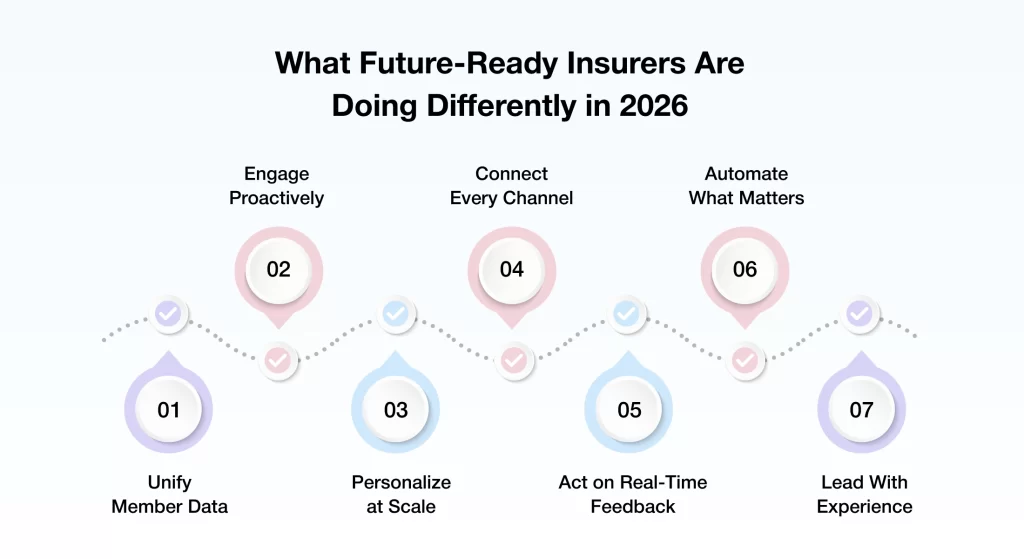
The key to transforming the member experience is not just technology, but how insurers integrate data, personalize, and automate across every touchpoint. Here’s how you can modernize your member experience to meet the rising expectations of today’s members.
Build a 360° Unified Member View
One of the foundational requirements for delivering a modern healthcare member experience is a unified view of the member. When information is fragmented across claims, benefits, enrollment, communications, and engagement systems, members are often forced to repeat information, restart conversations, and navigate disconnected experiences.
In 2026, leading insurers are moving beyond siloed data environments to create a comprehensive, real-time view of each member across every touchpoint. This unified perspective enables service teams, digital channels, and engagement programs to operate from the same source of truth, ensuring interactions are informed, contextual, and consistent.
A 360° member view enables insurers to:
- Deliver seamless experiences across digital and human-assisted channels.
- Reduce member effort by eliminating repetitive questions and requests
- Resolve inquiries faster with complete interaction and service history
- Personalize engagement based on individual needs, behaviours and preferences
- Improve care coordination and member support through greater visibility
Enable Proactive, Predictive Engagement
Leading insurers are moving beyond reactive service models and using AI and analytics to anticipate member needs before issues arise. By identifying behavioral and operational signals early, they can deliver timely, relevant support that reduces friction and improves the overall healthcare member experience.
Examples of proactive engagement include:
- Renewal Reminders before coverage gaps occur.
- Alerts when claims are delayed or at risk of denial
- Personalized wellness recommendations based on benefits and utilization
- Outreach triggered by care gaps or significant health events
By combining predictive analytics with intelligent automation, insurers can shift from reactive outreach to proactive, context-aware engagement that feels helpful rather than intrusive.
Personalize at Scale
Personalization is no longer a differentiator, it is a member expectation. Today’s healthcare consumers expect interactions that reflect their coverage, health needs, preferences, and recent experiences.
What true personalization at scale looks like:
- Dynamic content tailored to claims activity, plan type, and engagement history.
- Outreach triggered by life events, benefit utilization , or behavioral signals.
- Real-time recommendations that adapt as member needs and circumstances change
By leveraging data, analytics, and automation, insurers can move beyond one-size-fits-all communications and deliver more relevant, timely, and meaningful experiences across the member journey.
| Insight: Effective Personalization isn’t measured by how often you engage members, but by how relevant and timely those interactions are to their unique needs and circumstances. |
Redefine Omnichannel Support
Members don’t think in channels; they think in outcomes. Whether they start an interaction through a portal, mobile app, chatbot, or call center, they expect a seamless and consistent experience throughout their journey.
In 2026, leading insurers are moving beyond channel-specific service models and creating connected, omnichannel experiences where every interaction builds on the last.
Modern omnichannel support should enable:
- Seamless transitions between self-service and live agent support.
- Shared context across chat, voice, and other digital channels s.
- Consistent answers, recommendations and guidance across touchpoints
- Continuous conversations without requiring members to repeat information
By connecting channels through shared data and unified workflows, insurers can reduce friction, improve resolution times, and create more cohesive member experiences.
Embed Continuous Feedback Loops
Understanding member sentiment once or twice a year is no longer enough. Leading insurers are shifting from retrospective feedback models to continuous listening strategies that help identify and resolve experience issues in real time.
Traditional approaches such as annual satisfaction surveys and post-call questionnaires provide limited visibility into what members are experiencing at the moment. By the time feedback is collected, the opportunity to improve the interaction has often passed.
Continuous feedback in action includes:
- Capturing feedback directly within digital and service interactions
- Using Sentiment analysis across chat, call transcripts, and written communications .
- Monitor experience analytics to identify friction points and service gaps in real-time
- Tracking journey signals that indicate declining engagement or satisfaction
By treating feedback as an ongoing operational signal rather than a periodic measurement, insurers can continuously refine experiences, address issues faster, and improve member satisfaction over
Leverage Automation for Faster Resolutions
Speed remains a critical component of the healthcare member experience, but speed alone is no longer enough. The goal is not to automate every interaction but it is to automate the right interactions so members receive faster service while support teams can focus on more complex needs.
Many member requests are repetitive and transactional, such as checking claim status, updating personal information, or submitting routine documents. Requiring agent involvement for these tasks creates unnecessary friction for members and increases operational workload.
Areas where automation delivers the greatest value:
- Real-time claim status updates and proactive notifications
- Automated intake, routing, and tracking of service requests
- Self-service access to benefits, eligibility, and coverage information
- Automated document collection and verification workflows
By automating routine interactions, insurers can reduce response times, improve operational efficiency, and create a more seamless member experience while enabling service teams to focus on higher-value conversations.
Foster a Culture of Experience-Led Transformation
Technology can enable better experiences, but lasting transformation happens only when member experience becomes a shared organizational priority. To deliver meaningful improvements, insurers must embed experience-focused thinking into their processes, performance metrics, and day-to-day decision-making.
The organizations leading in healthcare member experience are not treating experience as a customer service initiative alone. They are aligning teams across operations, service, claims, care management, and technology around a common goal: creating seamless, member-centric journeys.
This requires:
- Experience metrics that go beyond operational KPIs
- Cross-functional collaboration around member outcomes
- Continuous improvement driven by member feedback and journey insights
- Accountability for experience across the organization, not just customer-facing teams
Measure What Members Experience; Not Just What Teams Deliver
Traditional operational metrics such as average handling time, call volume, and cost per interaction provide insight into efficiency, but they do not reveal how members actually experience their journey.
To improve healthcare member experience, insurers must complement operational KPIs with experience-focused metrics that measure effort, satisfaction, and outcomes across key touchpoints.
| Experience Area | What to Measure | How to Measure |
| Member sentiment | NPS, CSAT | Trigger short surveys after key events (claims updates, billing, coverage changes) |
| Issue resolution | First-contact resolution, repeat contacts | Track cases closed in a single interaction using CRM status |
| Repeat friction | Repeat contact rate | Count follow-up contacts for the same issue within a defined time window |
| Digital engagement | Self-service completion | Monitor task completion rates across the portal, app, and chat |
| Journey breakdowns | Drop-offs, abandonment | Identify stalled or incomplete workflows through journey analytics |
| Operational context | AHT, cost per interaction | Capture via contact center and service reporting tools |
How AVIZVA’s Solutions Empower Member Experience Excellence
Access no longer defines healthcare member experience by 2026 – anticipation, clarity, and continuity do.
Members expect their health plan to behave less like a static system and more like a digital companion—one that will provide them with the process of benefits understanding, lead them to make well-informed decisions, and even guide their taking of the right actions at the right time.
Traditional portals often sit idle until something goes wrong. The best practice today is a proactive, intelligent, and personalized member experience that anticipates needs, nudges the right actions, and simplifies complex healthcare decisions.
VIZCare Xperience’s MemberX Portal embodies these best practices. At the heart of this AI-powered platform lies a consolidated experience that brings benefits, authorizations, documents, and personalized guidance together—helping insurers deliver next-generation member experiences in 2026.
Instead of members hunting across multiple systems, MemberX brings everything together in a single, proactive, and intuitive experience:
1. Intelligent AI-Driven Assistance and Insights
A best practice for 2026 is using AI not just for automation, but to understand intent, context, and urgency, guiding members proactively.
- Conversational support via chat, voice, or text.
- Benefits, claims, and policies explained in plain language.
- Personalized reminders, alerts, and care nudges.
- Proactive insights based on member behavior and needs.
2. Full Self-Service Capabilities
Empowered members are more engaged and satisfied. Insurers should provide self-service access that reduces friction and call center dependency.
- View coverage, benefits, and accumulators in one place.
- Track claims and authorizations in real-time.
- Access documents with smart summaries.
- Manage dependents and life events digitally.
- Enable self-service anytime via web or mobile.
3.Seamless Experience Across All Channels
Best-in-class member experience means consistent, omnichannel engagement. Members should move across devices and channels without losing context.
- Consistent experience across web, mobile, chat, and iMessage.
- Smooth handoff from AI to live support when needed.
- Conversation history is preserved across channels.
- Always-on access with no repeated explanations.
4. Tailored Campaigns to Drive Better Health Outcomes
Being proactive means more than transactions—it prompts action. The best practice is personalized, behavior-based campaigns that prompt timely preventive care and wellness actions.
- Personalized wellness and education campaigns.
- Launch programs in-house or via third-party vendors.
- Targeting based on demographics, risk, and behavior.
- Multi-channel nudges via SMS, email, and in-app.
- Real-time engagement and performance tracking.
5. Making Healthcare Decisions Easier and More Transparent
A fundamental component of a strong healthcare member experience is decision clarity.. When members understand cost, coverage, and care options, they move forward with confidence.
- Smart provider search by cost, location, and availability.
- In-portal appointment scheduling.
- On-demand telehealth access.
- Look up medications, pricing, coverage, and local in-network pharmacies.
- Clear cost estimates and coverage breakdowns.
6. Driving Adoption and Sustained Engagement
The most advanced portal might be the best in the market, but if the users do not use it, then the portal will be unproductive. In 2026, an intuitive design, along with proactive guidance and continuous nudges, will be the major factors for getting the engagement to last.
- Clean, modern UX with zero jargon.
- Guided onboarding and contextual help.
- Accessible across web, mobile, and chat.
- Smart nudges to encourage ongoing use.
- Integrated agent support to avoid dead ends.
| Bring 2026-Ready Member Experience Best Practices to Life With MemberX. Know More! |
Engagement That Extends Beyond Members
Healthcare member experience does not exist in isolation. Best practices extend across the ecosystem—and VIZCare Xperience reflects this interconnected reality.
- BrokerX enables brokers and agencies to manage leads, quotes, proposals, commissions, and their book of business.
- EmployerX supports employers with enrollments, dependents, billing, benefit utilization, and plan performance.
- ProviderX streamlines eligibility, claims, authorizations, and referrals for providers.
Together, these experience gateways, when combined, create a connected ecosystem based on experience first, thus making it possible for the insurers to provide consistent and data-driven engagement throughout all the stakeholder touchpoints.
Member Experience Can’t Be a 2027 Conversation
A year from now, a healthcare plan that members merely tolerate versus one they actively choose will be distinguished by only one factor: its ability to seamlessly coordinate each touchpoint of the healthcare member experience.
| Final Insight: By 2026, it won’t be a question of whether payers are willing to invest in enhancing the healthcare member experience, but rather how rapidly they can transition from intention to execution. |
If you’re looking to modernize your health insurance member experience and create a scalable, future-proof engagement strategy, the right moment to take action is now.
Get in touch to explore how AVIZVA can help you design and deliver smarter, more connected member experiences for the years ahead.
FAQs
1. What is healthcare member experience, and why does it matter for insurers?
Healthcare member experience is the term used to describe members’ views of their interactions with their health insurance company, including benefits, service, and digital channels.
This is a major factor for insurers in retaining customers, building trust, and increasing customer lifetime value. In a very competitive market where products seem identical, it is the customer experience that separates plans and keeps customers loyal for a long time.
2. How can data intelligence and analytics improve healthcare member experience?
Insurers can go beyond merely reacting to customer service requests with data intelligence. When they have knowledge of claims activity, utilization patterns, and interaction history, they can pre-empt the members’ requirements and act at the appropriate time. This not only lessens the points of friction but also increases transparency and provides members with a guide when issues are about to escalate.
- Predict service issues before members contact support.
- Personalize outreach based on behavior and life events.
- Continuously optimize journeys using real-time experience insights.
3. What metrics should insurers track for member experience?
Insurers should go beyond operational metrics and track experience outcomes that reflect member sentiment and behavior. These metrics help link experience improvements to retention and cost efficiency.
- Net Promoter Score (NPS) and member satisfaction.
- First-contact resolution and repeat contact rates.
- Digital adoption, portal engagement, and self-service completion.
- Journey friction indicators (claim drop-offs, abandoned requests).
4. How does digital transformation affect member experience?
Member experience is being redefined by digital transformation with the help of seamless, omnichannel, and proactive engagement of members. When done right, it gives a possibility for insurance companies to coordinate personalized journeys through digital channels— not just presenting them with disconnected tools. This leads to quick resolutions, more straightforward guidance, and a consistent member experience, even at a large scale.