
Table of Contents
Key Takeaways
- Traditional analytics is static and slow, holding insurers back from real-time decision-making.
- Agentic AI turns healthcare analytics software into a self-learning, autonomous intelligence layer.
- It interprets data, predicts risks, automates workflows, and takes context-aware actions.
- Insurers gain faster operations, reduced errors, unified data flows, and stronger compliance.
- VIZCare AI enables this shift, helping organizations move from reactive reporting to proactive, continuous intelligence that boosts efficiency and member experience.
Most healthcare analytics platforms explain the past, but they don’t shape future decisions. By the time insights reach payer teams, key decisions have already been made, risks have escalated, and opportunities for timely intervention have passed.
Yet in an environment defined by rising consumer expectations, evolving regulations, and constant market change, is hindsight enough? How can payers remain competitive when their analytics only explain what happened instead of guiding what should happen next?
This is where Agentic AI marks a fundamental shift. Moving beyond static reporting, a new generation of healthcare analytics software is emerging : systems that continuously learn, adapt to changing conditions, and drive intelligent decisions in real time.
In this blog, we’ll explore how Agentic AI, through platforms like AVIZVA’s VIZCare AI is transforming analytics from a passive reporting function into an intelligent, decision-driven capability, and why now is the time for health insurers to evolve from Analytics 1.0 to Intelligence 2.0.
Why Traditional Systems Are Falling Short : The Static Trap
While traditional healthcare analytics tools serve as useful systems for reporting past performance, they are inherently limited in their ability to provide real-time insights and adapt to new information. These systems typically follow a rule-based, fixed framework that cannot handle the complex, dynamic nature of today’s healthcare environment.
Healthcare insurance organizations often experience the following pain points as a result of their outdated systems :
Slow Decision Velocity
In many cases, traditional systems are designed to take a reactive stance towards decision-making. This means that insurers do nothing until the end of a reporting period when they get their insights. Consequently, they are unable to respond promptly to emerging trends, consumer needs, or market changes.
Lack of Contextual Intelligence
Traditional analytics systems often rely on siloed internal data, making it difficult to connect information across sources and understand the broader business context. As a result, decision-makers may act on incomplete insights rather than a comprehensive view of the situation.
Manual, Rule-Based Reporting
The majority of healthcare insurers have to depend on fixed reporting systems. These systems require a human to perform updates and make adjustments. The static models are not capable of automatically adapting to the data and consumers’ behavior, which, in turn, limits their efficiency in executing their workflows or in providing the correct interventions at the right time.
AI Healthcare Analytics: What Distinguishes Agentic AI from Conventional Analytics
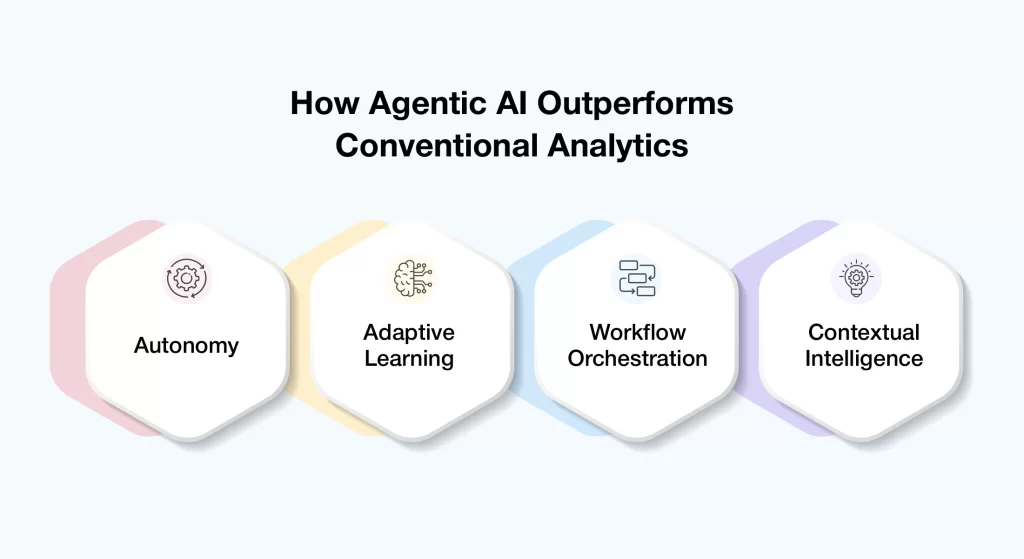
What sets Agentic AI apart from conventional analytics and AI-augmented BI platforms? Its ability to go beyond generating insights to continuously reason, adapt, and act. Four core capabilities define this next generation of AI-driven healthcare analytics for payers.
Complete Autonomy :
AI agents no longer need to be programmed for periodic reports; instead, they work continuously, monitor data streams, spot anomalies, and even issue recommendations or take actions.
Adaptive Learning :
AI models train and recalibrate automatically as new data arrives. The more they see, the smarter they get, setting a new benchmark for best healthcare analytics software 2026.
Workflow Orchestration :
AI is no longer a mere reporting tool; it goes deep into operational workflows. An alert from the AI agent can trigger a process, notify teams, or even auto-route tasks.
Contextual Intelligence :
AI agents grasp context. They merge claims data with member history, risk signals, regulatory constraints, and operational metrics to generate insights that are not only accurate but also relevant and feasible in real business contexts.
Simply put, agentic AI is an upgrade from just reporting to active decision intelligence. The AI agents don’t have to wait for quarterly reports to detect a fraud spike; instead, they spot fraudulent behavior patterns in real time, issue alerts, adjust their detection logic over time, and thus help stop fraud at its root.
The true value of AI healthcare analytics lies in its ability to transform data into proactive decisions. For healthcare payers, this unlocks a new generation of intelligent capabilities:
- Continuously optimize claims processing and fraud detection by adapting to evolving fraud patterns and improving detection accuracy over time.
- Deliver adaptive member engagement by identifying behavioral changes such as increasing claim frequency, coverage termination risks, or churn signals and enabling proactive outreach before issues escalate.
- Enable predictive operations and compliance by anticipating regulatory risks, forecasting high-cost populations, and triggering timely risk mitigation strategies before they impact business performance.
That is the promise of Agentic AI – a fundamental shift from both legacy analytics and first-generation AI-powered healthcare analytics. Instead of simply interpreting historical data, Agentic AI continuously learns, reasons, and acts, enabling payers to make faster, more informed decisions in real time.
The market is already moving in this direction. According to industry forecasts, the U.S. insurance analytics market – driven by AI, cloud, and big data technologies – is projected to grow from US$4.34 billion in 2025 to US$13.07 billion by 2033, underscoring the accelerating demand for intelligent, decision-centric analytics platforms.
The Architecture of Self-Learning Healthcare Analytics Software Systems
To realize this vision, health insurers need a robust, layered architecture that serves as the foundation for advanced analytics and AI. A modern self-learning analytics ecosystem for payers is built on healthcare analytics software principles that enable scalable healthcare data integration, intelligent automation, continuous learning, and actionable insights. The architecture typically includes the following layers :
- Data Orchestration Layer : The data orchestration layer is the very first step towards a self-learning healthcare system. This layer takes data from various sources and makes sure it is integrated and enriched with the context. Regardless of whether it is claims data, member interactions, or external market trends, this layer makes sure that all the data necessary for analysis is there.
- Cognitive Analytics Layer : The cognitive analytics layer is where advanced machine learning and AI transform unified data into actionable intelligence. In this layer, agentic AI models analyze vast volumes of integrated data to uncover hidden patterns, predict emerging trends, identify risks, and surface opportunities that traditional analytics often overlook. As new data continuously flows into the ecosystem, these models learn and adapt, ensuring that insights remain accurate, relevant, and responsive to evolving healthcare dynamics.
- Agentic AI Layer : At the core of this self-learning system is the agentic AI layer. This layer is composed of smart agents that, in addition to analyzing data, also perform actions. These agents can automate processes, provide recommendations, and even initiate workflows. The system learns from every interaction and, over time, adjusts its behavior to become more efficient and effective.
- Continuous Feedback Layer : The final layer closes the learning loop through continuous feedback. Every recommendation, workflow, and business outcome generates new data that is fed back into the system to evaluate performance and refine AI models.
This continuous learning cycle enables the platform to improve prediction accuracy, optimize workflows, reduce errors, and adapt to changing market conditions, regulatory requirements, and consumer needs without requiring constant manual intervention. With each iteration, the system becomes more intelligent, responsive, and precise : delivering increasingly accurate insights and recommendations while supporting the stringent security, privacy, and compliance requirements expected of HIPAA-compliant healthcare analytics software.
Healthcare Analytics Use Case Example
Imagine a self-learning claims analytics system in action. It identifies an unusual pattern in a member’s claim, automatically flags it for investigation, and supports a faster, more informed resolution. Once the outcome is confirmed, the system incorporates that feedback into its learning models, refining its detection capabilities for future claims. As it continuously processes new claims, the AI adapts to emerging fraud patterns, billing anomalies, and operational inefficiencies, becoming increasingly accurate over time. This continuous learning cycle enables health insurers to strengthen fraud detection, reduce payment errors, and improve claims processing efficiency without relying solely on manual rule updates.
How AVIZVA’s VIZCare AI Aligns with the Future of Healthcare Analytics
The future of healthcare analytics software is no longer defined by static reports or retrospective insights. As healthcare insurance operations grow more complex and time-sensitive, AI healthcare analytics is enabling insurers to move beyond explaining what happened in the past to predicting what will happen next. This shift marks the arrival of agentic AI: a new intelligence layer that continuously learns, understands context, and takes action across workflows in real time.
AVIZVA’s VIZCare AI embodies this next generation of healthcare analytics software. By combining self-learning AI, contextual intelligence, and autonomous workflow orchestration, it moves beyond traditional dashboards to deliver actionable insights and intelligent automation across payer operations. The result is a continuously evolving analytics ecosystem that empowers health insurers to improve operational efficiency, enhance decision-making, reduce costs, and deliver better outcomes for consumers.
| Quick Take: The real gap in healthcare analytics isn’t insight generation, it’s insight execution. Agentic AI is what closes that gap. |
Why VIZCare AI Is Built for What’s Next
VIZCare AI is a healthcare AI platform with ready-to-deploy agents and freedom to build your own applications. Following are some of its core capabilities :
Agentic By Design :
Autonomous AI agents that understand context, make informed decisions, trigger actions, and orchestrate complex workflows – not just respond to queries.
Healthcare Awareness :
Purpose-built for healthcare, with domain knowledge spanning benefits administration, eligibility, claims, provider networks, utilization management, and compliance.
Enterprise-Ready Architecture :
Built for secure, scalable deployment, VIZCare AI functions as HIPAA-compliant analytics software with support for HIPAA, SOC 2, and GDPR compliance, along with role-based (RBAC) and attribute-based (ABAC) access controls for fine-grained security and governance.
Action-Oriented Intelligence :
Transforms insights into operational outcomes by embedding AI directly into business workflows, enabling faster decisions, intelligent automation, and measurable business impact rather than simply generating reports or dashboards.
VIZCare AI’s ready-to-deploy conversational AI applications empower every stakeholder across the healthcare ecosystem to interact more intelligently and efficiently. This includes members, providers, employers, brokers, and operations teams.
- VIZCare AI for Service Agents : Summarizes calls, detects intent in real time, and guides agents with accurate next-best actions. It automatically logs notes, triggers follow-ups, and reduces after-call work to improve productivity and resolution speed.
- VIZCare AI for Brokers : Provides conversational access to book-of-business insights, simplifies quoting workflows, and clarifies commissions by surfacing performance, eligibility, and financial data in real time.
- VIZCare AI for Employers : Enables instant responses to billing, invoice, and payment-related queries while supporting employee onboarding, eligibility updates, and benefits administration workflows through conversational interfaces.
- VIZCare AI for Members : Explains coverage, eligibility, and claim details in simple, easy-to-understand language. Assists members with claim submissions, appeals, and status tracking that reduces friction and eliminates the need for repeated follow-ups.
- VIZCare AI for Operations : Streamlines enrollments, validations, and updates by orchestrating cross-functional workflows across employers, brokers, providers, and internal teams, ensuring faster and more accurate execution.
- VIZCare AI for Providers : Supports eligibility verification, prior authorizations, claims status checks, and billing inquiries – reducing administrative burden and enabling faster, more seamless provider interactions.
To help organizations act on intelligence, AVIZVA’s engineering team ensures that agentic, self-learning analytics drive measurable real-world outcomes. Beyond developing advanced AI capabilities, AVIZVA engineers the full technology stack i.e., from data pipelines and integrations to governance, cloud infrastructure, workflow orchestration, and security controls and ensuring enterprise-grade reliability, scalability, and performance at every layer.
The Path Forward : From Analytics 1.0 to Intelligence 2.0
If you’re a healthcare insurer still relying on legacy BI tools or first-generation reporting analytics, understanding how to choose healthcare analytics software is an important first step. The roadmap below outlines the capabilities organizations should prioritize when transitioning to Intelligence 2.0 :
- Audit Current Analytics Maturity : Assess the state of your existing analytics systems. Are they limited to generating historical reports, or have they evolved to support real-time, frontline, and even proactive decision-making?
- Integrate Adaptive AI Layers : Modernize your architecture by introducing agentic AI capabilities. These layers enable systems to understand contextual signals, adapt to changing conditions, and continuously improve performance with minimal manual intervention.
- Establish Governance for Explainable AI and Data Compliance : Implement strong governance frameworks to ensure transparency, accountability, and regulatory compliance (including HIPAA and other healthcare standards). Beyond compliance, explainability is essential for building trust across stakeholders and ensuring responsible use of AI-driven decisions.
- Adopt Self-Learning Platforms such as VIZCare AI : Move toward platforms that continuously evolve with data and usage. By adopting VIZCare AI, healthcare insurers can accelerate their transition to a self-learning intelligence ecosystem that improves over time and delivers sustained operational and clinical value.
Conclusion
The healthcare insurance industry is on the verge of an analytics transformation, where healthcare analytics software is evolving from static reporting to intelligent, agentic decision-making. Traditional static systems are increasingly insufficient for the demands of a fast-paced, data-driven ecosystem where real-time intelligence and continuous adaptation are essential.
By adopting self-learning analytics platforms such as VIZCare AI, insurers can unlock continuous, real-time intelligence that supports proactive decision-making, improves operational efficiency, reduces costs, and enhances consumer experiences.
As AI-driven systems mature, agentic intelligence will become a critical differentiator for insurers. Organizations that embrace this shift will be better positioned to streamline operations, reduce customer churn, and strengthen their competitive advantage in an increasingly dynamic market.
The question is no longer whether this transformation will happen but how quickly insurers are prepared to move from static Analytics 1.0 systems to an autonomous, self-learning intelligence ecosystem.
FAQs
1. Is healthcare analytics software HIPAA compliant? If yes, how to ensure compliance?
Indeed, HIPAA-compliant analytics software exists. In order to be conforming, the software has to feature robust data encryption, security-enhanced storage methods, and frequent inspections.
Furthermore, systems should offer controls for access based on roles and certify that all operations involving data comply with the privacy and security parts of the HIPAA standard, an approach reflected in modern healthcare analytics platforms such as VIZCare AI.
2. How does healthcare analytics improve member outcomes?
Healthcare analytics accomplishes the member outcomes goal through the use of valuable insights that give a way to the staff for their proactive interventions, individualized recommendations, and the incessant observance of the member’s behavior. The results are thus more timely and appropriate services, which, in addition to the risk detection, lead to better-managed health journeys.
3. What is predictive analytics in healthcare, and how accurate is it?
Predictive analytics in healthcare leverages both historical and real-time data to anticipate churn risk, utilization patterns, operational bottlenecks, and compliance gaps. While the precision of the predictions is influenced by the quality of the data and the maturity of the model, the contemporary AI-powered solutions are of great reliability, and they also keep learning through feedback loops.
4. What are use cases for AI/agentic AI in healthcare analytics?
AI and Agentic AI power use cases where insight instantly turns into action. Some of them include:
- 24×7 availability: Always-on AI monitors data continuously and delivers insights, alerts, and answers beyond business hours.
- Real-time support for service agents: Helps members with claim guidance and policy insights during live interactions to speed up resolution.
- Predictive risk and cost analytics: Identifies high-risk members, rising costs, and utilization trends before issues escalate.
- Operational performance optimization: Identifies bottlenecks, SLA risks, and delays across enrollments and authorizations.
- Conversational analytics access: Enables users to ask questions in plain language and receive contextual, data-backed answers.
- Intelligent, system-initiated actions: AI agents trigger follow-ups, route cases, and update systems based on analytics outcomes.