
Table of Contents
Key Takeaways
- The Gap: Generic integration tools cannot keep up with payer operations. Teams spend more time reconciling records than using them. The result is delayed approvals and inconsistent data.
- The Standard: A true insurance-grade platform needs six capabilities. Real-time sync, legacy and modern interoperability, intelligent orchestration, cloud-native scale, embedded compliance, and full visibility.
- The Answer: Purpose-built platforms like VIZCare Connect fix this. They align data models with payer-specific operations, not generic workarounds.
- Read on to see the six capabilities that turn integration into a real operational backbone.
In general, insurance operations run on fragmented systems: claims, member, provider, authorization, and billing, each speaking a different data language. When teams rely on generic integration tools, they spend more time reconciling records than using them. That gap shows up in delayed approvals, inconsistent policy views, and avoidable manual checks across workflows.
A purpose-built insurance data integration platform changes this by aligning data models with payer-specific operations instead of forcing workarounds. It connects systems in real time, preserves data context across transactions, and keeps updates consistent across downstream applications.
This is not about moving data faster; it is about making it usable at every operational touchpoint. The six capabilities below define what a true insurance-grade integration platform must deliver. This foundation directly impacts cost efficiency, compliance readiness, and member experience outcomes.
Why Generic Integration Tools Fall Short in Healthcare
Most integration tools are built for broad enterprise healthcare use cases, not the complexity of payer operations. That gap becomes visible when core systems fail to behave as one connected environment.
- Integrating legacy & modern systems: Health insurance software ecosystems still depend on core legacy platforms running alongside newer digital applications. Generic tools often require heavy custom work to bridge these gaps, which slows down operational flow instead of simplifying it.
- Data standardization & consistency: Member, claims, and provider data rarely share a uniform structure across systems. Without insurance-specific data models, the same entity can appear differently depending on where it is accessed.
- Ensuring data security & compliance: Regulatory rules around data movement, access control, and auditability are strict in health insurance solutions, but most generic tools treat these as layered configurations rather than built-in design principles.
- Cross-department alignment & governance: Different teams often rely on the same data but interpret it through separate operational lenses, creating duplication, mismatches, and governance friction.
- Real-time synchronization & scalability: Delayed or batch-based updates disrupt downstream processes and make it difficult for systems to stay aligned as transaction volumes grow.
These gaps make it clear that integration in insurance cannot rely on generic architecture; it requires capabilities designed around payer-specific data flow, governance, and operational efficiency in healthcare.
This is why the 6 capabilities below are non-negotiable when evaluating a healthcare data integration platform.
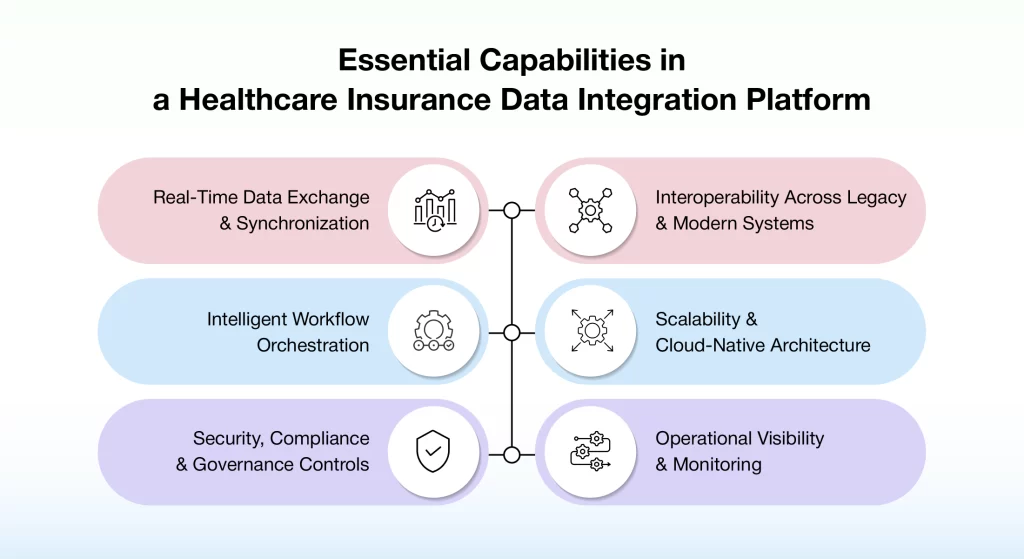
What are the 6 Must-Have Capabilities for Healthcare Insurance Data Integration
- Real-Time Data Exchange & Synchronization
- Interoperability Across Legacy & Modern Systems
- Intelligent Workflow Orchestration
- Scalability & Cloud-Native Architecture
- Security, Compliance & Governance Controls
- Operational Visibility & Monitoring
Modern insurance data integration is no longer about connecting systems; it is about ensuring every transaction, update, and decision flows through a controlled, consistent, and usable data layer. The capabilities below define what separates a functional integration layer from a truly operational backbone for payer organizations.
1. Real-Time Data Exchange & Synchronization
- Problem: Most insurance platforms still rely on batch processing, which creates a time gap between when data is updated and when it is actually usable across systems. This delay directly impacts claims accuracy, eligibility checks, and member-facing responses.
- Look for: A true integration platform should support continuous, event-driven data exchange where updates flow instantly across claims systems, member portals, provider networks, and internal applications. The goal is not just speed, but a single, always-consistent version of operational data across the ecosystem.
2. Interoperability Across Legacy & Modern Systems
- Problem: Insurance ecosystems are built on a long history of legacy platforms that were never designed to communicate with modern API-based systems. This leads to brittle integrations, repeated data transformation logic, and constant maintenance overhead.
- Look for: Native interoperability support across HL7 v2, FHIR R4, and EDI X12 standards, with built-in transformation capabilities. The platform should absorb complexity in the middle layer so downstream systems can interact without custom engineering effort every time a new system is added.
3. Intelligent Workflow Orchestration
- Problem: Operational workflows in insurance, such as prior authorization, claims adjudication, and enrollment, are tightly interconnected. Even small changes in one step often break downstream processes when orchestration is rigid or hardcoded.
- Look for: A configurable orchestration layer that allows business rules, conditional routing, and automated field mapping to be adjusted without rewriting integration logic. This ensures workflows evolve with business needs instead of becoming technical bottlenecks.
4. Scalability & Cloud-Native Architecture
- Problem: Insurance operations experience unpredictable spikes, open enrollment periods, new group onboarding, or regulatory changes that often overwhelm traditional monolithic systems.
- Look for: A modular, cloud-native architecture that scales horizontally based on demand. The platform should handle high transaction loads without performance degradation while remaining aligned with evolving compliance frameworks such as CMS and TEFCA.
5. Security, Compliance & Governance Controls
- Problem: As data moves across multiple systems, a lack of unified governance creates blind spots in access control, auditability, and regulatory compliance, increasing operational and legal risk.
- Look for: Security must be embedded at the architecture level, end-to-end encryption, role-based access controls, detailed audit trails, and built-in compliance readiness for HIPAA and CMS regulations. Governance should not be an add-on layer; it should be foundational.
6. Operational Visibility & Monitoring
- Problem: Integration failures are often invisible until they impact downstream processes like claims delays, eligibility mismatches, or member dissatisfaction. By then, resolution becomes reactive and costly.
- Look for: Real-time observability with system-wide dashboards, data health monitoring, and anomaly detection. A strong platform should surface issues at the integration layer itself, enabling teams to resolve problems before they propagate into business disruption.
VIZCare Connect: Healthcare Data Integration via Standards, APIs, and Real-Time Orchestration
VIZCare Connect is AVIZVA’s healthcare data connectivity platform designed to unify fragmented payer ecosystems through standards-based interoperability, real-time data movement, and a governed API layer.
It is built to support end-to-end integration needs across insurance operations, ensuring data is not just exchanged but standardized, traceable, and usable across systems.
Key Features of VIZCare Connect
1. Real-Time Data Orchestration & Synchronization
The platform enables continuous, event-driven data flow across payer systems, external partners, and regulatory interfaces. Instead of delayed batch updates, every transaction is synchronized in real time, ensuring consistent data across claims, members, providers, and operational systems. This reduces lag between system updates and actual decision-making.
2. Flexible, Standards-Based Data Exchange
VIZCare Connect supports multiple healthcare integration standards and formats, including file-based EDI, database interfaces, microservices-based JSON structures, and event-driven architectures. This flexibility allows insurers to integrate both legacy systems and modern applications without rebuilding core infrastructure.
3. Robust Healthcare API Suite (300+ APIs)
The platform provides a large suite of healthcare-specific APIs that support lookup, read, search, add, and update operations across core domains such as members, claims, enrollment, benefits, provider networks, and payments. These APIs are designed with embedded healthcare business logic to ensure transaction accuracy and contextual consistency.
4. Automated Orchestration with Built-In Rules Engine
Workflows are managed through a configurable orchestration layer that automates data movement, transformation, validation, and enrichment. The built-in rules engine ensures data is standardized and validated before reaching downstream systems, reducing manual intervention and integration errors.
5. Preloaded & Continuously Updated Healthcare Data
VIZCare Connect includes curated industry datasets such as provider directories, code sets (CPT, ICD-10, HCPCS, NDC), and network information. This helps validate incoming data, improve accuracy, and reduce dependency on external reference systems during integration workflows.
6. 360° Operational Visibility & Data Intelligence
The platform provides full visibility into data movement across systems with real-time tracking, dependency mapping, and issue detection. It enables teams to monitor transactions end-to-end, identify bottlenecks early, and maintain data integrity across the enterprise ecosystem.
Closing Thoughts
Using a generic integration layer in healthcare insurance is not a technical shortcut; it becomes a long-term cost driver. Broken data flows, delayed transactions, and inconsistent system views quickly translate into financial leakage, compliance exposure, and operational silos that never fully close.
The real challenge is that a health plan’s “connective tissue” depends on native support for HL7, FHIR, and EDI standards, along with real-time orchestration across every system that touches member and claims data. Without this foundation, integration remains fragmented and reactive.
Adopting a purpose-built platform like VIZCare Connect ensures end-to-end visibility, controlled data movement, and consistent experiences across all payer operations.
For insurers aiming to modernize data infrastructure with reliability and scale, AVIZVA stands out as the strongest platform choice.
Book a demo to explore VIZCare Connect.
FAQs
1. What is an insurance data integration platform?
It is a system that connects payer applications, enabling seamless, standardized, and real-time data exchange across claims, members, providers, and operational workflows.
2. Why are generic integration tools not suitable for healthcare insurance?
They lack native support for healthcare standards, real-time orchestration, and payer-specific data models, leading to inconsistencies and operational inefficiencies.
3. What standards should a healthcare integration platform support?
It should support HL7 v2, FHIR R4, and EDI X12 to ensure compatibility across legacy and modern healthcare systems.
4. How does real-time integration improve payer operations?
It reduces delays in claims processing, eligibility updates, and member communications by ensuring all systems reflect the latest data instantly.
5. What role does security play in data integration?
Security ensures the protected movement of sensitive data through encryption, access controls, and compliance with HIPAA and CMS regulations.