
Table of Contents
Key Takeaways
⦁ Business Imperative: Every AI initiative, analytics program, and CMS deadline inherits the quality of the data underneath it. Governance sets that ceiling first.
⦁ The Problem: Most payer governance programs are real but late. Policies, stewards, and catalogs sit downstream of integration, so they document data problems accurately and prevent few of them.
⦁ The Solution: Evaluate healthcare data governance software on six capabilities working together: data quality and profiling, security and access control, compliance support, cataloging and lineage, master data management, and stewardship workflows.
⦁ Key Outcome: Governance applied where data moves catches errors while they’re still cheap to correct. VIZcare Connect provides that layer for payers, TPAs, and PBMs.
Most payers, TPAs, and PBMs don’t have a healthcare data governance problem. They have a governance timing problem.
Across these healthcare enterprises, governance policies are already in place, data ownership has been established, and investments have been made in different solutions to catalog, manage, and govern information. Yet, despite these foundational efforts, the same data challenges persist. Member records still contain conflicting addresses. Provider rosters continue to differ between claims platforms and published directories. And too often, teams discover these discrepancies only after a claim is denied or a member/provider calls for help.
The scale of this gap is well documented. In a review of online provider directories across 52 Medicare Advantage organizations, CMS found that 48.74% of listed provider locations contained at least one inaccuracy. The finding highlights a critical distinction: having governance in place does not necessarily mean it is influencing data quality when it matters most. When governance is applied too late in the data lifecycle, inaccuracies can move through systems and into operational workflows before they are detected, leaving teams to address the consequences rather than prevent them.
This is the primary challenge driving investment in enterprise healthcare data governance solutions today. Analytics programs, AI initiatives, and regulatory commitments all depend on data that can be trusted as it moves between systems. In response, vendors often present remarkably similar lists of capabilities, making it difficult to distinguish one solution from another based on features alone. Furthermore, these capabilities do not deliver the same value in every context. Their impact depends on where and when they are applied across the data lifecycle and whether they can prevent issues before those issues affect downstream decisions and operations.
The six capabilities that follow are worth evaluating not just by what they do, but by when they do it. That distinction can make all the difference in choosing a governance solution that addresses data problems at their source.
At-A-Glance: Features Every Healthcare Data Governance Solution Should Include
| Feature | Why It Matters | Business Outcome |
| Data Quality & Profiling | Catches inaccurate, duplicate, and incomplete records before they propagate | Analytics and AI built on data the business already trusts |
| Security & Access Control | Limits PHI exposure at the record and attribute level | Smaller breach radius, fewer access-related audit findings |
| Compliance & Regulatory Support | Converts written policy into enforced control with an evidence trail | Audits become report generation, not discovery projects |
| Data Cataloging & Lineage | Shows where every field came from and what depends on it | Root cause found in minutes rather than weeks |
| Master Data Management | Resolves competing versions of member, provider, and group records | One consistent identity across claims, enrollment, and directory |
| Stewardship & Governance Workflows | Assigns accountability and gives owners a system to work in | Governance that survives past the implementation project |
6 Key Features To Look For In A Healthcare Data Governance Solution
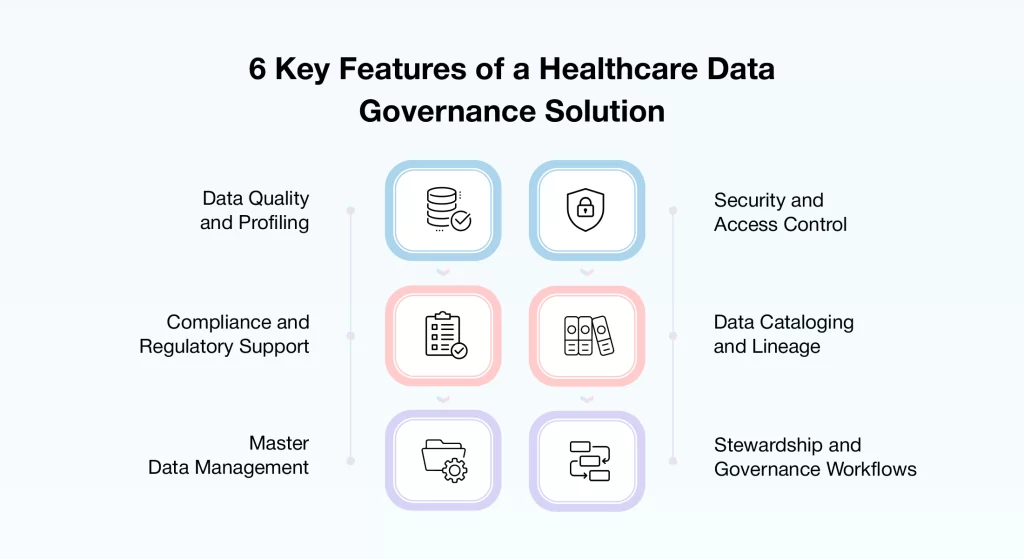
Each of the capabilities below features prominently in most vendor pitches. What differentiates them is not what they do, but where they operate in the data lifecycle.
1. Data Quality and Profiling
Data quality and profiling help identify, standardize, and resolve inaccurate, incomplete, or duplicate data before it propagates downstream. Profiling establishes a baseline for what ‘normal’ looks like across each data feed, while quality rules detect and act on deviations from that baseline.
What to Look For:
- Cleansing, standardization, and deduplication applied at ingestion – not deferred to scheduled cleanup jobs
- Continuous quality monitoring with thresholds defined by feed, data domain, or trading partner
- Real-time anomaly detection that can flag a malformed or incomplete eligibility file as soon as it arrives
- Field-level profiling across claims, enrollment, accumulator, and provider data
For a payer, poor data quality is rarely an abstract problem. A duplicate member record can split accumulator balances across two identities. A stale provider taxonomy code can route a claim to the wrong pricing rule. By the time these issues surface in reporting, the underlying data has already moved through multiple systems.
Many of these failures originate upstream in healthcare data integration, not in the reporting layer where they become visible.
Business Outcome: Fewer downstream exceptions and rework, more reliable operational data, and analytics that teams can trust without second-guessing the underlying numbers.
2. Security and Access Control
Security and access control determine who can access healthcare data, which attributes they can see, and under what conditions. In a payer environment, these controls must extend beyond broad role-based permissions to the individual attributes within a record. Two users may legitimately need access to the same member record, but for different purposes and with different levels of visibility.
What to Look For:
- Role-based access control (RBAC) for broad permissions, complemented by attribute-based access control (ABAC) for contextual, policy-driven decisions
- Encryption at rest and in transit across integration pathways, including partner data exchanges
- Dynamic masking that limits contact center agents’ visibility to the information needed for a specific interaction
- Pseudonymization in analytics environments where direct member identification is unnecessary
- Least-privilege access enforced through policies, rather than relying solely on manual provisioning and periodic reviews
When access permissions are broader than necessary, a compromised credential can expose more data than the user needs to perform their role. This makes healthcare data security and governance increasingly interconnected considerations in enterprise data management.
Business Outcome: Reduced exposure to sensitive healthcare data, more consistent enforcement of access policies, and controls that can withstand audits and reviews without creating unnecessary friction for service teams.
3. Compliance and Regulatory Support
Compliance and regulatory support translates written policies into enforceable controls, supported by an auditable trail of evidence. For healthcare organizations, effective governance should make compliance an ongoing operational process, not a scramble to reconstruct what happened when an audit approaches.
What to Look For:
- Privacy and Security Rule requirements mapped to specific policies, controls, and technical enforcement points within a dedicated data governance solution for HIPAA compliance
- HITECH breach notification support, backed by auditable records of data access and disclosure
- GDPR controls for organizations subject to its requirements, including applicable international data transfers
- Tamper-evident audit logs capturing data access, transformation, and transmission events
- Consent management linked to member records, with permissions enforced across downstream data access and use, not simply documented through periodic attestations
Regulatory requirements also introduce firm timelines for putting governance into practice. Under the CMS Interoperability and Prior Authorization Final Rule (CMS-0057-F), impacted payers must implement or enhance four FHIR-based APIs:
- Patient Access
- Provider Access
- Payer-to-Payer
- Prior Authorization
The API requirements generally begin taking effect on January 1, 2027, although specific compliance dates vary by payer type and provision.
These APIs extend the movement of healthcare data beyond internal systems, making it essential for payers to maintain appropriate controls over data access, exchange, consent, and use. Governance must therefore operate as part of the data-sharing process itself – not merely as a retrospective compliance check.
Business Outcome: Reduced audit preparation effort, stronger evidence of control effectiveness, and greater readiness to meet applicable regulatory requirements and deadlines.
4. Data Cataloging and Lineage
A data catalog tells the enterprise what data it has, where it lives, and what it means. Data lineage goes a step further, showing where each field originated, how it was transformed, and which downstream systems, processes, and reports depend on it.
Within a robust healthcare data governance platform, these two capabilities work together to answer a critical question when something changes or breaks: What else will this affect?
What to Look For:
- An enterprise-wide catalog spanning claims, enrollment, provider, benefit, accumulator, and prior authorization data
- Technical and business metadata captured automatically rather than maintained manually
- A business glossary that establishes consistent definitions for terms such as ‘active member’
- Column-level lineage across ingestion, transformation, and delivery
- Impact analysis that identifies downstream dependencies before a schema or data-model change is deployed
Without lineage, a single mis-mapped field in a partner feed can trigger a multi-week investigation across multiple teams. With end-to-end visibility, teams can trace the issue back to its source, identify affected downstream assets, and address it before it spreads further.
The distinction matters because a catalog that simply documents what exists is useful for discovery. A catalog connected to lineage and impact analysis becomes operational when teams need to understand the consequences of a data change.
Business Outcome: Faster root-cause analysis, fewer downstream surprises, and less manual reconciliation across enterprise reporting and operational teams.
5. Master Data Management (MDM)
Healthcare master data management creates a trusted, authoritative view of core entities and keeps that identity consistent across the systems that use it. In a payer environment, the entities that matter most include members, providers, groups or employers, and service locations.
What to Look For:
- Deterministic and probabilistic matching to identify and resolve duplicate member and provider records across platforms
- Survivorship rules that determine which source takes precedence for each attribute
- Cross-system propagation that pushes mastered data into operational systems rather than leaving the golden record isolated in an MDM hub
- HL7 FHIR alignment that allows mastered entities to map consistently to the resources exposed through CMS-mandated APIs
Provider data illustrates the problem clearly. The directory, claims platform, contracting system, and credentialing system may each maintain a version of the same provider. Without a governed identity layer, those versions can diverge – creating inconsistencies that surface across directories, claims processing, network management, and member experiences.
MDM brings those identities together, establishes which attributes should be trusted, and propagates the governed view to the systems that depend on it. This is where governance and healthcare data interoperability become closely connected: interoperability is only as reliable as the entities moving between systems.
Business Outcome: Consistent member, provider, group, and service-location data across operational systems and channels, with fewer identity conflicts and downstream reconciliation efforts.
6. Stewardship and Governance Workflows
Stewardship and governance workflows turn policies and ownership models into day-to-day action. They assign accountability to specific people and give them a structured way to review, resolve, approve, and monitor data issues.
This is often where governance programs lose momentum. A platform can define who owns a data domain, but that ownership has little operational value if stewards have no workflow for acting on the issues that reach them.
What to Look For:
- Named data owners and stewards mapped to specific domains, datasets, or business processes rather than to the enterprise at large
- Approval workflows for policy changes, new data sources, and access exceptions
- Issue queues that route data-quality exceptions to the people responsible for resolving them at the source
- Governance dashboards that track open issues, resolution times, recurring exceptions, and policy coverage
- KPI tracking aligned to a defined healthcare data governance strategy
Governance maturity is visible in the work it produces. A platform that cannot show how many quality exceptions were raised, who resolved them, how long they remained open, or whether the same issues are recurring is documenting governance – not operationalizing it.
The distinction is important: effective stewardship shouldn’t be an auxiliary layer sitting alongside daily data operations. When anchored by a practical healthcare data governance framework, stewardship becomes embedded directly into the daily workflows where data is created, changed, shared, and consumed.
Business Outcome: Clear accountability, faster issue resolution, and a governance operating model that continues to function long after implementation is complete.
Beyond Features: Questions Every Healthcare Organization Should Ask Before Choosing a Data Governance Solution
Most data governance solution vendors offer the same core capabilities. The real differences lie in how those capabilities operate in practice. The questions below move beyond feature sheets to help you evaluate real-world performance before you choose healthcare data governance software for your organization, ensuring it stops data issues before they propagate downstream.
- Can the platform scale across multiple systems?
Ask how many source systems the largest production deployment supports – not simply how many the platform can accommodate in theory. - Does it integrate with the existing payer ecosystem?
Name your claims platform, enrollment system, PBM feeds, and clearinghouse, and ask which integrations are available out of the box versus requiring custom development. - Does it support interoperability standards natively?
Ask how the platform handles standards such as HL7 v2, FHIR R4, and EDI X12 and whether that support is built into the product or depends on additional implementation work. - Can governance policies be automated end to end?
Look for policies that can trigger validation, remediation, routing, approval, or access decisions automatically. The more governance depends on manual intervention, the harder it is to apply consistently at scale. - How long does it take to onboard a new data source?
Ask for a real production example. If onboarding is measured in days, the platform is doing more of the work. If it takes quarters, implementation effort may be carrying much of the load. - Does it provide enterprise-wide visibility?
Look beyond summary dashboards. Ask whether teams can trace individual records and transactions across ingestion, transformation, access, and downstream delivery. - Is the data environment ready for AI initiatives?
Ask whether the platform can provide structured, deduplicated, governed, permission-aware, and lineage-traced data that can be safely used by analytics and AI applications, particularly where PHI is involved.
Ultimately, the value of a healthcare data governance solution is not determined by how many capabilities appear on its feature matrix. It comes from how those capabilities work together across the data lifecycle and whether governance can act at the point data is created, moved, transformed, accessed, and consumed.
How AVIZVA Helps Healthcare Organizations Build Trusted Data Governance
AVIZVA treats governance as a property of the data layer, not as a separate system layered on top of it. VIZCare Connect applies quality, security, and traceability controls at the point healthcare data moves between systems and partners, where issues can be identified and corrected before they propagate downstream.
For payers, TPAs, and PBMs, this means:
- A unified data foundation that replaces fragmented point-to-point connections and creates a consistent layer for governing data across the enterprise
- Automated validation, normalization, and reconciliation applied before data reaches core administrative systems
- Healthcare-native interoperability across HL7, FHIR, and EDI X12, supported by 300+ purpose-built healthcare APIs
- Preloaded healthcare reference data, including NPPES provider records and CPT, ICD-10, and NDC code sets
- Entity-centric views of members, providers, plans, claims, and prior authorizations to maintain consistency across systems
- Transaction-level monitoring and audit trails that support both operational response and regulatory evidence
By applying governance controls at the exchange layer, VIZCare Connect helps ensure that data is validated, standardized, and traceable before it reaches downstream analytics, member portals, operational workflows, and AI applications, shifting governance from a retrospective control to a preventive one.

The Right Healthcare Data Governance Starts With a Strong Data Foundation
Healthcare data governance is no longer optional. As payer operations become increasingly dependent on data moving accurately and in near real time, governance must do more than document what happened after the fact. The question in 2027 is whether governance operates early enough in the data lifecycle to prevent problems before they reach downstream systems, workflows, and decisions.
The six capabilities work as an interconnected system. Quality without lineage can identify an issue without tracing it to its source. Security without stewardship can enforce access without establishing accountability for exceptions. MDM without interoperability can create a trusted record that downstream systems cannot reliably consume. When these capabilities operate together at the data layer, governance becomes part of how data moves, not a control applied after the fact.
That foundation matters for everything built on top of it: CMS compliance, enterprise analytics, operational decision-making, and the AI initiatives shaping the next generation of healthcare. The goal is not simply to govern more data. It is to govern data early enough and close enough to where it moves that fewer downstream problems have to be managed in the first place.
FAQs
1. What features should a healthcare data governance solution include?
At minimum: data quality and profiling, security and access control, compliance and regulatory support, cataloging and lineage, master data management, and stewardship workflows. The feature most often absent from vendor checklists is native handling of healthcare data formats. A platform treating HL7, FHIR, and EDI X12 as custom integrations will govern everything except the data the business actually runs on.
2. Why is data quality important in healthcare data governance?
Data quality determines whether every other control produces a useful result. Lineage on inaccurate data traces the path of a wrong answer, and a golden record built from unvalidated sources is authoritatively wrong. The effect compounds financially: one duplicate member identity can fragment accumulator balances and generate appeals costing more to resolve than the record cost to fix.
3. How does healthcare data governance support HIPAA compliance?
Governance supplies the technical enforcement behind HIPAA’s administrative requirements. The Security Rule specifies access control at §164.312(a)(1) and audit controls at §164.312(b), and both require a system that demonstrates enforcement rather than intent. Immutable logs, attribute-level permissions, and automated policy application provide that demonstration, and they also support the risk analysis provision at §164.308(a)(1)(ii)(A) that OCR cites most frequently in enforcement actions.
4. What is the role of master data management in healthcare?
MDM resolves competing versions of the same entity into one authoritative record, which in payer operations means members, providers, groups or employers, and service locations. It differs from a data warehouse commercially: a warehouse stores a copy for reporting, while MDM pushes the resolved record back into the systems generating claims, directories, and member communications.
5. How do healthcare organizations evaluate a data governance solution?
Effective evaluations test architecture rather than features. Run a proof of concept against your own messiest production feed, ask named reference customers for real onboarding timelines, and confirm whether controls execute in real time or on a batch schedule. Reference calls with payers of comparable size usually surface more than any demo.
6. How much does healthcare data governance software cost?
Pricing here is quote-based and rarely published, so cost is best estimated from the variables that drive it: number of connected source systems, volume of mastered entities, deployment model, and whether governance is licensed standalone or bundled into an integration platform. Standalone tools carry a separate integration cost, since the data still has to reach them, which is why bundled pricing often compares favorably once implementation is counted.