
Table of Contents
Key Takeaways
- The Hurdle: Fragmented systems and legacy HL7 interfaces force healthcare organizations into complex, custom integrations that slow digital initiatives and inflate administrative costs.
- The Pivot: FHIR HL7 replaces rigid, message-based exchange with an API-first model, letting applications pull only the data they need in real time.
- The Payoff: VIZCare Connect unifies HL7 and FHIR interoperability into one platform, orchestrating data across payers, providers, and partners while scaling with regulatory and business demands.
- Keep exploring to see how combining FHIR interoperability with AI turns connected healthcare data into predictive insights, automated workflows, and faster, more informed decisions.
Healthcare organizations generate enormous volumes of data every day, but that information often remains distributed across disconnected technology environments. Electronic health records (EHRs), claims systems, care management platforms, provider networks, CRM applications, laboratories, and pharmacies all generate information that different stakeholders need to access & exchange. When these systems cannot exchange information efficiently, organizations face fragmented data, delayed workflows, duplicate records, increased administrative overhead, and disconnected healthcare experiences
For decades, traditional HL7 standards have played an important role in enabling healthcare data exchange. Standards such as HL7 v2 and CDA have helped organizations share clinical and administrative information across different systems. However, traditional integration approaches can involve complex interfaces, extensive message mapping, and ongoing maintenance, particularly across large and diverse healthcare ecosystems.
As healthcare increasingly embraces digital health applications, connected experiences, and more flexible data exchange, the need for modern interoperability approaches has grown. This is where FHIR (Fast Healthcare Interoperability Resources) comes in. Developed by HL7 International, FHIR is a modern healthcare interoperability standard that uses web-based technologies, including RESTful APIs, to enable structured and consistent information exchange across applications.
Understanding the relationship between HL7 & FHIR is now essential for healthcare payers, providers, and digital health organizations looking to build connected, scalable, and future-ready healthcare ecosystems. More importantly, it helps explain how modern interoperability can make healthcare information.
What Are HL7 and FHIR? Understanding the Foundations of Healthcare Interoperability
Healthcare interoperability has evolved through multiple standards designed to address different requirements for exchanging clinical and administrative information. Understanding the relationship between HL7 and FHIR is essential because they serve different roles while contributing to the same objective: enabling consistent, structured communication across healthcare systems.
What Is HL7?
Health Level Seven (HL7) International is a global standards development organization that develops frameworks and standards for exchanging clinical and administrative healthcare information.
Its standards, including HL7 Version 2 (V2), Version 3 (V3), and Clinical Document Architecture (CDA), have supported healthcare data exchange across electronic health records (EHRs), laboratories, pharmacies, hospitals, and other clinical systems for decades.
HL7 standards provide common structures and messaging approaches that allow different healthcare applications to exchange information. HL7 V2, in particular, remains widely used for exchanging clinical and administrative messages across healthcare environments.
What Is FHIR?
Fast Healthcare Interoperability Resources (FHIR) is a modern healthcare data exchange standard developed by HL7 International. It uses a resource-based approach to represent healthcare information in standardized, reusable structures.
FHIR supports modern web technologies, including RESTful APIs, and commonly uses JSON and XML formats to represent and exchange data. Its modular resources can represent information such as patients, practitioners, encounters, observations, medications, and claims.
This approach makes it easier for healthcare applications, cloud platforms, EHRs, and other systems to access and exchange structured information through standardized interfaces. However, successful interoperability still depends on consistent implementation, compatible terminology, appropriate security controls, and agreed-upon data exchange requirements.
Why Was FHIR Introduced?
Traditional HL7 standards significantly improved healthcare interoperability but often required complex interfaces, custom message mappings, and point-to-point integrations. As healthcare organizations embraced mobile applications, cloud platforms, patient-facing services, and real-time data exchange, FHIR was introduced to provide a more flexible, API-first approach that simplifies integration while improving scalability and interoperability.
Why Has FHIR Become a Leading Healthcare Interoperability Standard?
FHIR has gained significant adoption because it aligns with the industry’s move toward API-driven healthcare applications, standardized data access, and connected digital experiences.
Regulatory initiatives have also played an important role. In the United States, the 21st Century Cures Act and subsequent ONC interoperability regulations established requirements to support standardized APIs and improve access to electronic health information. CMS interoperability regulations further accelerated the adoption of FHIR-based APIs among specific categories of health plans and healthcare organizations.
The 2024 CMS Interoperability and Prior Authorization Final Rule takes this further by introducing additional FHIR-based API requirements for impacted payers, covering patient access, provider access, payer-to-payer data exchange, and prior authorization workflows, with key implementation deadlines beginning in 2027.
At the same time, major EHR vendors and healthcare technology providers have adopted FHIR APIs to support data exchange between providers, payers, patients, and third-party applications.
Its resource-based architecture, developer accessibility, and compatibility with modern web technologies make FHIR an important foundation for new healthcare interoperability initiatives.
An important distinction: FHIR is increasingly central to modern healthcare interoperability, but it has not made traditional HL7 standards obsolete. HL7 V2, CDA, and FHIR continue to coexist across healthcare technology environments. Organizations therefore need interoperability architectures capable of supporting multiple standards, integration methods, and data formats.
| Note: While FHIR is widely recognized as the leading standard for new healthcare interoperability initiatives, HL7 Version 2 remains extensively used across healthcare organizations. Most enterprises operate in hybrid environments where HL7 V2, CDA, and FHIR coexist, making HL7 interoperability platforms that support multiple standards increasingly important. |
FHIR vs HL7: What’s the Difference?
The terms HL7 and FHIR are often used interchangeably, but they are not the same. HL7 international is the organization responsible for developing healthcare interoperability standards, while FHIR (Fast Healthcare Interoperability Resources) is one of the standards it has developed for exchanging healthcare information.
The key difference lies in their approach to data exchange and integration.
Traditional HL7 standards, particularly HL7 Version 2(V2), rely primarily on structured messages exchanged between healthcare systems. These standards have enabled organizations to share clinical and administrative data for decades. However, integrating diverse systems can involve interface engines, custom mappings, and ongoing maintenance.
In contrast, FHIR HL7 takes a more resource-based approach. It structures healthcare information into standardized resources that applications can access and exchange through RESTful APIs, among other supported methods. Rather than relying exclusively on predefined messages, applications can retrieve or exchange specific resources relevant to their requirements.
This approach aligns more naturally with modern web applications, cloud platforms, mobile solutions, patient portals, and third-party healthcare applications. It can also support more flexible and timely data exchange, although actual performance depends on the underlying implementation, infrastructure, and participating systems.
The following comparison highlights the major differences :
| Feature | Traditional HL7 | FHIR |
| Data Exchange Model | Primarily message-based (V2) or document-based (CDA) | Resource-based, supporting API, messaging, and document exchange |
| Data Format | XML-based documents (CDA), pipe-delimited messages (HL7 V2), and other documents | Primarily JSON or XML with standardized healthcare resources |
| Integration Complexity | Often requires interface engines, message transformation, and custom mappings | Standardized resources, APIs, and implementation profiles |
| Data Access | Entire messages or documents are exchanged | Applications retrieve only the required resources through APIs |
| Exchange Pattern | Mostly batch or event-driven messaging | Real-time, on-demand data exchange |
| Implementation | More complex and time-consuming to configure and maintain | Faster implementation using modern development frameworks |
| Mobile & Web Support | Limited support for modern mobile and cloud applications | Designed for web, cloud, and mobile environments |
| Developer Experience | Requires specialized HL7 expertise | Familiar REST APIs simplify development and integration |
| Typical Use Cases | Hospital interfaces, laboratory systems, ADT messaging, legacy healthcare integrations | Patient portals, payer applications, digital health platforms, remote care, analytics, AI-enabled applications |
Why FHIR Represents the Next Step in Healthcare Interoperability
FHIR was not designed to replace every existing HL7 implementation overnight. Healthcare organizations have invested heavily in HL7 Version 2 interfaces, CDA documents, and other established standards that continue to support mission-critical clinical and administrative workflows. Consequently, many healthcare ecosystems today operate in hybrid environments where traditional HL7 standards and FHIR coexist.
However, as healthcare increasingly adopts cloud computing, digital member experiences, mobile applications, and API-driven architectures, the limitations of traditional integration approaches have become more apparent. FHIR addresses many of these challenges through standardized, resource-based data structures and modern API capabilities.
Rather than relying exclusively on custom point-to-point interfaces, organizations can use standardized FHIR APIs to exchange structured information across payers, providers, pharmacies, care management platforms, and third-party applications. When supported by consistent implementation guides, terminology, and security frameworks, this approach can reduce integration complexity, improve scalability, and make healthcare data more accessible across connected systems.
For healthcare payers and providers pursuing digital transformation, FHIR offers an important foundation for more timely data exchange, supporting applicable regulatory interoperability requirements, and enabling emerging capabilities such as AI-assisted care management, connected member experiences, and workflow automation.
Consider a prior authorization workflow. A payer may need to access clinical information from a provider, verify member eligibility, and evaluate relevant benefit details before processing a request. With appropriately implemented FHIR APIs, these systems can exchange relevant information through standardized interfaces rather than relying entirely on manual requests and disconnected integrations. This can help reduce information gaps and support more efficient authorization workflows.
Ultimately, FHIR’s significance lies not simply in modernizing how healthcare systems communicate, but in making information more accessible and usable across the healthcare ecosystem.
How FHIR Enables Healthcare Interoperability
Healthcare organizations depend on multiple systems to manage clinical, administrative, and financial information. EHRs, claims platforms, care management solutions, provider directories, CRM systems, laboratories, and pharmacies each hold different pieces of the healthcare journey. When these systems cannot communicate effectively, organizations face duplicate work, delayed decisions, fragmented member experiences, and increased administrative costs.
FHIR interoperability addresses this challenge by providing a standardized, resource-based framework for exchanging healthcare information. Through RESTful APIs and other supported exchange methods, FHIR enables applications to access and share structured healthcare data using common formats and definitions.
This makes it easier to connect applications, support integrated workflows, and improve information accessibility across the healthcare ecosystem. The extent of interoperability depends on how consistently participating systems implement FHIR specifications, terminology, security, and data exchange requirements.
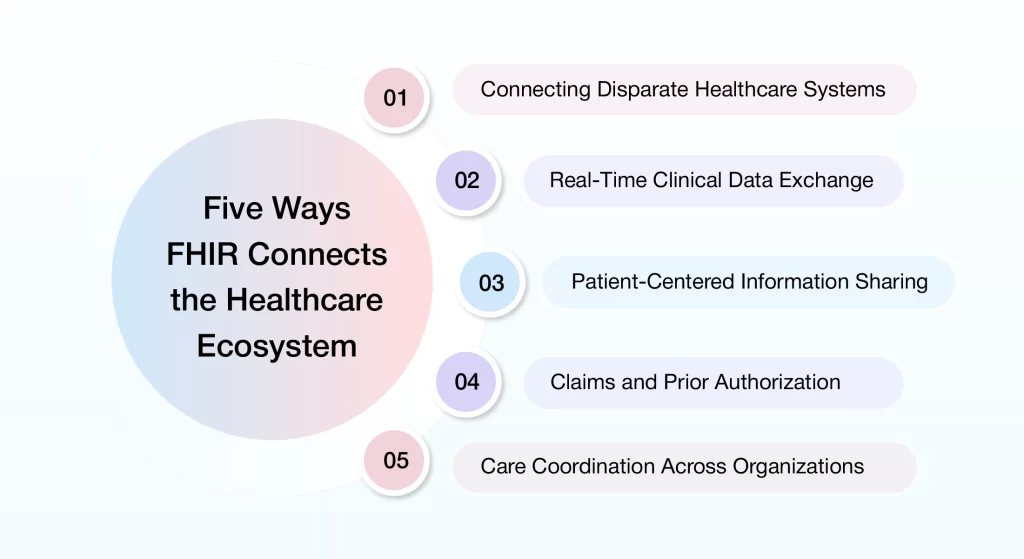
Connecting Disparate Healthcare Systems
Most healthcare organizations operate a mix of legacy and modern applications. Connecting these environments through traditional interfaces can require extensive development, custom data mapping and ongoing maintenance.
FHIR provides a standardized approach to representing and exchanging healthcare information. Its resource-based architecture and API capabilities can simplify integration between applications and reduce dependence on individually developed interfaces.
Key benefits include:
- Connect EHRs, claims systems, care management platforms, CRM solutions, laboratories, and pharmacies through standardized interfaces.
- Reduce reliance on custom point-to-point interfaces where compatible FHIR implementations are available.
- Establish more consistent data structures across connected applications.
- Simplify integration with new healthcare partners and digital solutions.
Enabling Real-Time Clinical Data Exchange
Many healthcare workflows still depend on scheduled file transfers and batch-based processing. This can create delays when clinical or administrative information is needed for an operational decision.
FHIR enables applications to retrieve and exchange healthcare resources through secure APIs, supporting more timely access to information when the participating systems are configured accordingly.
This helps organizations:
- Access relevant clinical information when supporting care decisions.
- Reduce information delays associated with scheduled data exchanges.
- Improve responsiveness across clinical and administrative teams.
- Support digital applications that require timely access to healthcare information.
Supporting Patient-Centered Information Sharing
Patients increasingly expect their healthcare information to be accessible across providers, health plans, and digital health applications. At the same time, organizations must ensure that information is shared securely and with appropriate authorization.
FHIR supports patient-centered interoperability by providing standardized ways to access and exchange healthcare information across connected applications.
Organizations can use it to:
- Power patient portals and mobile health applications.
- Reduce repeated collection of information across care settings.
- Help authorized providers access relevant patient information.
- Enable patients to securely access and share their health records through supported applications.
Connecting Claims and Prior Authorization Workflows
Claims processing and prior authorization often require information from multiple systems, including eligibility platforms, provider systems, clinical records and benefits administration systems. When these systems are disconnected, teams may spend additional time gathering information, resolving inconsistencies, and processing manual requests.
FHIR-based APIs can support more standardized information exchange between participating payer and provider systems. Implementation guides such as HL7 FHIR Da Vinci are particularly relevant to payer-provider workflows.
Potential improvements include:
- More efficient access to clinical information required for authorization reviews.
- Reduced manual information gathering across payer and provider workflows.
- Standardized exchange of relevant claims and administrative information.
- Better integration between data exchange and automated operational workflows.
Supporting Care Coordination Across Organizations
Care coordination depends on accurate and timely information being available to the professionals involved in a patient’s care. Without interoperability, providers, specialists, hospitals, care managers, pharmacies, and health plans may operate with incomplete or outdated information.
FHIR provides a common framework for representing and exchanging healthcare information, helping organizations coordinate information across participating systems.
This can support:
- Sharing relevant patient information across authorized care teams.
- Reducing avoidable information gaps and repeated data collection.
- Improving information continuity during transitions between care settings.
- Supporting more coordinated, data-informed healthcare delivery.
Together, these capabilities make FHIR more than a technical data exchange standard. It provides an important foundation for connecting healthcare systems, improving information accessibility, and supporting the next generation of digital healthcare services.
Real-World FHIR Use Cases
FHIR has evolved beyond a technical interoperability specification to become a foundation for many modern healthcare applications. Healthcare payers, providers, and digital health organizations use FHIR APIs and related implementation guides to support standardized data access, streamline information exchange, and build connected digital experiences.
Here are some important applications across the healthcare ecosystem.
Patient Portals & Mobile Health Applications
FHIR enables patient portals to securely retrieve supported healthcare information from connected systems, giving individuals easier access to their health records.
Common applications include:
- Viewing medical history and lab results
- Accessing medications and immunization records
- Scheduling appointments
- Sharing health information with authorized providers
Claims And Benefits Data Exchange
Healthcare claims involve information from multiple clinical and administrative systems. FHIR interoperability can support the exchange of structured information related to claims, coverage and explanation of benefits.
Organizations can use FHIR to:
- Exchange relevant member and coverage information
- Share structured claims and benefit information
- Support integration between payer applications and other healthcare systems, including clinical data supporting claims
- Improve access to information used in claims-related workflows
Prior Authorization Automation
Prior authorization is one of the more information-intensive workflows in healthcare. It often requires clinical documentation, member eligibility, provider details, and benefit information to be considered together.
FHIR-based implementation guides, including the Da Vinci Prior Authorization Support (PAS) implementation guide, support standardized exchange of information between payers and providers.
This can help:
- Reduce manual information requests.
- Support electronic submission of authorization requests.
- Exchange relevant clinical documentation.
- Improve visibility into authorization status and workflow progression.
Provider Directory Integration
Maintaining accurate provider information across multiple applications is a persistent challenge for healthcare payers.
FHIR’s Healthcare Directory (HD) implementation guide supports standardized exchange of information about healthcare practitioners, organizations, locations, and networks.
Potential applications include:
- Sharing provider directory information across systems.
- Supporting provider search and discovery applications.
- Improving consistency of provider information.
- Enabling more efficient directory data exchange.
Population Health Analytics
Population health initiatives depend on information from diverse sources to identify healthcare trends, monitor outcomes, and understand healthcare utilization.
FHIR can help standardize the exchange of clinical and administrative information used by analytics platforms.
Applications include:
- Aggregating relevant patient and clinical information.
- Supporting quality measurement and reporting.
- Monitoring population health indicators.
- Enabling data-driven preventive care initiatives.
FHIR provides the data exchange foundation, while analytical platforms and appropriate data models perform the deeper analysis.
Care Management
Care managers often need information from multiple systems to understand a member’s healthcare journey. This may include clinical records, medications, encounters, claims, and care plans.
FHIR resources can support the exchange of this information across participating applications, helping care management teams:
- Access relevant member information.
- Coordinate care across providers.
- Support outreach and follow-up activities.
- Maintain better visibility into care plans and patient progress.
Value-Based Care
Value-based care depends on the ability to share and evaluate information across payers, providers, and care teams. FHIR can support this by enabling standardized exchange of clinical, administrative, and quality-related information.
Potential applications include:
- Exchanging information used in quality measurement.
- Supporting care coordination across participating organizations.
- Sharing relevant information for performance monitoring.
- Supporting data exchange associated with value-based reimbursement models.
Ultimately, FHIR helps establish the information-sharing foundation required for more connected, data-driven healthcare delivery.
Challenges of FHIR Implementation and How to Overcome Them
While FHIR provides a more flexible approach to healthcare interoperability, implementing it across complex healthcare environments is rarely straightforward. Healthcare organizations must often connect legacy infrastructure, align different data standards, maintain regulatory compliance, and support evolving integration requirements.
Successful FHIR implementation requires more than adopting APIs. It involves the right integration architecture, data governance, security controls, and operational strategy to ensure information can be exchanged consistently and reliably.
Legacy System Integration
The Challenge:
Many healthcare organizations still rely on HL7 V2 interfaces, CDA documents, proprietary applications, and legacy databases that were not originally designed for FHIR-based integration. Connecting these environments directly to modern applications can require extensive data transformation, custom mappings, and interface development.
How to Overcome It:
Adopt interoperability platforms that support multiple standards, API orchestration, message transformation, and data mapping. These platforms can help translate information between legacy HL7 interfaces and FHIR-based applications, allowing organizations to modernize data exchange
Data Quality and Standardization
The Challenge:
Incomplete, duplicate, outdated, or inconsistent healthcare records can undermine the reliability of exchanged information. Even when systems successfully exchange FHIR resources, differences in data definitions, identifiers, and terminology can create inconsistencies across applications.
How to Overcome It:
Establish strong data governance and quality management practices, including:
- Master data management (MDM) to improve consistency across key data entities.
- Data validation and quality checks to identify missing, duplicate, or inconsistent records.
- Standardized healthcare terminologies and terminology mapping to support consistent interpretation.
- Data normalization and transformation to align information across different source systems.
- Continuous data quality monitoring to identify and address issues over time.
Security and Compliance
The Challenge:
Healthcare interoperability involves exchanging sensitive clinical, administrative, and financial information across multiple organizations and applications. Payers and providers must ensure that information is accessed only by authorized users and that data exchange complies with applicable privacy and security regulations, including HIPAA where relevant.
How to Overcome It:
Implement a comprehensive security framework that incorporates:
- OAuth 2.0-based authorization to control application access to protected resources.
- SMART on FHIR to support standardized authorization and authentication patterns for healthcare applications.
- Role-based or attribute-based access controls to enforce appropriate permissions.
- Encryption for data in transit and at rest.
- Audit logging and monitoring to maintain visibility into data access and exchange activities.
- Consent and authorization management aligned with applicable privacy requirements.
Security should be incorporated into the interoperability architecture from the beginning rather than added after integration is complete.
Governance and Implementation Consistency
The Challenge:
FHIR provides standardized resource definitions, but organizations may implement resources, terminology, profiles, and workflows differently. Differences in implementation can create compatibility issues even when participating systems technically support FHIR.
Version differences and inconsistent interpretations of implementation requirements can introduce additional complexity.
How to Overcome It:
Establish an enterprise interoperability governance framework that includes:
- FHIR profiles and implementation guides aligned with specific business and regulatory requirements.
- Standardized resource definitions, API specifications, and terminology bindings.
- Clear ownership of data definitions and interoperability policies.
- Cross-functional governance teams involving IT, security, compliance, and business stakeholders.
- Conformance testing and ongoing monitoring to validate compatibility across connected systems.
- Version management to support changes in FHIR releases and implementation requirements.
A consistent governance approach helps ensure that interoperability works across organizational boundaries, not just within individual applications.
Scalability and Performance
The Challenge:
As healthcare organizations expand digital services and connect additional payers, providers, partners, and applications, integration platforms must accommodate increasing API traffic and data exchange requirements.
Poorly designed architectures can create performance bottlenecks, increase response times, and make integrations difficult to maintain as usage grows.
How to Overcome It:
Adopt scalable interoperability architectures that can accommodate changing workloads and integration demands. Key capabilities include:
- Elastic infrastructure to accommodate fluctuations in API traffic.
- API management, rate limiting, and traffic monitoring.
- Efficient data retrieval and resource management.
- Asynchronous processing and event-driven integration where appropriate.
- Load balancing, fault tolerance, and high availability.
- Performance monitoring and automated testing to identify bottlenecks.
The architecture should be designed around actual workload requirements, security considerations, and the availability expectations of each use case.
Successfully implementing FHIR goes beyond exposing APIs. Organizations need to combine standardized data exchange with reliable integration architecture, strong governance, data quality management, and security controls.
For healthcare payers and providers, addressing these challenges creates a more sustainable interoperability foundation, one that connects existing infrastructure with modern digital applications while supporting evolving analytics, automation, and AI-driven healthcare initiatives.
How AI Makes FHIR Even More Powerful
FHIR addresses one of healthcare’s fundamental interoperability challenges by providing a standardized way to exchange information across different systems. However, exchanging data is only the first step. Healthcare organizations also need to interpret that information, identify meaningful patterns, and use it to support operational and clinical decisions.
This is where artificial intelligence complements FHIR. By combining standardized healthcare data exchange with AI capabilities, organizations can improve data integration, automate information-intensive processes, generate predictive insights, and support more informed decision-making.
In simple terms, FHIR helps connect and structure healthcare information, while AI helps interpret that information and turn it into actionable intelligence.
Intelligent Data Mapping
Healthcare data originates from different EHRs, claims platforms, provider systems, and legacy applications, each with its own data structures, identifiers, and terminology.
AI can assist integration teams by identifying relationships between source data fields and standardized FHIR resources, suggesting mappings, and helping detect inconsistencies across datasets. This can reduce manual mapping effort and accelerate integration projects.
However, suggested mappings still require validation against established FHIR specifications, implementation guides, and healthcare terminology standards to ensure that the resulting information retains its intended meaning.
Automated Data Quality and Normalization
Adopting FHIR does not automatically eliminate incomplete, duplicate, or inconsistent healthcare records. Data quality remains essential, particularly when information is exchanged across multiple organizations.
AI can complement established data quality processes by helping to:
- Identify missing, duplicate, or conflicting information.
- Detect inconsistencies in healthcare records.
- Suggest mappings between different clinical terminologies.
- Flag unusual data patterns for further validation.
- Support data enrichment and normalization workflows.
Combined with deterministic validation rules and data governance practices, these capabilities can improve the consistency and reliability of information used by downstream applications.
Predictive Insights and Risk Identification
Once healthcare information is accessible across connected systems, AI models can analyze relevant datasets to identify patterns, emerging risks, and potential changes in utilization.
FHIR can facilitate access to structured information, while AI models apply analytical techniques to identify patterns that may not be immediately apparent through traditional reporting.
Examples include:
- Identifying members with patterns associated with higher healthcare utilization.
- Highlighting potential care gaps and readmission risks.
- Supporting population health and utilization management initiatives.
- Identifying emerging cost patterns across member populations.
These predictions can help teams prioritize investigation and intervention, subject to appropriate model validation and ongoing monitoring.
Conversational Access to Healthcare Data
Healthcare professionals and operational teams often need to retrieve information from multiple systems before they can respond to a request or make a decision.
FHIR APIs can provide a standardized way for AI-powered assistants to access relevant information from connected applications, subject to user permissions and applicable security controls.
For example, an authorized care manager could ask an AI assistant for a summary of a member’s recent encounters, medications, and relevant care plan information. The assistant could retrieve information through connected FHIR APIs, organize it, and present a consolidated summary.
This can reduce the effort involved in navigating multiple applications and help care managers, customer service teams, and clinicians access relevant information more efficiently.
AI-Assisted Clinical Decision Support
AI can analyze structured FHIR information alongside clinical guidelines, historical records, and other relevant sources to support clinical decision-making.
Potential applications include:
- Summarizing relevant patient history.
- Highlighting potential clinical risks.
- Identifying information that may require further review.
- Supporting guideline-based care recommendations.
- Helping clinicians prioritize relevant patient information.
These capabilities should complement, rather than replace, clinical judgment. Recommendations must be appropriately validated, explainable where required, and subject to suitable clinical oversight.
Intelligent Workflow Automation
Many healthcare processes involve repetitive administrative tasks that require information from multiple systems. Combining FHIR-based data exchange with AI and workflow automation can help streamline these activities.
Potential applications include:
- Prior authorization: Retrieving and organizing relevant clinical and administrative information to support authorization workflows.
- Claims operations: Identifying missing information, highlighting potential exceptions, and supporting claims review.
- Care management: Prioritizing follow-up activities and organizing relevant member information.
- Clinical documentation: Generating summaries and assisting with documentation workflows.
- Member services: Helping service teams retrieve relevant eligibility, benefits, and claims information.
The objective is not simply to automate individual tasks, but to connect information retrieval, intelligent assistance, and operational workflows so teams can respond more efficiently.
A Real-World Example: AI-Assisted Prior Authorization
Consider a prior authorization request awaiting review. The provider’s clinical notes are stored in an EHR, member eligibility details are maintained in the payer’s system, and benefit information resides in another application.
With FHIR-based interoperability, participating systems can exchange relevant clinical and administrative information through standardized APIs.
AI can then help interpret and organize the retrieved information by:
- Summarizing relevant clinical notes and medical history.
- Checking available eligibility and coverage information.
- Identifying missing documentation or information requiring clarification.
- Organizing relevant details against applicable authorization requirements.
- Preparing a summary for the appropriate clinical or administrative reviewer.
The request can then be routed through an integrated workflow for further review and decision-making, with authorized professionals retaining responsibility for decisions that require clinical judgment.
The value lies in bringing connectivity, intelligence, and action together. FHIR helps make relevant information accessible, AI helps teams interpret it, and workflow automation helps move the process forward with less manual coordination.
Bringing FHIR and AI Together
As healthcare organizations expand their use of AI, the quality, consistency, and accessibility of underlying data become increasingly important.
FHIR provides a standardized framework for exchanging healthcare information, while AI can help interpret that information, identify patterns, and support intelligent workflows. When combined with strong data governance, reliable integration architecture, appropriate security controls, and human oversight, these technologies can help healthcare organizations move beyond basic data connectivity toward more intelligent, analytics-driven operations.
AVIZVA’s VIZCare Connect: Enabling Seamless Healthcare Interoperability With Intelligent Data Exchange
Achieving healthcare interoperability requires more than adopting FHIR. Most healthcare organizations must connect a diverse mix of EHRs, claims platforms, care management systems, provider networks, legacy HL7 interfaces, and modern cloud applications. Building and maintaining these integrations individually can increase complexity, slow digital initiatives, and make it difficult to scale.
AVIZVA’s VIZCare Connect helps healthcare organizations simplify these interoperability challenges by providing a unified integration platform that connects fragmented systems and enables secure, real-time healthcare data exchange across the ecosystem. Rather than treating interoperability as a collection of point-to-point integrations, VIZCare Connect creates a centralized connectivity layer that supports modern, API-driven healthcare.
Key capabilities include:
- HL7 and FHIR interoperability for seamless communication between legacy and modern healthcare systems.
- Healthcare API connectivity to integrate payer, provider, partner, and third-party applications.
- Real-time data orchestration and synchronization that keeps critical healthcare information current across connected systems.
- Automated data transformation to exchange information between different formats and standards without extensive custom development.
- Scalable integration that supports growing interoperability needs across payers, providers, TPAs, PBMs, and broader healthcare ecosystems.
Why AVIZVA
Modern healthcare organizations need more than reliable data exchange. They need an interoperability foundation that supports digital transformation, regulatory compliance, and future innovation.
VIZCare Connect helps organizations move beyond basic integrations by creating an intelligent connectivity layer that:
- Improves access to trusted healthcare data across systems.
- Accelerates integration projects with standardized APIs and interoperability services.
- Reduces the complexity of connecting legacy and cloud-based applications.
- Supports modern healthcare initiatives, including AI, automation, analytics, and digital member experiences.
- Scales with evolving business, regulatory, and interoperability requirements.
As healthcare continues to embrace API-first architectures, AI, and connected care models, interoperability becomes a strategic capability rather than a technical requirement. By combining FHIR HL7 support, intelligent orchestration, and enterprise-grade integration capabilities, AVIZVA’s VIZCare Connect helps healthcare organizations build a secure, connected, and future-ready data ecosystem.
FAQs
1. Why is FHIR important for healthcare interoperability?
FHIR improves healthcare interoperability by using modern APIs that allow healthcare systems to exchange specific data resources in real time. It simplifies integration between EHRs, payer platforms, and healthcare applications, making data easier to access, share, and use across the healthcare ecosystem.
2. How does FHIR improve healthcare data exchange?
FHIR improves data exchange by using RESTful APIs instead of the message-based approach older HL7 standards rely on. Applications can request just the resources they need in real time, rather than exchanging entire documents. This speeds up integration and makes data far easier to access.
3. What is the difference between HL7 V2 and FHIR?
HL7 V2 relies on structured, pipe-delimited messages exchanged in batches, while FHIR uses modern REST APIs to request specific data in real time. HL7 V2 still runs many hospital and lab interfaces today, but FHIR is built for cloud, mobile, and web-based applications.
4. Is FHIR replacing HL7?
Not entirely; FHIR is not replacing HL7 overnight. It is the newest standard developed by HL7 itself. Many organizations still depend on HL7 V2 and CDA for legacy workflows, so most healthcare ecosystems run FHIR and older HL7 standards side by side rather than switching completely.