
Table of Contents
Key Takeaways
- The Challenge: Payers have access to massive volumes of healthcare data, but fragmented systems and poor data quality often prevent them from turning it into actionable insights.
- The Shift: Real-time healthcare interoperability is becoming essential as organizations move beyond traditional batch-based processes toward faster, standards-based data exchange.
- The Opportunity: Effective healthcare data exchange improves operational efficiency by reducing errors, supporting faster decisions, and helping organizations meet regulatory requirements.
- The Bottom Line: Modern healthcare API integration, FHIR-based connectivity, and adherence to healthcare data standards are critical for building scalable and reliable data exchange workflows.
Healthcare organizations are generating more data than ever, yet turning that data into actionable insight remains a significant challenge. Claims flood in, enrollment data arrives in fragments, and member information varies from one system to another. Even when those systems are technically connected, payer teams are often left reconciling discrepancies instead of acting on insights. The result is an ecosystem rich in data, but poor in the clarity needed to make faster, smarter decisions.
That challenge is becoming more pressing as expectations for how quickly and seamlessly healthcare data should move continue to rise. CMS interoperability mandates, real-time reporting requirements, and FHIR adoption deadlines are accelerating faster than many legacy EDI and batch-based processes can accommodate. As a result, data quality and integration issues often surface only when a provider raises a concern or a member calls – leaving teams in a reactive cycle of identifying and resolving problems after the fact, rather than proactively anticipating and addressing them.
Bridging this gap requires more than simply connecting systems; it requires rethinking how data moves, is validated, and is ultimately translated into action. This blog explores the core barriers to effective healthcare data exchange, from siloed systems and inconsistent standards to the limitations of legacy processes. It also examines practical strategies that payers, TPAs, and PBMs are adopting to create more seamless data flows, improve data quality, reduce errors, and build the operational agility needed to respond proactively. The goal is not simply better data exchange, but a stronger foundation for timely insights, more efficient operations, and better experiences for healthcare consumers.
What Is Healthcare Data Exchange?
Healthcare data exchange refers to the movement of critical healthcare information across systems within a payer organisation and between external partners. This includes enrolment, eligibility, claims, accumulator, provider, and prior authorisation data shared with clearinghouses, PBMs, providers, and regulators.
This concept is closely related to health information exchange (HIE), which focuses on securely sharing clinical and administrative information between healthcare entities, providers, payers, and other stakeholders.
While often used interchangeably, data exchange and interoperability are not the same. Data exchange is about moving data from one system to another, whereas interoperability ensures that data is usable, contextual, and actionable across workflows and organizations.
For healthcare data exchange to deliver meaningful value, four interconnected layers must work together :
- Data Connectivity: Secure, reliable, and standardised connections that enable data to move seamlessly between systems and partners.
- Data Consistency: Consistent definitions, structures, and formats that ensure data means the same thing across systems and healthcare stakeholders.
- Workflow Integration: Integration of exchanged data into business workflows so information is available at the right time and can support timely decisions and actions.
- Data Governance: Policies, controls, and oversight that maintain data quality, privacy, security, compliance, and accountability throughout the exchange process.
This multi-layered approach ensures that healthcare enterprises can move beyond simple data transfer toward meaningful, operationally useful interoperability.
The Real Cost Of Broken Data Exchange For Payers, TPAs & PBMs
Inefficient healthcare data exchange comes with tangible operational and financial consequences for payers, TPAs, and PBMs. Data silos and fragmented systems lead to duplicate work, reprocessed claims, compliance risks, and delays in member onboarding. These issues not only affect internal efficiency but also impact revenue, member satisfaction, and regulatory standing.
Key Impacts of Broken Data Exchange :
- Duplicate Work: Teams spend extra time correcting errors caused by incomplete or inconsistent data.
- Revenue Leaks: Rejected claims, stale eligibility information, and missed accumulator syncs directly affect payments and reimbursements.
- Compliance Exposure: Failure to meet CMS interoperability mandates, prior authorization rules, and information-blocking penalties can result in fines and reputational damage.
- Delayed Member Onboarding: Fragmented data slows verification processes, impacting member experience and operational timelines.
7 Key Barriers To Effective Healthcare Data Exchange
Interoperable data flows help healthcare entities reduce manual reconciliation, improve member experiences, and meet regulatory requirements. Yet, payers, TPAs, and PBMs face persistent barriers that slow down real-time information flow, increase costs, and create compliance risks. Understanding these healthcare data exchange challenges is the first step toward designing solutions that streamline data exchange and reduce operational friction.
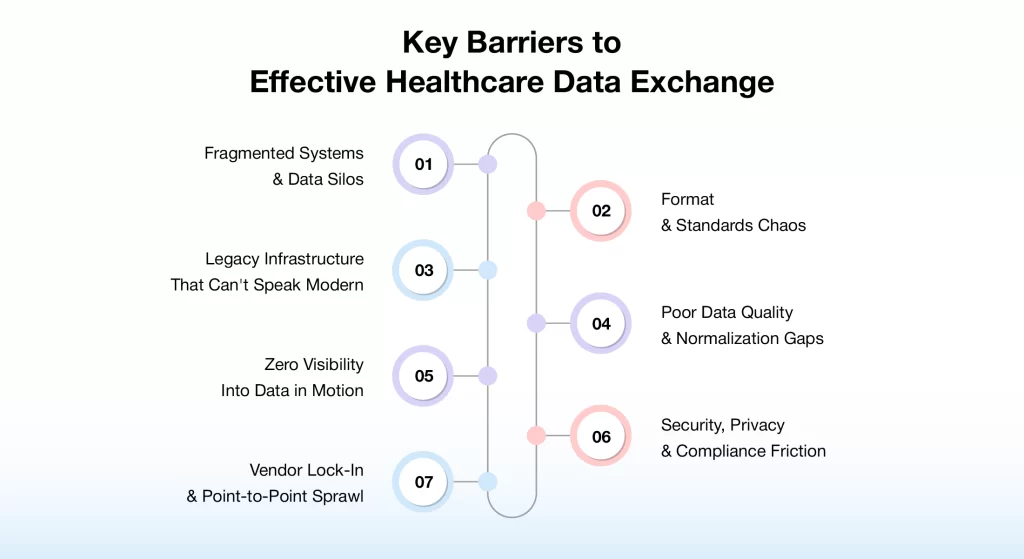
Following are the 7 key barriers to effective healthcare data exchange :
1. Fragmented Systems
Multiple administrative platforms, legacy technologies, and an increasingly complex partner ecosystem can fragment data across the organisation
- Enrolment, claims, eligibility, and consumer data reside in separate repositories.
- Cross-system reconciliation requires manual intervention, increasing errors and delays.
- Siloed data prevents a unified view of consumer information, creating blind spots for operational and strategic decisions.
2. Inconsistent Data Standards
Healthcare data standards such as HL7, FHIR, and X12 EDI provide a common framework for structuring and exchanging information across different healthcare systems. However, when these groups rely on multiple formats without consistent implementation, data mapping issues and integration complexity increase.
- X12 EDI, HL7, FHIR, flat files, and proprietary APIs often coexist.
- Inconsistent standards result in mapping errors and rework.
- Lack of standardisation slows integration with new partners and digital tools.
3. Legacy Infrastructure
Many core healthcare systems rely on batch-based processing incompatible with real-time operational needs.
- Claims, prior authorisations, and eligibility updates lag behind actual events.
- Legacy architecture struggles to support FHIR APIs and real-time reporting.
- IT teams spend significant resources maintaining fragile interfaces instead of enabling innovation.
4. Poor Data Quality
Data inconsistencies and normalisation gaps undermine the value of exchanged information.
- Local coding variations and unvalidated feeds cause misaligned member or provider records.
- Duplicate or incomplete records trigger claim denials and operational rework.
- Missing or inaccurate data reduces confidence in reporting, analytics, and decision-making.
5. Zero Data Visibility
Without active monitoring, failures go undetected until downstream processes fail.
- Feed disruptions or mapping errors often surface only when claims are rejected or benefits are miscalculated.
- Lack of real-time alerts prevents proactive incident management.
- IT teams are forced into reactive troubleshooting rather than strategic planning.
6. Security, Privacy & Compliance Friction
Regulatory constraints often slow the exchange of legitimate data.
- HIPAA-conservative policies may block necessary sharing between providers, payers, and PBMs.
- Balancing security with operational agility is complex, especially when multiple systems and partners are involved.
- Compliance risks increase when data exchange lacks audit trails or traceability.
7. Vendor Lock-In & Point-To-Point Sprawl
Each new integration often requires custom projects, creating long-term dependencies.
- Point-to-point connections limit flexibility and increase maintenance costs.
- Vendor-specific APIs and proprietary protocols make scaling or changing partners challenging.
- Organizations struggle to maintain consistent interoperability across evolving healthcare networks.
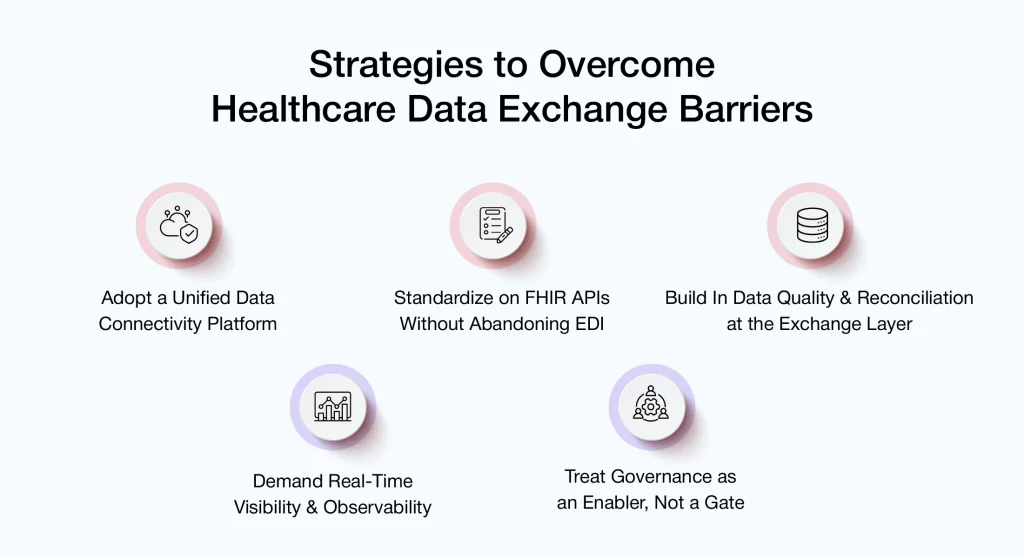
How To Overcome Healthcare Data Exchange Barriers: 5 Proven Strategies
Breaking down these interoperability barriers requires both technology and operational rigour. Organisations that rely on disconnected systems, legacy infrastructure, and inconsistent standards can significantly improve data flow, compliance, and operational efficiency through modern health information exchange solutions. These interoperability solutions focus on secure connectivity, standardised APIs, and real-time data visibility, helping organizations build more reliable data flows across payer, provider, and partner ecosystems. The following strategies outline practical approaches to achieving this:
1. Adopt A Unified Data Connectivity Platform
A centralised data connectivity layer eliminates the chaos of point-to-point integrations and reduces maintenance overhead.
- Consolidate multiple internal systems and external partner feeds in a single platform.
- Provide a primary integration zone for all product and API workflows.
- Reduce latency and errors that occur from duplicated or mismatched connections.
- Enable faster onboarding of new partners or systems without custom integration projects.
2. Bridge Legacy EDI With Modern FHIR
Healthcare interoperability using FHIR enables enterprises to exchange structured data through standardized APIs while bridging modern applications with existing EDI-based systems. Rather than replacing legacy infrastructure, organizations can gradually adopt FHIR-based integration to achieve real-time data exchange.
- Maintain existing EDI flows for legacy partners while exposing FHIR endpoints for modern applications.
- Gradually implement FHIR-based integration for claims, eligibility, and prior authorisation.
- Enable seamless integration with digital tools, analytics platforms, and patient engagement applications.
3. Build Data Quality & Reconciliation Into The Exchange Layer
Prevent errors before they propagate downstream by validating and normalising data at the point of exchange.
- Detect duplicate records, missing fields, or inconsistent identifiers.
- Normalise coding schemes (CPT, ICD, local codes) across all feeds.
- Enrich data with reference sources to ensure accuracy for claims and member records.
- Reconcile accumulator, eligibility, and provider data automatically before it reaches core systems.
4. Demand Real-Time Visibility & Observability
Proactive monitoring is critical to prevent silent failures in data exchange pipelines.
- Track transactions end-to-end across internal and partner systems.
- Receive automated alerts when feeds break, mappings fail, or data is delayed.
- Maintain audit trails to meet compliance requirements and enable quick investigations.
- Enable operational teams to act in real time, reducing downtime and member impact.
5. Treat Governance As An Enabler
Modern data governance ensures security, compliance, and accountability while enabling faster, safer data sharing.
- Implement role-based access, lineage tracking, and usage policies to protect sensitive information.
- Automate enforcement of compliance requirements like HIPAA and CMS rules.
- Empower teams to securely share data without unnecessary bottlenecks.
- Provide transparency and auditability to satisfy regulators, partners, and internal stakeholders.
Inside a Modern Healthcare Data Exchange Architecture: What “Good” Looks Like
A modern healthcare data exchange architecture goes beyond simple point-to-point integrations. It combines the power of orchestration, standardised APIs, enriched industry data, and comprehensive operational visibility to deliver reliable, real-time, and actionable healthcare information. At the core, an ideal reference architecture includes the following :
- Orchestration Engine: Centralised control of all data flows, enabling automated routing, transformation, and reconciliation across multiple systems and partners.
- API Layer: Supports FHIR, CMS-compliant endpoints, and scalable integration with internal and external systems. Healthcare API integration enables secure communication between payer platforms, provider systems, digital applications, and external healthcare networks while maintaining consistent data exchange across connected environments.
- Preloaded Industry Data: Includes validated NPPES provider information, code sets (CPT, ICD-10, NDC), and reference tables to accelerate data normalization.
- 360° Operational Views: Provides actionable insights into all transactions, end-to-end data flow visibility, and monitoring dashboards for operational teams.
VIZCare Connect: A Practical Example Of Modern Healthcare Connectivity
VIZCare Connect is a healthcare data connectivity platform designed to address the end-to-end data integration & interoperability needs of healthcare enterprises. It embodies the ideal architecture of next-gen healthcare data exchange highlighted above and delivers the following tangible capabilities :
- Real-time orchestration of healthcare transactions
- Access to 300+ healthcare APIs compliant with FHIR and CMS standards
- Preloaded NPPES provider data and code sets (CPT, ICD-10, NDC)
- Automated data reconciliation across feeds and systems
- End-to-end transaction visibility with audit trails and operational dashboards
The Road Ahead: Where Healthcare Data Exchange Is Going in 2026 And Beyond
Healthcare data interoperability is moving toward more real-time, standards-based connectivity, making the foundation healthcare teams build today critical for future data requirements. The following key trends are shaping the future :
- Event-Driven, Real-Time Exchange: Nightly batch updates are giving way to continuous, event-driven data flows that provide instant visibility into eligibility, claims, and prior authorisation updates.
- AI-Assisted Mapping and Transformation: Artificial intelligence helps automate complex data transformations, resolve format inconsistencies, and accelerate integration between legacy systems and modern FHIR APIs.
- Expanding Partner Ecosystems: Healthcare payer organizations are exchanging data with a growing range of partners, from virtual care providers and remote monitoring platforms to digital health and care management solutions. This expanding ecosystem requires scalable, secure, and interoperable data exchange capabilities that can support new connections without adding integration complexity.
- Convergence Of Clinical And Administrative Data: Clinical and administrative data are increasingly being brought together to create a more complete view of the member and their healthcare journey. Combining claims, eligibility, prior authorisation, provider, and clinical data enables more accurate reporting, richer analytics, faster decision-making, and more coordinated member and provider experiences.
These trends underscore the urgency for healthcare organizations to modernize their data exchange layers today. A strong foundation ensures that real-time, AI-enhanced, and multi-partner interoperability initiatives can be implemented efficiently, securely, and at scale.
Closing Thoughts
Healthcare data exchange challenges are rarely about individual interfaces – they are platform and strategy problems. Fragmented systems, inconsistent standards, and reactive workflows create operational friction, revenue leakage, and compliance risks. A next-gen, unified integration platform transforms scattered data into actionable, reliable intelligence across payers, TPAs, and PBMs.
With a centralized orchestration layer, standardized APIs, preloaded reference data, and end-to-end visibility, organizations can reduce errors, accelerate decision-making, and ensure every feed flows seamlessly.
FAQs
1. How does HL7 FHIR improve healthcare data exchange?
HL7 FHIR standardizes how healthcare information is structured and shared, enabling real-time, API-driven access to patient, claims, and provider data. Unlike legacy formats, FHIR allows disparate systems to exchange usable, contextual data quickly, reducing errors and improving operational efficiency.
2. What is the difference between healthcare data exchange and interoperability?
Healthcare data exchange refers to the movement of data between systems or organizations. Interoperability goes further; it ensures that the exchanged data is consistent, actionable, and meaningful, so systems and users can effectively interpret and act on it.
3. Why is healthcare interoperability important for providers and payers?
Interoperability enables providers and payers to access accurate, timely data across multiple systems, improving care coordination, reducing claim errors, and supporting compliance. It also allows seamless collaboration with partners, telehealth platforms, and analytics tools, enhancing both operational efficiency and patient outcomes.
4. How does healthcare data exchange improve patient outcomes?
By providing clinicians and care teams with complete, accurate, and real-time information, healthcare data exchange helps prevent delays, misdiagnoses, and redundant tests. Better visibility into claims, prior authorizations, and care history enables timely interventions, coordinated care, and higher-quality patient experiences.
5. How does healthcare data exchange reduce operational costs?
Efficient data exchange reduces duplicate work, claim reprocessing, and manual reconciliation. Automated workflows, standardized APIs, and real-time visibility minimize errors, speed up processes, and lower administrative overhead, ultimately decreasing operational expenses while improving revenue capture.