
Table of Contents
Key Takeaways
- Business Imperative: Real-time claims are now a competitive necessity for U.S. health insurers.
- The Problem: Batch-based systems delay adjudication, increase denials, and inflate administrative costs.
- The Solution: VIZCare Connect enables real-time healthcare interoperability, synchronizing claims, eligibility, and benefits through API-led, event driven data exchange.
- The Outcome: Faster claims cycles, higher straight through processing, fewer denials, always-on compliance, and measurable payer ROI.
In today’s high-stakes U.S. healthcare insurance market, speed has become the primary competitive differentiator. Yet many payers and third party administrators (TPAs) remain constrained by the hidden inefficiencies of slow, batch driven claims cycles.
When a claim sits in a processing backlog for days, the impact quickly compounds: delaying payments, increasing operational costs, and creating friction for both providers and members. At the core of this challenge is a continued reliance on batch based claims and benefits workflows, built for periodic processing rather than real-time decision-making.
Data integration in healthcare enables real-time data exchange and offers a clear path forward. However, achieving this shift requires more than incremental system upgrades; it calls for modern solutions across the healthcare ecosystem. By moving beyond file based data transfers, payer systems can exchange data securely, consistently, and in real time, enabling faster decisions and more efficient operations.
In this blog, you’ll learn how to :
- Unlock real-time claims and benefits decision-making
- Reduce operational delays driven by batch-based processing
- Strengthen data accuracy and speed through healthcare interoperability services
- Convert interoperability investments into measurable payer ROI with AVIZVA
The Limitations Of Traditional, Batch Based Claims Processing
Batch processing introduces delays in adjudication, leaving claims stuck in queues and vulnerable to data mismatches from EHRs or TPAs. The consequence is clear: as highlighted in Experian Health’s State of Claims 2025 report, denial rates frequently exceed 10%, largely due to incomplete or non standardized data.
Where batch-based models fall short :
Reliance on traditional batch processing creates a cascading effect of operational inefficiencies, compounding delays, increasing errors, and impacting overall system performance.
| Issue | Impact on Payers |
| Adjudication Delays | Extended cycles of increased rework and delays |
| High Denials | Rates rise from data gaps and mismatches |
| Rising Costs | Admin expenses grow due to manual fixes |
| Poor Member Experience | Attrition from slow benefits verification |
The Core Solution: Healthcare Interoperability Services For Real-Time Claims Processing
To achieve meaningful improvements in speed and efficiency, payers must move beyond incremental process optimization. This requires a structural transition from transactional, retrospective data models to predictive and proactive data utilization that supports real-time decision-making at the point of service.
Rather than validating information only after a claim is submitted, payers can :
- Verify eligibility at the point of interaction
- Align benefits prior to claim submission to prevent downstream errors
- Respond to changes as they occur, rather than hours or days later
This transformation is fundamentally dependent on the speed and accuracy of data exchange across systems. As a result, achieving seamless interoperability for health insurance claims across healthcare systems becomes a critical enabler of real-time claim adjudication and improved operational performance.
Interoperability As The Real-Time Engine
At its core, interoperability in healthcare enables standardized, secure, and continuous data exchange across internal payer systems and external partners.
For health insurers, this translates into the breakdown of silos across key operational domains, including core claims processing platforms, member and eligibility systems, and finance and billing applications. This elimination of silos elevates the business operations of a payer in the following ways :
- Faster onboarding of TPAs and care networks
- A unified source of truth across operational workflows
- Consistent application of business rules and compliance logic
- Seamless collaboration with external ecosystem partners
- Easier adoption of evolving regulatory requirements
Modern interoperability solutions in healthcare are no longer file-based or periodic in nature. Instead, they are designed for event-driven, API-led data exchange that enables real-time connectivity and responsiveness across systems.
The Key Pillars Of Real-Time Payer Operations
1. FHIR-Based Integration
The HL7 FHIR (Fast Healthcare Interoperability Resources) standard serves as a foundational pillar of modern healthcare data exchange. It provides a structured, API-driven framework that bridges disparate payer systems, such as core claims engines, finance modules, and member portals enabling them to function as a unified, interoperable ecosystem.
2. API-Led Connectivity
APIs act as standardized, secure connectors rather than fragile, custom-built integrations. They enable seamless data exchange between internal systems and external stakeholders, including TPAs, care networks, and EHR systems, ensuring consistent and reliable information flow across the healthcare ecosystem. In modern architectures, healthcare API integration serves as the backbone of scalable interoperability.
3. Data Transformation
Raw healthcare data is often unstructured and inconsistent. Interoperability solutions address this by normalizing, cleansing, and enriching data, ensuring it is adjudication-ready as soon as it enters the system, thereby improving processing accuracy and efficiency.
Real-time data not only enhances claims processing but also enables event-driven architectures. This allows systems to trigger automated workflows, such as high-priority care management alerts, the moment a relevant data point is received.
| Feature | Legacy Batch-Processing | Real-Time Interoperability |
| Data Flow | Scheduled intervals (daily/weekly) | Continuous, event-driven |
| Error Detection | Post-submission (leads to denials) | At the source (point-of-entry) |
| Processing Cost | High (due to manual rework) | Low (automated STP) |
| Compliance | Reactive / Manual Reporting | Automated / “Always-on” |
Healthcare Interoperability Use Cases:
One of the most impactful healthcare interoperability use cases is real-time eligibility and benefits verification. By enabling instant verification, payers can identify coverage mismatches early, align benefits before claims are submitted, and reduce denials at the source.
For claims teams, this translates into tangible operational gains, including lower rework, faster resolution times, and higher first-pass accuracy ultimately improving both business efficiency and overall claims performance.
As real-time data begins to flow seamlessly across the payer ecosystem, the impact is immediate and measurable.
Driving Payer ROI: Measurable Interoperability Benefits for Health Insurers
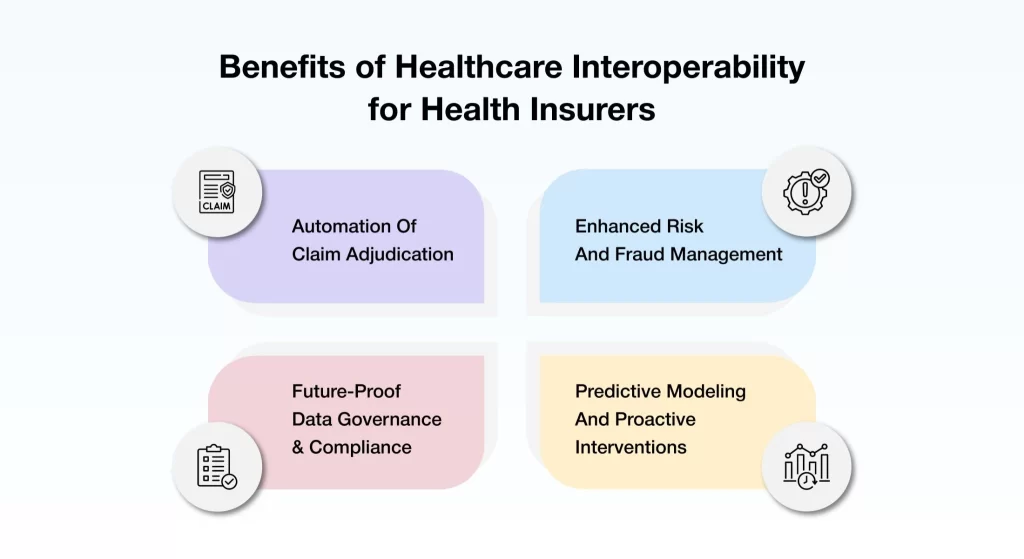
For payer executives, the true value of real-time data lies in its ability to deliver measurable business outcomes. Healthcare interoperability is a critical enabler, driving tangible improvements across cost efficiency, operational speed, and data accuracy.
Key areas where interoperability delivers ROI include :
1. Automation Of Claim Adjudication
Real-time data flows enable high straight through processing (STP) rates, allowing claims to be adjudicated automatically with minimal manual intervention. As a result, the claims lifecycle is significantly reduced from days to minutes accelerating processing times and lowering administrative overhead.
2. Enhanced Risk And Fraud Management
Real-time access to claims and utilization data strengthens prepayment integrity by enabling earlier detection of anomalies and high-risk transactions. Interoperability driven data flows allow payers to identify unusual billing patterns before payment is issued, improve accuracy in risk adjustment and reporting, and intervene proactively. As a result, financial leakage is reduced, and overall confidence in claims outcomes is significantly enhanced.
3. Future-Proof Data Governance & Compliance
Real-time interoperability service enables a standardized and centralized approach to data management, supporting evolving regulatory requirements with greater accuracy and transparency. By establishing a single source of truth across claims, eligibility, and benefits, and streamlining reporting for mandates such as CMS interoperability rules, payers can ensure consistent compliance. As a result, organizations move from reactive data gathering to proactive, audit ready reporting reducing risk and improving regulatory confidence.
4. Predictive Modeling And Proactive Interventions
Real-time data availability allows payers to move beyond reactive operations toward predictive, insight-driven decision-making. With continuous access to claims trajectories, member utilization patterns, and historical as well as current eligibility data, insurers can develop more accurate predictive models. These models help identify members at risk of high-cost conditions, detect early indicators of non-adherence or avoidable utilization, and uncover opportunities for timely, targeted interventions. As a result, the payer’s role evolves from transactional adjudication to proactive risk management and care optimization.
Inside AVIZVA’s End-To-End Interoperability Strategy For Payers
In healthcare insurance, the fundamental challenge is not the availability of data, but the absence of real-time data access. When eligibility, benefits, and accumulator information are processed in batches or trapped within disconnected systems, it results in delayed adjudication, inconsistent benefit decisions, and rising operational inefficiencies.
VIZCare Connect enables real-time data to become actionable across systems: accelerating claims processing, simplifying benefits decisions, and enhancing end-to-end operational performance.
VIZCare Connect is a healthcare data connectivity platform designed to address the end-to-end data integration and interoperability needs of healthcare enterprises. Engineered for scale, it orchestrates millions of transactions across disparate systems while preserving data accuracy and lineage.
Key Capabilities Of VIZCare Connect
1. Real-Time Data Orchestration & Synchronization
The platform supports a wide range of integration protocols and formats, automates complex data flows, and leverages built in AI to dynamically configure sources, map fields, and optimize transformations.
2. A Robust Suite Of 300+ Healthcare APIs
The platform offers a suite of healthcare APIs to accelerate internal product development and unlock enterprise grade innovation at scale. The healthcare APIs are purpose built to support lookup, read, search, add, and update functions across all key healthcare data types.
3. Preloaded & Continuously Updated Healthcare Industry Data
The platform provides an enriched, ready-to-use dataset that complements enterprise data, enabling enhanced analytics, decision-making, and AI-driven insights.
4. 360° Data Views For Business & Operational Intelligence
The platform delivers end-to-end visibility across all systems and touch points, providing real-time insights and analytics to drive scalable, accurate, and efficient healthcare operations.
5. Your Strategic Roadmap To Transforming Healthcare Insurance
True healthcare transformation is defined by how payer data moves, not where it is stored. It requires a structured, phased roadmap that operationalizes interoperability into real-time, measurable outcomes across the payer ecosystem.
6. Assess The Current Data Ecosystem
Begin by identifying where delays and inefficiencies originate across the data ecosystem. This includes mapping batch dependencies across claims, eligibility, and benefits systems, pinpointing manual touch-points and rework heavy workflows, and assessing data quality gaps along with latency challenges.
7. Establish The Data Foundation For Interoperability
Implement data standardization and governance frameworks to enable seamless interoperability across systems. This includes standardizing core administrative and claims data models, defining governance rules to ensure accuracy, consistency, and controlled access, and aligning data standards with evolving regulatory requirements.
8. Build API-Led Connectivity Across The Payer Ecosystem
Establish secure, scalable, and reusable API driven connectivity as the backbone of interoperability. This includes enabling APIs across internal payer systems, integrating TPAs, partner platforms, and external data sources, and ensuring a standardized approach to connectivity that supports scalability and future growth.
9. Activate Real-Time Interoperability With A Payer Centric Engine
Transition from periodic data exchange to continuous, event driven interoperability across the payer ecosystem. This includes enabling event based data sharing, supporting real-time validation and decision triggers, and maintaining end-to-end visibility across data movement to ensure speed, accuracy, and operational control.
10. Automate High-Impact Claims And Benefits Workflows
Prioritize automation in areas that deliver immediate operational and financial impact. This includes automating eligibility and benefits validation, embedding real-time data checks to reduce denials at the source, and enabling straight through processing for clean, rule-compliant transactions to improve speed, accuracy, and efficiency.
11. Integrate AI And Predictive Intelligence
Leverage real-time data flows to embed intelligence across payer operations. This includes enabling predictive risk identification, strengthening prepayment integrity checks, and improving forecasting and reporting accuracy to support more proactive, data driven decision making.
12. Partner With AVIZVA To Accelerate Adoption
Accelerate interoperability transformation through proven execution capabilities. This includes leveraging AVIZVA’s healthcare interoperability offering, deploying payer focused frameworks and accelerators, and reducing time-to-value while ensuring regulatory compliance and operational stability.
By partnering with AVIZVA, payers transition from fragmented, patchwork integration to purpose built interoperability. This delivers measurable outcomes, including higher straight through processing (STP) rates and reduced denial volumes, lower administrative overhead, seamless regulatory readiness for 2026 and beyond, along with enhanced member and provider experiences that drive long-term engagement and loyalty.
Conclusion
Speed has become a defining factor for success in healthcare insurance. Payers that can access, validate, and act on data in real time are reducing costs, improving accuracy, and delivering superior experiences, while those that cannot risk falling behind.
This is where healthcare interoperability services create a clear competitive advantage. By transforming fragmented data into real-time, actionable intelligence, they enable faster decision-making, stronger compliance, and more efficient operations across the payer ecosystem.
AVIZVA empowers insurers to activate interoperability where it matters most at the point of decision without disrupting existing systems. See what real-time interoperability looks like in action.
Partner with AVIZVA and start transforming payer operations today.
FAQs
1. How do healthcare interoperability services improve real-time claims adjudication?
Healthcare interoperability services give insurers access to accurate, connected data at the moment claims decisions are made, reducing delays caused by incomplete or outdated information.
- Member eligibility, coverage, and provider data are validated instantly before claims processing.
- Claims systems receive consistent data from multiple sources, reducing manual reviews and rework.
- Missing information and documentation gaps are identified earlier in the adjudication cycle.
- Faster, more accurate decisions reduce claim delays, administrative costs, and avoidable denials.
2. What role does HL7 FHIR play in healthcare interoperability services?
HL7 FHIR is a key foundation of FHIR healthcare interoperability, providing a standardized way for insurers, providers, and healthcare systems to exchange structured data quickly and consistently.
- Member clinical, claims, and administrative data can move across systems using a common format.
- Payers gain faster access to relevant healthcare information, enabling more informed decisions.
- API-based FHIR connections reduce dependency on manual data exchange and complex legacy integrations.
- Real-time data availability improves care coordination, risk management, and operational efficiency.
3. How do API-led interoperability solutions benefit health insurers?
API-led interoperability solutions help insurers connect fragmented systems and create a unified data ecosystem across internal and external stakeholders.
- Data moves seamlessly between payer, provider, and partner systems without manual intervention.
- Claims, authorization, and member information remain synchronized across workflows.
- New technologies and third party applications can be integrated faster without replacing existing infrastructure.
- Connected data enables insurers to improve automation, compliance readiness, and member experiences at scale.