
Table of Contents
Key Takeaways
❖ Analytics Evolution: Healthcare payer analytics is moving beyond traditional reporting toward predictive and actionable intelligence that helps organizations identify patterns, anticipate risks, and support better decisions.
❖ Connected Data: Payers need a connected data foundation that brings together claims, member, provider, financial, and operational information to create reliable analytics.
❖ AI Readiness: Successful AI adoption depends on governed, secure, and context-rich healthcare data that can support accurate and meaningful insights.
❖ Strategic Approach: A strong payer data strategy aligns analytics capabilities with priorities such as cost management, member experience, operational efficiency, and value-based care.
❖ VIZCare: AVIZVA’s VIZCare suite helps payer organizations connect healthcare data and apply AI-driven intelligence across payer workflows.
Healthcare payers have no shortage of data. Every claim, enrollment change, provider interaction, prior authorization, member inquiry, payment, and care event adds to an already complex data ecosystem. The real challenge is turning that information into actionable intelligence that supports better decisions across payer operations.
Claims data may reside in one system while member, provider, clinical, financial, and operational information remains scattered across others. Different teams may work with inconsistent data or disconnected views of the same business problem. By the time reports are consolidated and insights reach decision-makers, the operational conditions they describe may have already changed.
In 2027, healthcare payer analytics is evolving beyond retrospective reporting toward a more connected, proactive approach. Payers increasingly need the ability to identify emerging patterns, anticipate operational risks, understand cost drivers, and support timely decisions across claims, member services, provider networks, and healthcare administration.
Achieving this shift requires more than adding dashboards, deploying predictive models, or introducing AI tools. It calls for a healthcare data strategy built on interoperability, data quality, governance, and access to reliable information across the payer ecosystem. With the right foundation, analytics can move closer to the point of decision by helping healthcare payers improve operational efficiency, strengthen member experiences, manage costs, and pursue sustainable business growth.
Healthcare Payer Analytics: The Shift From Reporting Data to Predicting What Comes Next
Traditional payer reporting answers an important question: What happened?
How many claims were processed? How did medical costs change? Which providers recorded the highest utilization? How many members contacted customer service?
Those metrics provide essential visibility into payer operations. However, they primarily explain past performance. They do not always reveal why trends are emerging, what may happen next, or which actions could improve outcomes.
Healthcare payer analytics expands this capability by helping organizations move from understanding historical performance to anticipating potential outcomes and making more informed decisions.
This progression can be understood through three levels of analytics:
- Descriptive analytics: what happened? Provides visibility into historical performance across claims, medical costs, utilization, member activity, provider performance, and operational metrics.
- Predictive analytics: What might happen next? Uses historical and current data to identify patterns and estimate potential outcomes, such as rising utilization, emerging cost pressures, or increased demand for member services.
- Prescriptive analytics: What should we do about it? Helps evaluate potential interventions, prioritize opportunities, and identify actions that may improve operational or financial outcomes.
Each level builds on the previous one. Descriptive analytics establishes visibility, predictive analytics helps anticipate change, and prescriptive analytics supports decisions about how to respond.
The distinction matters because having more reports does not automatically make a health plan data-driven. An organization may have hundreds of dashboards yet still struggle to identify emerging risks, establish root causes, or coordinate action across departments.
More mature analytics environments connect data to operational decisions. Consider a health plan experiencing an increase in medical utilization. A traditional report might flag the increase. A more advanced analytics environment could help identify the member populations and services contributing to the trend, examine variation across provider groups, and highlight areas for further investigation. Predictive models may then estimate whether the trend is likely to continue, while decision-support tools help teams evaluate appropriate next steps.
The progression toward predictive and prescriptive analytics is particularly relevant as payers navigate rising cost pressures, increasingly complex risk arrangements, and evolving value-based care models. However, the quality of these insights depends on the completeness, timeliness, and reliability of the underlying data.
The goal is not to replace reporting. It is to build on it that connects historical visibility with forward-looking intelligence and actionable decisions.
The Core Data Sources Powering Healthcare Payer Analytics
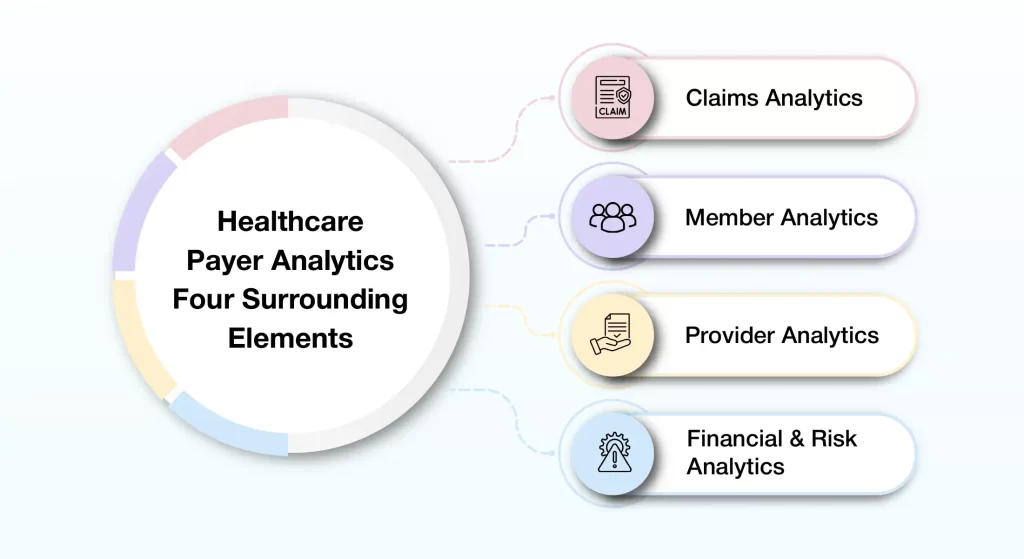
Useful payer intelligence rarely comes from a single dataset. It emerges when claims, member, provider, financial, risk, and operational data can be analyzed together.
Each data domain provides a different perspective on payer performance. Claims data reveals utilization and payment patterns, member data adds context to healthcare needs and service interactions, provider data helps explain network performance, and financial and risk data supports broader business planning.
An effective healthcare payer analytics strategy must account for these interconnected domains, enabling teams to move beyond isolated metrics toward a more complete understanding of operational performance, cost drivers, and emerging opportunities.
Claims Analytics: Identifying Cost Patterns and Improving Claims Performance
Claims data provides a detailed view of healthcare utilization and financial activity, including services delivered, diagnoses, procedures, billed and allowed amounts, provider activity, and payments.
Claims analytics helps health plans understand where costs are occurring, identify processing inefficiencies, and investigate patterns that may affect financial and operational performance.
Key applications include:
- Utilization and claims trends: Track changes in claim volumes, service utilization, and spending over time.
- High-cost services and populations: Identify areas contributing disproportionately to medical and pharmacy expenditure.
- Payment accuracy and anomalies: Flag unusual billing patterns, potential duplicate payments, and claims requiring further review.
- Provider and service cost variation: Compare costs across service categories, provider groups, and geographic regions.
- Denials and processing exceptions: Identify recurring denial reasons, processing bottlenecks, and opportunities to improve claims workflows.
- Emerging cost drivers: Examine shifts in service utilization, treatment patterns, and pharmacy spending.
The value comes from connecting these observations rather than examining individual metrics in isolation.
For example, if medical costs increase within a member population, claims analytics can help identify whether the change is associated with a particular service category, condition, geography, provider group, or utilization pattern. Combining claims data with member demographics, eligibility, provider network information, and relevant clinical data can provide additional context for understanding the trend.
This enables payer teams to investigate potential causes, prioritize areas for review, and make more informed decisions about cost management and operational improvement.
Member Analytics: Understanding Utilization, Engagement and Healthcare Needs
A member’s healthcare journey extends far beyond claims activity. Enrollment and eligibility records, digital interactions, service requests, care management activity, benefits utilization, communication preferences, and healthcare service usage all contribute to a broader understanding of member needs.
Member analytics brings these signals together to identify patterns that may remain hidden when information is distributed across disconnected systems. By connecting member-level insights with operational and healthcare utilization data, payers can better understand how members access services, engage with their health plans, and navigate their healthcare journeys.
Integrating additional contextual information, such as social determinants of health (SDOH) data, can provide further insight into factors that may influence healthcare access, engagement, and outcomes. Depending on data availability, quality, and appropriate permissions, SDOH indicators can help payers identify potential barriers related to transportation, housing stability, food access, and other social factors.
This makes SDOH data integration in payer analytics an important consideration for organizations seeking a more comprehensive understanding of member populations and the challenges that may affect their healthcare experiences.
For example, analytics teams can examine which populations have higher rates of avoidable emergency department utilization, where members disengage from health programs, which service interactions generate recurring friction, and where targeted outreach may be beneficial. When relevant contextual information is available, teams can investigate whether barriers to care access or other factors may be contributing to these patterns.
These insights create opportunities to move beyond broad engagement strategies toward more relevant, context-informed interactions. Rather than applying the same approach across all populations, payer teams can better identify where members may benefit from clearer benefit information, personalized communications, care management support, or assistance navigating available services.
The objective is to turn member data into a more complete understanding of member needs and use that understanding to guide more relevant, timely, and effective engagement.
Provider Analytics: Improving Network Performance
Provider performance influences healthcare costs, access to care, quality, member experience, and the success of value-based care arrangements. For health plans, understanding these dimensions is essential to building effective provider networks and making informed contracting and network management decisions.
However, evaluating provider performance requires more than reviewing individual metrics. Relevant information is often distributed across claims systems, provider directories, contract records, quality reporting, referral data, utilization records, and network management platforms. When these sources remain disconnected, it becomes difficult to develop a consistent view of provider activity and its impact on overall payer performance.
Provider analytics and value-based care analytics help payers connect these data points to evaluate utilization patterns, cost variation, network efficiency, quality indicators, and performance against contractual or value-based care objectives.
For example, a health plan may identify significant differences in the cost of comparable services across provider groups. By analyzing claims, service mix, member risk profiles, network participation, negotiated rates, and available quality measures together, analytics teams can investigate whether these differences reflect variations in patient complexity, utilization patterns, reimbursement arrangements, or other contributing factors. This provides a more evidence-based foundation for network optimization, provider engagement, and informed contracting decisions.
The objective is not simply to generate another provider scorecard. It is to give network and operations teams the context needed to understand why performance differs, identify areas for further investigation, and determine where collaboration or operational changes may be beneficial.
In value-based care environments, this capability becomes even more important. Payers and providers need a shared understanding of expenditure, utilization, quality, risk, and outcomes to evaluate performance against agreed-upon goals. Connected analytics can help health plans monitor alternative payment models, identify performance gaps, and support more informed discussions with provider organizations.
Ultimately, provider analytics helps transform network management from periodic performance review into a more continuous, evidence-based process—supporting better-informed contracting decisions, more effective provider relationships, and stronger alignment between cost, access, and quality objectives.
Financial and Risk Analytics: Supporting Better Payer Decisions
Healthcare costs rarely change because of a single factor. Population risk, utilization patterns, provider performance, service mix, pharmacy spending, and changing member needs can all influence a health plan’s financial performance. Understanding how these factors interact is essential for making informed decisions about expenditure, resource allocation, and long-term business planning.
Financial and risk analytics help payer organizations connect operational, clinical, and financial information to develop a more comprehensive view of current performance and emerging pressures.
Key applications include:
- High-risk and high-cost population identification: Analyze claims, utilization, and relevant member data to identify populations that may require closer review or additional support.
- Cost and utilization forecasting: Use historical trends and current data to estimate future expenditure and anticipate potential changes in healthcare demand.
- Risk adjustment analytics: Evaluate relevant diagnosis, enrollment, and claims information to support risk adjustment processes and improve the accuracy of risk-related assessments.
- Population health management: Identify patterns across member populations, investigate potential care gaps, and help teams prioritize appropriate outreach and support.
- Financial performance monitoring: Track medical expenditure, budget variances, claims trends, and other indicators against business objectives.
- Emerging cost pattern detection: Examine changes in service utilization, provider activity, and pharmacy spending to identify potential cost pressures requiring further investigation.
For population health teams, a well-defined population health analytics strategy moves beyond reviewing historical utilization and aggregate risk scores. It helps teams identify where risk patterns are emerging, which populations may benefit from additional assessment, and where targeted interventions could be appropriate.
For finance and operations leaders, these insights provide a stronger foundation for forecasting expenditure, allocating resources, evaluating potential interventions, and assessing financial performance against business objectives.
For example, an increase in projected medical expenditure may reflect changes in service utilization, the mix of services delivered, provider reimbursement, or the health needs of the enrolled population. By connecting claims, member, provider, and financial data, payer teams can investigate the contributing factors and evaluate potential responses rather than relying solely on historical spending reports.
The goal is to connect financial visibility with forward-looking intelligence that helps payer leaders anticipate emerging pressures, assess their implications, and make better-informed business decisions.
Why More Healthcare Data Is Not Always Leading to Better Insights
The growing volume of available healthcare data can create the impression that better analytics should follow automatically. In practice, more data does not necessarily translate into more meaningful insights.
The challenge is often not a lack of data, but the difficulty of bringing it together. Information is distributed across claims systems, member systems, provider databases, care management applications, CRM, data warehouses, external partners, and legacy infrastructure. When these sources remain disconnected, obtaining a complete and consistent view of operations becomes difficult.
Analysts may spend significant time locating, reconciling, validating, and preparing data before meaningful analysis can begin. Disconnected reporting environments can also produce conflicting metrics and inconsistent interpretations of the same operational activity, making it harder for decision-makers to establish a reliable picture of performance.
Data quality adds another layer of complexity. Duplicate member records, outdated provider information, inconsistent identifiers, missing fields, differing business definitions, and delayed updates can undermine the reliability of analytics outputs. Even sophisticated analytical models can produce misleading results when they rely on incomplete, inconsistent, or outdated data.
Infrastructure limitations can create further challenges. Batch-based data exchanges and tightly coupled legacy systems may introduce delays that limit the usefulness of information for time-sensitive operational decisions. The appropriate data architecture must therefore reflect both the analytical requirements and the speed at which decisions need to be made.
For healthcare analytics leaders, creating value from data requires more than collecting information. It requires a connected data foundation supported by strong governance, consistent definitions, reliable data quality, and timely access to trusted information. These capabilities help establish a consistent view of the business and enable analytics teams to move from fragmented reporting toward more informed, data-driven decisions.
This foundation is equally important for AI-driven analytics. Reliable, well-governed data can improve the quality and relevance of AI outputs, while weak data foundations can introduce inconsistencies, limit performance, and undermine trust. For healthcare payers, data readiness is therefore not simply a technical consideration; it is a critical enabler of effective analytics and responsible AI adoption.
How AI Is Transforming Healthcare Payer Analytics From Insights to Intelligent Actions
AI is extending the capabilities of healthcare payer analytics by helping organizations detect patterns, interpret complex datasets, and prioritize issues that may require attention. When integrated with reliable data and established analytics processes, AI can help teams move beyond reporting what has happened toward anticipating what may happen and identifying appropriate next steps.
One important application is predictive risk identification. Models can analyze historical and current information to identify patterns associated with rising healthcare utilization, emerging cost pressures, member risk, or operational exceptions. These signals can help payer teams prioritize further investigation, allocate resources, and assess where timely intervention may be beneficial. Their effectiveness depends on the quality of the underlying data, appropriate model validation, and ongoing performance monitoring.
These capabilities reflect the broader evolution of AI in health insurance operations, where AI can support predictive insights, identify operational patterns, and inform decision-making.
AI can also strengthen anomaly detection and pattern analysis across large volumes of healthcare information. Rather than relying entirely on manual reviews, analytics teams can use AI-assisted tools to flag unusual claims patterns, unexpected changes in utilization, potential payment anomalies, or emerging operational bottlenecks. These findings serve as signals for further investigation, not definitive evidence of an error or underlying cause.
Another important capability is AI-assisted decision support. Traditional analytics can help reveal what is changing, while AI can help organize and interpret the context surrounding that change. For example, when investigating a claims exception or a change in utilization, teams may need to consider claims history, eligibility, provider information, benefit rules, and operational records together. AI can help retrieve, summarize, and contextualize relevant information so that authorized users can evaluate the situation and determine the appropriate next step.
This creates an opportunity to shorten the distance between identifying an issue and responding to it. When connected to governed workflows, AI-generated insights can support activities such as prioritizing cases, guiding operational teams, and recommending follow-up actions, while keeping decisions within appropriate business rules and human oversight.
However, healthcare AI requires more than analytical capability. Payer organizations must account for data access controls, privacy and security, governance, traceability, model validation, and the potential for bias. They must also ensure that AI outputs are grounded in reliable information and appropriate healthcare and payer-specific context.
AI should therefore be treated as an integrated component of the broader healthcare payer data and analytics architecture and not as an isolated intelligence layer. Its value depends on how effectively it connects trusted data, relevant insights, operational workflows, and accountable decision-making.
Data Strategies That Make Healthcare Payer Analytics Successful in 2027
A successful healthcare payer data strategy does not begin with choosing the most sophisticated analytical model. It begins by establishing the conditions under which data can support dependable insights, informed decisions, and measurable business outcomes.
For healthcare payers, this means building a strategy around connected data, clearly defined business priorities, and the governance and infrastructure required to support AI-driven intelligence.
Create a Connected Data Foundation
Healthcare payer analytics becomes more valuable when teams can examine relationships across data domains instead of working within isolated systems.
This requires connecting claims, member, provider, operational, financial, and other relevant data while preserving the context, quality, and lineage needed to interpret it correctly.
Integration must also reflect the complexity of payer technology environments. Payers exchange information through APIs, EDI transactions, databases, files, event-driven architectures, and legacy interfaces. Supporting these different mechanisms is essential to achieving healthcare data interoperability across complex payer ecosystems.
A connected data foundation should accommodate diverse systems and formats while establishing consistent definitions, reliable data quality checks, and appropriate access controls. Where needed, it should also support timely data exchange so information is available at the pace required by the use case.
The objective is not simply to move data between systems. It is to make information sufficiently consistent, contextualized, and trustworthy to support cross-domain analytics, operational intelligence, and AI-driven applications.
Align Analytics With Payer Priorities
Analytics initiatives can become overly technology-led when organizations focus on collecting more data, building additional dashboards, or deploying more models without defining which decisions these capabilities are intended to improve.
A more effective approach starts with business priorities and works backward to the data and analytical capabilities required.
For claims operations, priorities may include understanding cost drivers, improving payment accuracy, identifying processing bottlenecks, or investigating unusual claims patterns. Population health teams may need better visibility into risk indicators and utilization trends. Member experience teams may focus on service friction, engagement patterns, and access to benefits. Network teams may need to understand provider access, utilization, cost variation, and quality indicators.
Each use case calls for its own combination of data, analytical methods, performance measures, and operational workflows.
The starting point should therefore be a clear business question:
What does the organization need to understand, decide, or improve that it cannot reliably do today?
From there, teams can identify the required data sources, establish baseline measures, define the intended outcomes, and determine how insights will influence operational decisions. This helps keep analytics investments tied to measurable priorities rather than technology adoption alone.
Prepare for AI-Driven Healthcare Intelligence
AI readiness requires more than making enterprise data accessible to a model. It requires data that is reliable, consistently defined, appropriately governed, and available with the context needed for the intended use case.
Healthcare data and analytics leaders should establish clear data ownership, validation processes, access controls, and monitoring practices. Access should reflect user roles and the sensitivity of the information involved, while AI-generated outputs should be evaluated for accuracy, relevance, and potential bias.
Governance also needs to extend beyond the data itself. Organizations should define how models are validated and monitored, how outputs are reviewed, and when human oversight is required, particularly when AI supports decisions that could affect members, providers, claims, or benefits.
Scalability is another important consideration. As AI use cases expand across claims operations, member services, provider management, care management, and other functions, disconnected point solutions can introduce new data silos and inconsistent controls.
A scalable architecture should make it possible to reuse trusted data, shared services, and governance practices across multiple use cases without assuming that every application requires the same data, access, or processing approach.
By investing in data quality, interoperability, governance, and scalable architecture, healthcare payers can build a stronger foundation for AI-driven analytics while maintaining the accountability and controls required in healthcare.
How AVIZVA Helps Payers Build Analytics-Driven Healthcare Operations
Building analytics-driven healthcare operations requires more than analytical tools. Healthcare payers need connected data, healthcare-specific intelligence, and digital platforms that help teams translate insights into informed action.
AVIZVA helps healthcare payers, TPAs, and PBMs build these capabilities through healthcare technology engineering and its VIZCare product suite.
Connecting healthcare data across systems
Through VIZCare Connect, AVIZVA helps organizations integrate healthcare data across disparate systems and formats. By supporting data exchange and interoperability across complex technology environments, it helps establish a connected foundation for analytics and operational intelligence.
Applying AI to healthcare workflows
VIZCare AI provides a healthcare-focused AI platform designed around payer operations, terminology, and business context. It supports the development of AI-driven experiences that can help teams work with information across domains such as claims, members, providers, benefits, and prior authorizations.
Turning insights into operational action
VIZCare Empower supports internal healthcare business operations through unified workflows, automation, and AI-enabled assistance. By bringing relevant information and operational processes together, it helps teams manage activities across functions and respond more efficiently to business needs.
Enabling better digital experiences
Through its Xperience product, AVIZVA helps payers deliver digital experiences for members, providers, employers, and brokers. Self-service capabilities and connected information can help users access relevant information and complete tasks through digital channels.
Together, these capabilities support a broader approach to healthcare technology that connects data, applies healthcare-specific intelligence, and embedds digital capabilities into operational workflows. For payers preparing for 2027 and beyond, this creates a foundation for advancing analytics-driven operations while aligning technology investments with business priorities.
Conclusion: The Future of Healthcare Payer Analytics Is Actionable Intelligence
By 2027, the differentiator in payer analytics will not be how many dashboards an organization maintains or how much healthcare data it stores.
It will be how effectively the organization can connect that data, establish trust in it, identify what matters, and turn insights into timely operational decisions.
That requires payer organizations to position healthcare payer analytics as part of a broader data strategy. Claims, members, providers, risk, costs, and operations cannot remain separate analytical domains when the decisions payers make increasingly depend on understanding their relationships.
The same principle applies to AI. Predictive models and AI-driven intelligence become significantly more useful when they operate on connected, governed, healthcare-specific data.
For payer data and operations leaders, the opportunity in 2027 is therefore not simply to generate more insight. It is to build an environment in which trusted healthcare data can continuously inform decisions across the organization.

FAQs
1. What is healthcare payer analytics?
Healthcare payer analytics is the process of analyzing claims, member, provider, financial, risk, and operational data to help payer organizations identify patterns, manage costs, improve outcomes, and make informed decisions.
It goes beyond traditional reporting by using descriptive, predictive, and prescriptive analytics to understand what happened, anticipate what may happen next, and determine where action is needed.
2. What data strategies should payers prioritize in 2027?
In 2027, payers should prioritize data strategies focused on creating connected, governed, and analytics-ready healthcare data environments.
Key priorities include integrating claims, member, provider, financial, and operational data; improving data quality and governance; aligning analytics with business goals; and preparing data foundations for AI-driven intelligence.
3. How do payers use predictive analytics to manage cost and risk?
Payers use predictive analytics to identify emerging risks, forecast costs, detect utilization patterns, and understand factors influencing healthcare spending.
By analyzing historical and current data, predictive models can help identify high-risk populations, anticipate cost changes, support risk adjustment efforts, and enable teams to take timely action.
4. What role does AI play in payer analytics?
AI helps payer organizations analyze complex healthcare data, identify patterns, and support faster, more informed decisions across operations.
AI can assist with predictive risk identification, automated pattern detection, and decision support by bringing together information from claims, members, providers, benefits, and operational systems. However, effective AI adoption requires secure, governed, and reliable healthcare data.
5. How can payers strengthen data governance and interoperability?
Payers can strengthen data governance and interoperability by creating consistent data standards, improving data quality, establishing clear ownership, and connecting information across healthcare systems.
A strong data foundation helps ensure analytics outputs are accurate, traceable, and usable while enabling better collaboration across claims, member services, provider operations, and other payer functions.