
Table of Contents
Key Takeaways
- Best for healthcare data governance and compliance-ready operations: AVIZVA helps healthcare enterprises strengthen the data, interoperability, security, and operational visibility underlying compliance.
- Best for structured healthcare compliance programs: Compliancy Group centralizes policies, risk assessments, workforce requirements, vendor management, and other compliance activities.
- Best for workforce compliance and credentialing: MedTrainer combines compliance management, healthcare education, credentialing, and documentation.
- Best for regulatory change management: YouCompli turns healthcare regulatory updates into assigned, trackable actions and documented evidence.
- Best for enterprise compliance training: HealthStream combines healthcare compliance education, policy management, and workforce-focused compliance capabilities.
- Best for clinical training and workforce performance: Relias connects healthcare learning with compliance tracking, competency management, and workforce development.
Healthcare compliance becomes increasingly difficult to manage as an organization grows faster than the systems and processes supporting it.
Sensitive member, patient, provider, claims, and operational information can move across dozens of systems and applications, from core healthcare platforms and partner systems to APIs, files, and internal tools. Each connection introduces another place where information, processes, and controls need to be understood and managed. Compliance teams must keep all of this aligned while also managing regulatory requirements, policies, workforce obligations, security controls, audits, and supporting evidence.
When these responsibilities are spread across spreadsheets, emails, separate repositories, and disconnected systems, compliance becomes more than an administrative challenge. Information becomes fragmented, making it harder to see where risks exist, understand how systems and processes are connected, and determine whether the right controls are actually in place.
This is where the choice of enterprise healthcare compliance software becomes important. Not every organization has the same compliance priorities.
Some may need stronger HIPAA program management, while others may be focused on workforce credentialing, regulatory intelligence, compliance training, or audit readiness. But in complex healthcare environments, all these activities increasingly depend on having a reliable view of the data, systems, processes, and interactions that create compliance risk in the first place.
The question, then, is not simply which compliance software offers the most features. It is which part of compliance is hardest for your organization to see, manage, and control and whether your technology foundation is equipped to address it.
Best Healthcare Compliance Software for Healthcare Enterprises
No single healthcare compliance platform is the strongest choice for every compliance function. The better question is not which product offers the longest list of features, but which platform is best aligned with the specific compliance challenges an enterprise needs to address.
| Offerings | Key Strengths |
| VIZCare Connect | Healthcare data security, governance & operational visibility: Ensuring data protection, interoperability, compliance, and operational oversight across complex healthcare environments |
| Compliancy Group | HIPAA program management: Streamlining risk assessments, policies, training, vendor oversight, and compliance documentation |
| MedTrainer | Credentialing & workforce readiness: Managing provider credentials, training, documentation, and related workflows |
| YouCompli | Regulatory change management: Tracking regulatory updates, interpreting their impact, assigning accountability, and monitoring implementation |
| HealthStream | Enterprise workforce development: Supporting compliance education, policy administration, audit preparation, and ongoing professional development |
| Relias | Clinical learning & competency: Delivering role-based training, competency development, compliance education, and workforce enablement |
The distinction matters because not all compliance challenges are the same. A hospital system focused on tracking employee training completion needs tools built around workforce compliance. A payer trying to trace healthcare data across interconnected systems needs visibility into data flows, systems, and controls. Both fall under the broader umbrella of compliance, but the technology required to solve each problem is fundamentally different.
1. VIZCare Connect: Best for Healthcare Data Governance And Operational Visibility
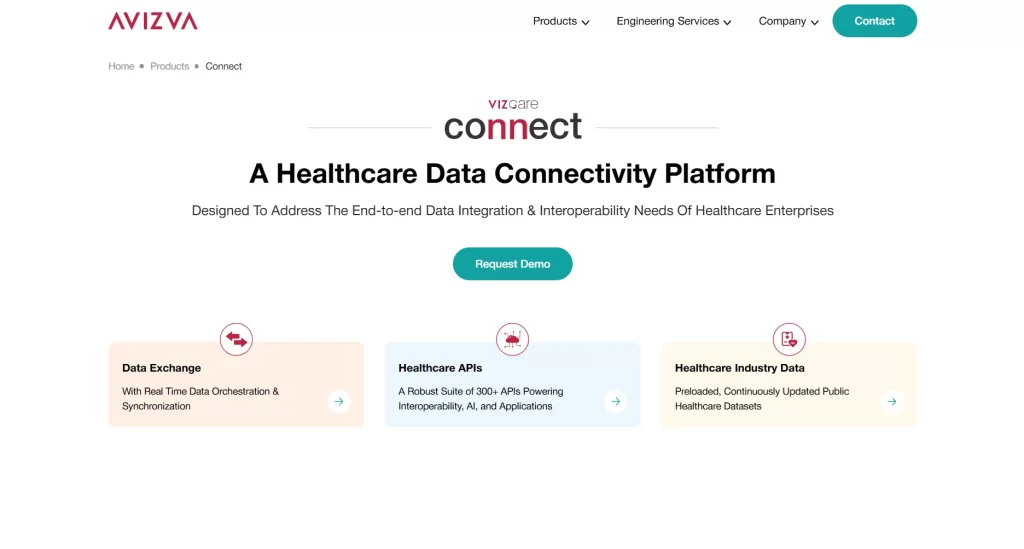
For healthcare enterprises, compliance does not begin when an auditor asks for evidence. It starts much earlier – when healthcare information is collected, exchanged, protected, validated, and governed across the organization.
That’s why VIZCare Connect takes a different approach from conventional healthcare compliance management platforms. Rather than focusing solely on individual compliance activities, VIZCare Connect serves as a healthcare data connectivity layer that drives data exchange, offers a robust suite of APIs, and delivers end-to-end enterprise visibility.
This approach is particularly relevant for payers, TPAs, PBMs, and other healthcare enterprises where compliance risks are closely tied to fragmented data, complex system interactions, and limited visibility across the technology environment.
Healthcare Data Governance
An enterprise cannot confidently govern information it cannot trace. VIZCare Connect provides visibility into healthcare data movement, system dependencies, and transaction flows. It supports data validation and enrichment and maintains lineage as information moves through connected systems.
For compliance and technology teams, that creates a stronger foundation for answering practical questions such as:
- Where did this information originate?
- Which systems received it?
- What transformations or business rules were applied?
- Where did a transaction fail?
- Is downstream information consistent with the source?
That visibility can make reporting, auditing, monitoring, and discrepancy investigation more manageable across complex healthcare environments.
Secure Healthcare Data Management
Security controls need to remain effective wherever healthcare information moves and wherever it is accessed.
VIZCare Connect’s technology approach incorporates controls such as encryption, authentication and authorization, role-based access, logging, auditability, and secure APIs. Furthermore, the product is offered by AVIZVA, which is a HIPAA-compliant and SOC 2 Type II organization.
For enterprises handling PHI and PII across multiple applications, platforms, and external connections, protecting a single database is only one part of the challenge. Compliance also depends on maintaining appropriate security controls as data moves between systems, is accessed by different users, and passes through different stages of its lifecycle.
Healthcare Interoperability
For many healthcare enterprises, compliance is closely tied to how data moves between systems. When information passes through multiple platforms, applications, and external connections, organizations need to know where that data goes, how it is handled, and whether the right controls are in place.
VIZCare Connect supports healthcare data exchange through FHIR APIs and other integration methods. It provides more than 300+ healthcare APIs, real-time orchestration, healthcare-specific business logic, and continuously updated healthcare datasets. These capabilities can help enterprises connect disparate systems while improving visibility and control over the movement of healthcare information.
This makes it particularly relevant when compliance challenges are closely connected to the underlying data architecture. Instead of addressing compliance as a standalone administrative function, the focus is on creating a more connected and governable technology environment.
Where It Adds Value:
Healthcare enterprises that need greater control, traceability, security, and visibility across complex healthcare data ecosystems.
What To Consider:
VIZCare Connect is not a direct substitute for dedicated compliance administration platforms focused on activities such as employee training, policy attestations, or compliance task management. Its strength lies in building the healthcare data foundation that can help enterprises drive more governable, transparent, and compliance-ready operations.
2. Compliancy Group: Best For HIPAA Program Management
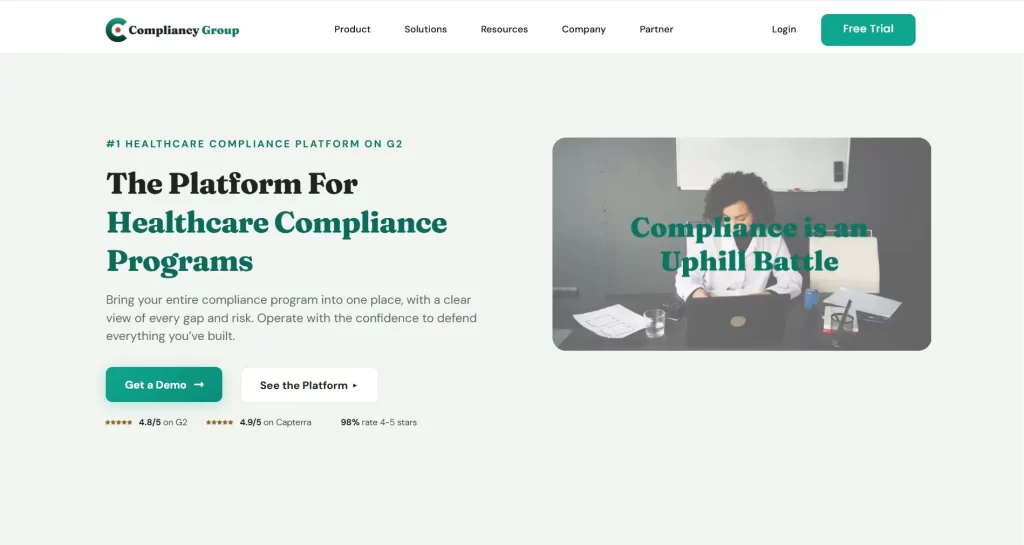
For organizations looking for a more traditional healthcare compliance management system, Compliancy Group takes a program-management approach.
Its platform brings together risk assessments, policies and procedures, workforce training, incident management, vendor management, Business Associate Agreements, sanction screening, and compliance monitoring.
That makes it particularly useful when the central challenge is coordinating the many recurring tasks involved in maintaining a formal compliance program.
Instead of keeping risk assessments in one system, employee records in another, and policy documentation somewhere else, compliance teams can manage these activities from a shared environment. Automated reminders and task tracking also help reduce dependence on manually maintained calendars and spreadsheets.
Compliancy Group has expanded beyond a narrow single-location model. Its current offerings include enterprise options supporting complex organizations and multiple locations. The key capabilities include risk assessments, policy and procedure management, workforce compliance training, incident reporting, vendor and BAA management, compliance monitoring and documentation & exclusion and sanctions screening.
Where It Adds Value:
Healthcare organizations seeking structured management of HIPAA and broader healthcare compliance activities.
What To Consider:
Its primary strength is managing the compliance program itself. Organizations whose main problem is governing complex healthcare data exchange may need additional interoperability and data-management capabilities alongside it.
3. MedTrainer: Best For Credentialing & Workforce Readiness
Healthcare enterprises often face a different operational problem: keeping provider and employee requirements current across locations.
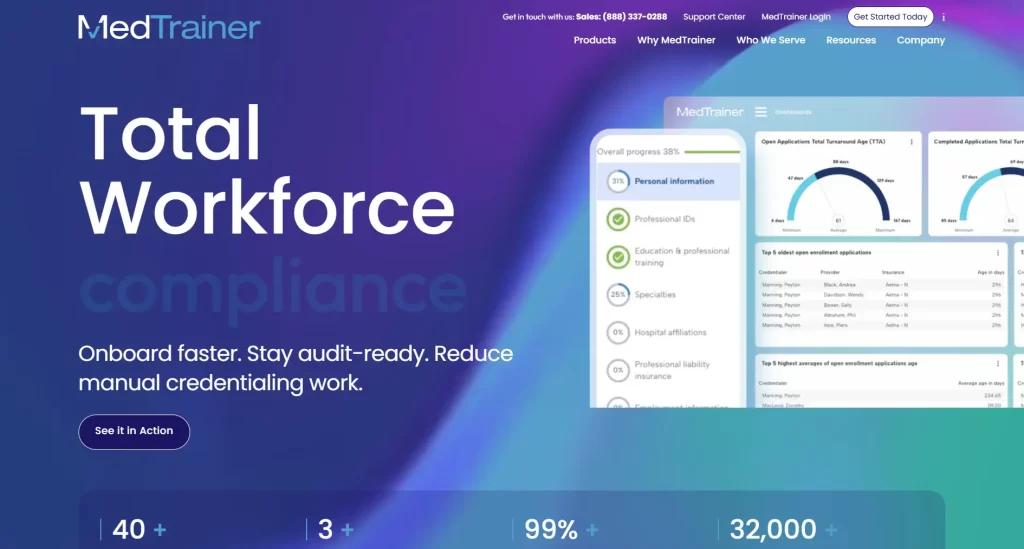
MedTrainer addresses that through a platform combining compliance, education, credentialing, and documentation. Its credentialing capabilities support provider profile management, primary source verification, license verification, exclusions monitoring, payer enrollment, privileging, and related workflows. The platform also provides healthcare-specific learning and compliance functionality. Its key capabilities include healthcare compliance training, provider credentialing, license and certification tracking, policy and document management, automated compliance workflows & reporting and dashboards.
That combination can be valuable for healthcare organizations where workforce readiness and provider administration create a significant part of the compliance workload. For multi-location organizations, centralized reporting can also make it easier to identify missing documents, upcoming requirements, credentialing status, and other gaps without maintaining separate local trackers.
Where It Adds Value :
Provider organizations and healthcare enterprises managing substantial employee, provider, credentialing, and education requirements.
What To Consider :
MedTrainer is particularly strong around people, credentials, education, and related documentation. Enterprises primarily trying to govern healthcare data across a complex system ecosystem are solving a different compliance problem.
4. YouCompli: Best For Regulatory Change Management
Knowing a regulation changed is only the first step. The harder enterprise problem is determining what changed, who needs to respond, what actions are required, and whether those actions were completed. YouCompli supports healthcare regulatory compliance management by helping teams monitor changes, assign responsibilities, and maintain documentation.
The platform combines healthcare regulatory analysis with workflow management. It monitors federal, state, and Medicare Administrative Contractor sources, organizes relevant changes, and helps compliance teams translate those changes into assigned work.
Teams can establish ownership, due dates, rollout activities, and progress tracking, then maintain documentation showing what was reviewed and completed.
This creates a useful chain from regulatory change → interpretation → responsibility → action → verification.
Its key capabilities include regulatory source monitoring, expert regulatory analysis, requirement and action tracking, assignment of ownership and due dates, progress reporting & documentation and audit trails.
For a large healthcare organization, that can be more useful than simply receiving another regulatory alert. The platform is designed to help turn regulatory intelligence into operational accountability.
Where It Adds Value :
Healthcare compliance departments are struggling to monitor and operationalize frequent regulatory changes across teams or facilities.
What To Consider :
YouCompli is highly focused on healthcare regulatory change management. It is not intended to replace the underlying healthcare data infrastructure through which regulated information is exchanged and governed.
5. HealthStream: Best For Enterprise Workforce Development
Compliance can fail even when the right policy exists if the workforce does not understand, acknowledge, or consistently apply it. HealthStream approaches that problem through healthcare workforce development and compliance.
Its Compliance Suite brings compliance training and policy management together in a healthcare-focused environment. The solution supports regulatory compliance related to areas including CMS, OSHA, HHS, and HIPAA. Its key capabilities include healthcare compliance education, policy management, workforce development, training tracking, audit readiness and regulatory-focused learning content.
For large organizations, this matters because distributing a policy is only part of the requirement. Teams also need to know who received training, whether it was completed, where competency gaps exist, and whether changes have been implemented across the workforce.
HealthStream is therefore particularly relevant when healthcare regulatory compliance management is closely connected to employee education and organizational readiness.
Where It Adds Value :
Hospitals, health systems, and other large healthcare organizations where workforce training and policy implementation are major compliance priorities.
What To Consider :
Its center of gravity is workforce and compliance education rather than enterprise healthcare data governance.
6. Relias: Best For Clinical Learning & Competency
Relias is another strong option when compliance depends heavily on workforce knowledge, clinical competencies, and ongoing education.
The Relias Platform combines healthcare learning with compliance tools, requirements tracking, policy management, competency tracking, reporting, and workforce development.
Its learning platform supports role-based assignments and multiple training formats, while real-time dashboards help organizations track completion and readiness. Relias also offers policy and procedure management and tools for tracking licenses, credentials, and other workforce requirements.
Its key capabilities include healthcare learning management, compliance training, policy and procedure management, credential and requirement tracking, competency management & reporting and workforce insights.
The result is broader than simply hosting mandatory courses. Organizations can connect education with competency and performance management, which is useful in environments where regulatory readiness depends on whether staff can consistently apply what they have learned.
Where It Adds Value :
Healthcare organizations prioritizing clinical education, workforce competency, mandatory training, and performance development.
What To Consider :
Relias is strongest when compliance requirements are workforce and education-driven. Data interoperability and cross-system healthcare information governance sit outside that primary focus.
What Enterprise Organizations Should Evaluate Before Choosing Healthcare Compliance Software
A feature checklist can make two very different healthcare compliance solutions appear comparable. When comparing compliance software for healthcare organizations, enterprise buyers should look beyond features and evaluate governance, security, integrations, and audit readiness.
| Evaluation Area | What to Assess |
| Regulatory Coverage | Which federal, state, healthcare, privacy, security, accreditation, and organizational requirements the platform supports |
| Security & Privacy | How PHI, PII, credentials, documents, and other sensitive information are protected |
| Audit Readiness | Whether the system preserves documentation, actions, evidence, histories, and reports required for review |
| Workflow Automation | Which recurring assignments, reviews, alerts, validations, approvals, and follow-ups can be automated |
| Integration | Whether the solution works with existing healthcare, HR, clinical, administrative, and enterprise systems |
| Data Governance | How effectively the organization can maintain visibility, traceability, quality, ownership, and control over information |
| Scalability | Whether the platform can support more facilities, entities, departments, users, partners, and transaction volumes |
| Administration | How easily teams can assign ownership, identify gaps, monitor progress, and demonstrate completion |
One criterion deserves particular attention: scalability is not simply the number of users a platform can support.
For a multi-entity healthcare enterprise, scale also means maintaining consistent controls when another facility is acquired, a new partner is connected, transaction volumes increase, policies change, or a regulatory requirement affects several systems at once.
This is why the buying decision should start with the source of compliance complexity.
Organizations primarily concerned with policies, assessments, and formal compliance programs should prioritize dedicated compliance-management platforms. Organizations managing large clinical or provider workforces should give more weight to credentialing, education, and competency capabilities. Enterprises whose risks originate from fragmented systems, healthcare data exchange, and limited operational visibility should also examine the architecture supporting those processes.
The Best Healthcare Compliance Technology Depends on Where Your Risk Lives
The best healthcare compliance software is not necessarily the product that claims to cover the most requirements. It is the one that gives the organization better control over the area where compliance is most likely to break down.
For one enterprise, that could mean proving that thousands of employees completed mandatory training. For another, it could mean keeping provider credentials current across dozens of facilities. A compliance team dealing with constant regulatory changes may care most about turning new requirements into accountable work.
For healthcare enterprises operating across interconnected systems, however, another question becomes equally important:
Can you see, trace, protect, and govern the healthcare data on which compliant operations depend?
Modern healthcare compliance technology must help organizations maintain visibility, control, and accountability across complex healthcare environments.
VIZCare Connect helps healthcare organizations address that foundation by connecting disparate systems, governing healthcare data exchange, applying healthcare-specific business rules, and creating greater operational visibility across the data lifecycle.
FAQs
1. What is healthcare compliance software?
Healthcare compliance software helps organizations manage activities, controls, documentation, and evidence associated with healthcare regulatory requirements. Depending on the platform, this can include policies, risk assessments, employee training, credentialing, regulatory monitoring, audit trails, incident management, data governance, and security controls.
The category is broad, so enterprises should define which compliance function they need to manage before comparing products.
2. Why do healthcare organizations need compliance software?
Healthcare organizations operate across numerous regulatory, privacy, security, workforce, and operational requirements. Manual processes make it difficult to consistently assign responsibilities, monitor completion, maintain evidence, and identify gaps.
Compliance technology centralizes relevant activities and information so organizations can improve visibility and reduce dependence on spreadsheets, email, and individually maintained records.
3. What features should enterprise healthcare compliance software have?
Enterprise healthcare compliance software should provide appropriate regulatory coverage, security and privacy controls, audit trails, reporting, workflow automation, integrations, role-based administration, and multi-location scalability.
The exact feature set depends on the use case. Provider organizations may prioritize credentialing, while data-intensive healthcare enterprises may place greater weight on interoperability, data lineage, governance, and transaction visibility.
4. How does healthcare compliance software help manage regulatory changes?
A compliance platform can monitor or incorporate regulatory updates, identify affected requirements, assign actions, track deadlines, update relevant policies or training, and preserve evidence showing how the organization responded.
More specialized regulatory change platforms may also provide expert analysis that helps compliance teams interpret new requirements before assigning implementation work.
5. Can healthcare compliance software manage multiple facilities?
Yes, many enterprise healthcare compliance platforms support multiple facilities, departments, entities, or locations. However, buyers should evaluate more than whether multiple locations can technically be added.
A suitable enterprise platform should provide centralized oversight while allowing responsibilities, policies, workforce requirements, reporting, and controls to be managed appropriately at the facility or organizational level.